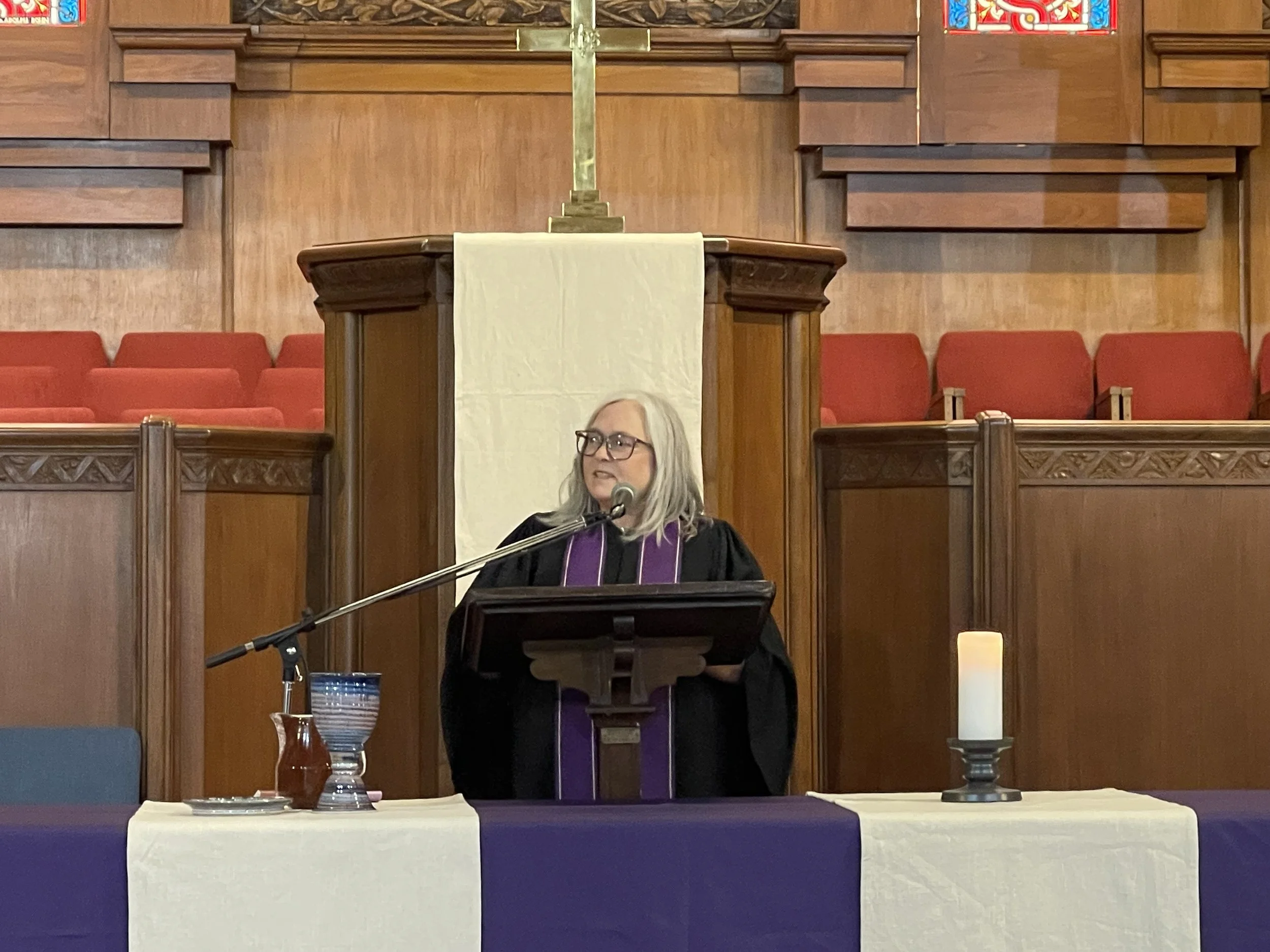
The Rev. Kristin Hutson preaches beneath a silver cross emblazoned with the letters IHS. Photo: Gerald Farinas.
When the Rev. Kristin Hutson started her tenure at Edgewater Presbyterian Church, I placed the old silver table cross on the pulpit high above the Communion table—a pulpit we no longer use in favor of elders and worshippers being at the same level.
Pastor Kristin preaches beneath the cross at a lectern.
Watching me polish the cross one Sunday, one of our friends from Bryn Mawr Cares asked me what the IHS emblazoned in the middle of the cross means.
If you’ve ever looked closely at the Communion table, pulpit, or stained glass in many other traditional churches like ours, you may have noticed the letters IHS carved, stitched, or etched into the design.
These letters aren’t just decoration. They’re part of a long Christian tradition known as the Christogram—a sacred symbol that abbreviates the name of Jesus Christ.
What is a Christogram?
A Christogram is a combination of letters that represent Jesus’ name, often used for visual emphasis in churches, vestments, manuscripts, and sacred objects.
The most common one in the churches that branch directly out of the Roman Catholic Church—like ours in the Presbyterian tradition—is IHS.
It comes from the first three letters of Jesus’ name in Greek: ΙΗΣΟΥΣ (Iēsous). The Latin alphabet equivalent of the first three Greek letters—iota (Ι), eta (Η), and sigma (Σ)—is IHS.
Some have created phrases around it like Iesus Hominum Salvator or Jesus, Savior of Humanity—but these phrases came later and are not the original meanings of IHS.
Where did it come from?
Christograms began appearing as early as the third and fourth centuries, especially as Christianity spread and became more public.
The Eastern Church often used the Chi-Rho symbol—XP from the Greek Christos—while the Western Church popularized IHS, especially after the time of St. Bernardine of Siena in the 15th century.
Bernardine used it as a symbol to encourage moral reform and to unite communities under the banner of Jesus.
Unfortunately, his idea of moral reform included accusing people of being witches and sodomites and punishing them.
But that’s for a different time.
Eventually, the IHS became widely used in the Roman Catholic Church—and the churches that split directly from it like the Lutheran, Anglican, and Reformed churches—adorning everything from church furniture to gravestones.
Why do they exist?
These symbols were important in a time when many Christians were illiterate.
They provided a recognizable, sacred shorthand for the presence and authority of Christ.
The Christogram served as both decoration and devotion—a visual profession of faith.
What use are they for Presbyterians today?
In the Reformed tradition, Presbyterians are often cautious about religious imagery.
We tend to value the Word more than the image.
Yet, symbols like IHS remind us that faith is not only spoken—it’s embodied. It shapes our spaces and marks our identity.
At Edgewater Presbyterian Church, the IHS on the cross above Pastor Kristin when she preaches reminds us that Jesus is at the center of our worship, our service, and our communal life.
It’s a symbol that transcends language and time. It connects us to generations of believers before us and to a global Church across traditions.
For Presbyterians today, IHS is not just an old decorative feature. It’s a quiet proclamation: This place, this people, this Table—belong to Jesus.
And that is something still worth carving into wood, stitching into cloth, and remembering with every eye that passes over it.