God sent a cleansing breath, not heat of judgment
Scripture reading: John 3:1-17
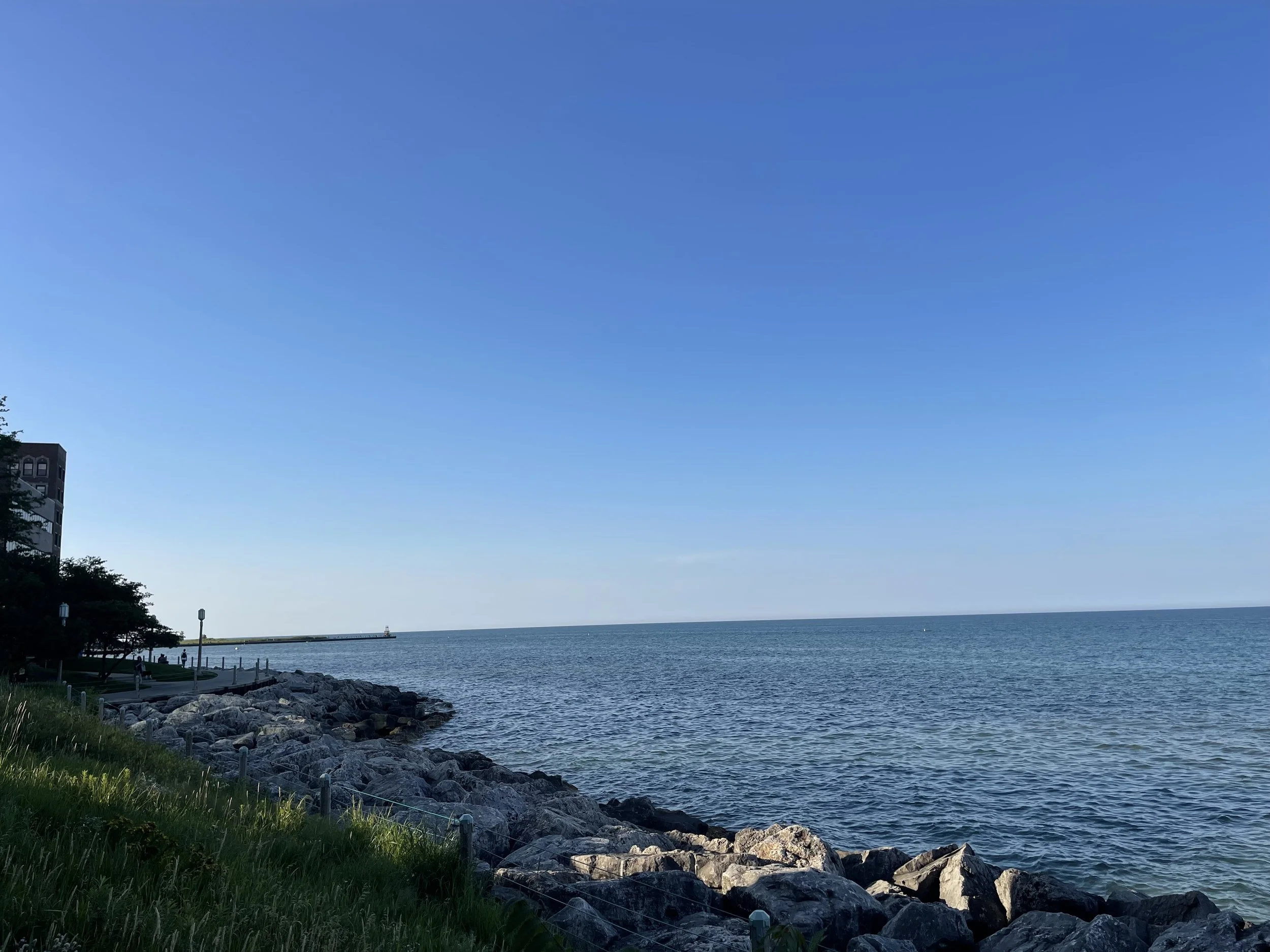
Photo: Gerald Farinas.
When the weight of the world feels less like a metaphor and more like a physical burden resting on my shoulders, I find myself drawn to the water. There is a specific spot on the campus of Loyola University, just a few minutes from my apartment, where the boulder promenade sits in front of the Madonna della Strada Chapel. I go there to sit on the concrete that juts out into the lake, right before those heavy brass and bronze doors.
Standing there, I close my eyes. I let the city noise fade until all that remains is the wind and the water. Some days, it is just the gentle lapping of waves folding quietly upon the rocks. Other days, it is the tempestuous rush of a Great Lake acting like an ocean, waves crashing into the stones with a force that vibrates in your chest. When I stand on that lakefront with my face out toward the wind, I breathe in and draw into me a refreshing, cleansing spirit. In those moments, staring into the vastness of the horizon, I am reminded that there are forces at work far larger than my own anxieties.
This sense of being overwhelmed by great matters is exactly where we find Nicodemus in the third chapter of the Gospel of John. He is a leader and a man of high standing. He comes to Jesus under the cover of night, maybe because he is afraid of what his peers might think, or maybe because the quiet of the night is the only time his mind is still enough to ask the questions that actually matter.
I think of Nicodemus often because I have friends who come to me in the same way. They aren't particularly religious in the traditional sense, but they know they can talk to me about spiritual things without me judging them or immediately telling them they need to go to church. Quite frankly, sometimes the answer isn't found by sitting in a church at 11 a.m. on a Sunday. Instead, they come to me in times of deep doubt. They come asking about this and that. They ask, "Did I do enough? Could I have done more? What does it say about my moral character that I did this but didn't do that?"
Nicodemus represents the best of religious tradition, yet he is stuck in that same loop of performance and calculation. He sees the signs Jesus performs and recognizes God’s presence, but he is trying to wrap his head around God using the same old earthly logic. When Jesus tells him he must be born from above, or born again, Nicodemus can only think of the physical. He asks how a grown man can climb back into his mother’s womb. He is looking for a mechanical explanation for a spiritual transformation.
Jesus responds by pointing him toward the very thing I feel when I sit by the lakefront. He tells Nicodemus that the wind blows where it chooses. You hear the sound of it, but you do not know where it comes from or where it goes. So it is with everyone born of the Spirit. In the Greek text of this Gospel, the word for wind and Spirit is the same: pneuma. When we stand in the gusts coming off Lake Michigan and draw that air into our lungs, we are participating in a physical parable of what Jesus is describing. To be born of the Spirit is to stop trying to control the outcome and instead learn how to be carried by the wind of God. It is a transition from the heavy "how" of Nicodemus to the liberating "who" of Jesus Christ.
In the Presbyterian Church (U.S.A.), we often talk about the order of things. We value our structure. But the Gospel reminds us that the Holy Spirit is not a force we can domesticate or predict. Like the waves hitting the rocks at Loyola, the Spirit moves with its own rhythm, offering a cleansing that we cannot manufacture for ourselves.
The climax of this midnight meeting is perhaps the most famous verse in all of Scripture, John 3:16. However, we often stop there and miss the vital context of verse 17. The Gospel tells us that God did not send the Son into the world to condemn the world, but in order that the world might be saved through him.
For those of us carrying burdens, and for my friends who worry if their moral character is sufficient, this is the ultimate relief. We often treat our faith like a courtroom where we are constantly on trial, measuring whether we have done enough or understood enough. But Jesus invites Nicodemus, and us, into a different reality. The Sacraments of the Church remind us that we are already claimed. We are not called to solve the mystery of the wind; we are called to trust the one who moves within it.
When the waves are tempestuous and the mind is heavy, we do not need a new set of rules or a heavier checklist of deeds. We need to be born again into the realization that the world is already loved. We are invited to step out of the shadows of our own worry and into the light of a God who came not to judge, but to rescue.