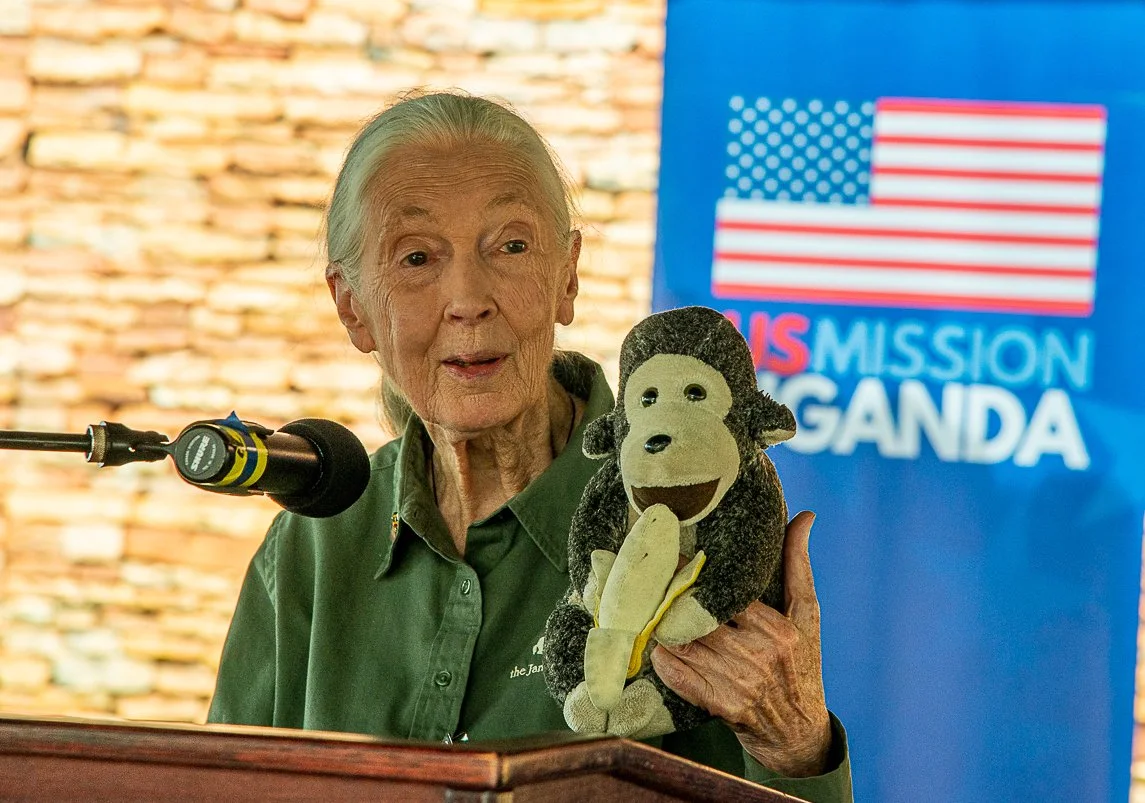
Photo: U.S. Mission Uganda via Wikimedia Commons.
Jane Goodall has died. To say those words is to feel a deep loss. She was more than a scientist. She was a witness to the beauty of life and a reminder that humans are part of creation, not apart from it. Her life and her studies leave us grieving, but also thankful.
When she watched chimpanzees in Gombe, she saw something the world had not seen before. She saw them using tools. She saw them solving problems together. She saw their families and their bonds. The scientific world had to admit that these creatures, so close to us, share more with us than we wanted to believe.
For me, this also touches Christian faith.
The Bible says, “Then God said, ‘Let us make humankind in our image, according to our likeness; and let them have dominion over the fish of the sea, and over the birds of the air, and over the cattle, and over all the wild animals of the earth, and over every creeping thing that creeps upon the earth’” (Genesis 1:26, NRSVue).
Too often, we have thought dominion means power to take and destroy. Goodall showed us another way. She showed us that dominion means care. It means responsibility. It means humility before the lives of other creatures that God has made.
Her work changed how Christians could read Scripture. If we are made in the image of God, then we carry God’s creativity and God’s love. But we also see glimpses of those same qualities in the animals around us.
The Bible reminds us of this, “But ask the animals, and they will teach you; the birds of the air, and they will tell you; ask the plants of the earth, and they will teach you; and the fish of the sea will declare to you. Who among all these does not know that the hand of the Lord has done this?” (Job 12:7-9, NRSVue).
Jane Goodall spent her life asking the animals. And they taught her.
Her voice stirred the Church to think again about creation. She reminded us that God loved the world so much that God entered it in Jesus Christ. Christ did not walk on earth as a spirit. He walked among us in flesh, among trees and rivers, among birds and wild beasts.
The Gospel of Mark says, “He was in the wilderness forty days, tempted by Satan, and he was with the wild animals; and the angels waited on him” (Mark 1:13, NRSVue).
Goodall’s work makes me think of that verse. Christ was with the animals. We should be too.
Christians today talk more about creation care and ecology. That is part of Goodall’s legacy. She gave us eyes to see creation not as scenery, but as community. She gave us words to resist using the earth only for profit and instead to see ourselves as caretakers.
To grieve her death is to lose a prophet of creation. But she leaves us with hope. Every time we protect animals, every time we teach children that to love God means to love all living things, we carry on her work.
Jane Goodall is gone. But her witness remains. She taught us that to care for creation is not only science. It is faith. She taught us that to live in kinship with other creatures is not only ethics. It is discipleship. And for that, even in grief, I give thanks.