Look up! Don’t miss the artistry on this Edgewater church’s New Community House
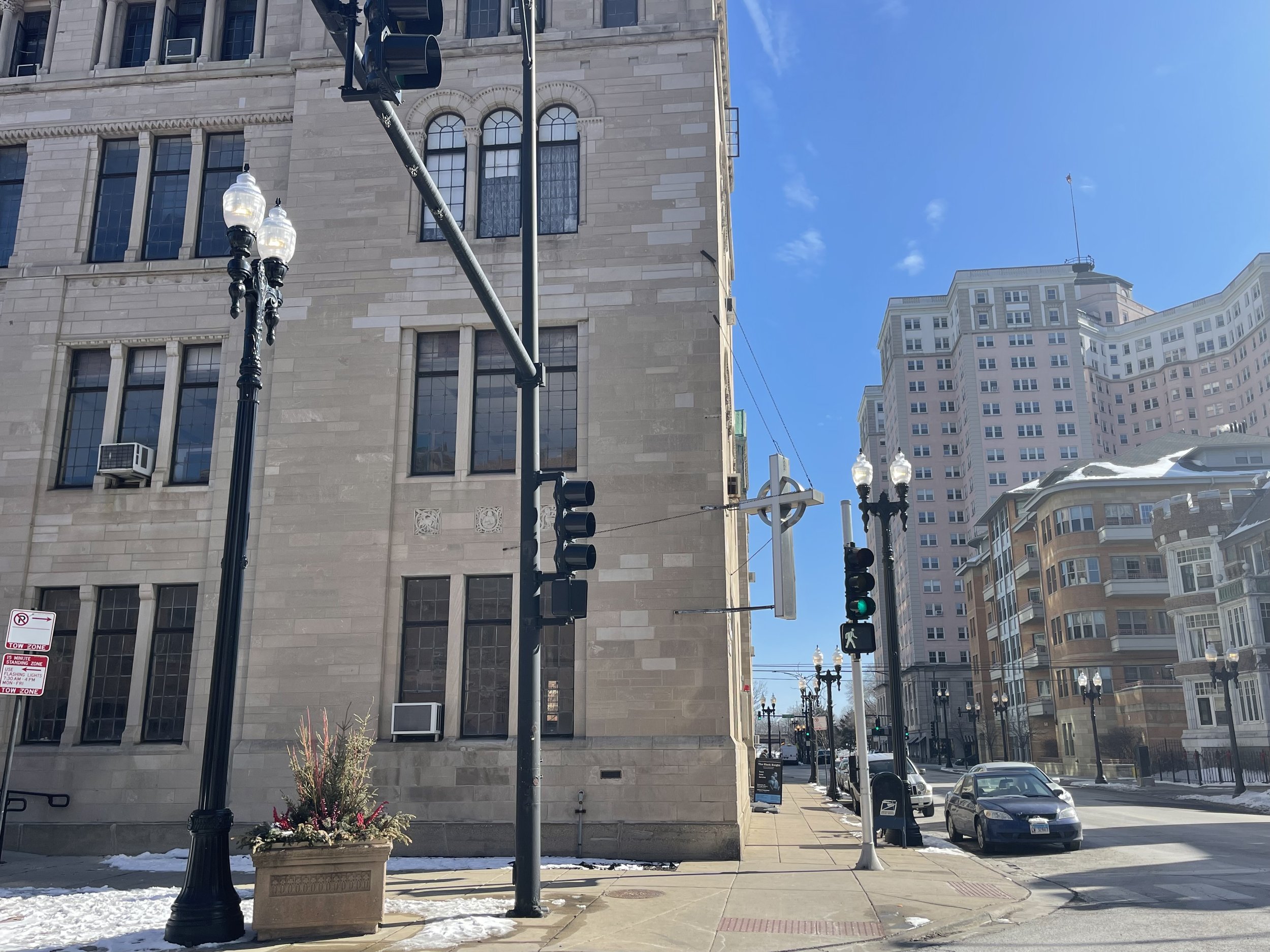
Photo: Gerald Farinas.
The New Community House, the limestone building of Edgewater Presbyterian Church, whose presence might seem understated at first glance, is currently the subject of possible landmarking by the City of Chicago.
As understated as it might be, behind its walls and etched into its very facade at 1020 W. Bryn Mawr Ave., lies a remarkable story of artistry, architecture, and community purpose.
Built in 1926 rooted in Romanesque tradition
The New Community House was constructed in 1926, a decade when Edgewater was swelling with growth and civic pride.
The design, commissioned from the respected Chicago firm Perkins, Fellows & Hamilton, reflects the French Romanesque style—a blend of solid, fortress-like strength with rounded arches and decorative flourishes that hint at medieval European churches.
The choice of materials further grounds the building in Chicago’s story. The walls are clad in Bedford Indiana limestone, the same stone used for monumental buildings across the Midwest.
In its pale gray surface, the community house tied itself both to the solidity of the city and to the neighborhood’s aspirations for permanence.
Emil Zettler’s sculpted touch
What truly distinguishes the New Community House are the carvings over its south and west doors, executed by Chicago artist Emil Zettler.
Zettler, a German-born sculptor and designer, left his mark on numerous Chicago landmarks during the early 20th century, often blending stylized ornament with narrative storytelling in stone.
At the New Community House, Zettler gave the entrances a unique dual message:
Above the south door, he carved biblical figures, tying the building to the sacred narrative and mission of the congregation.
Above the west door, he carved family scenes, an intimate celebration of everyday life and kinship—perfect for a space that would become a hub for neighborhood gatherings.
These reliefs bridge the spiritual and the communal, reminding visitors that faith and daily life are bound together.
Though modest in scale compared to his larger commissions, they represent the artistry of a man who also worked with Frank Lloyd Wright and contributed to the broader Arts and Crafts and early modernist movements in Chicago.
More than a building
For 99 years, the New Community House has housed everything from refugee support programs to theater rehearsals, embodying the very word “community” in its name. Its limestone walls have heard prayers, poetry, protest, and performance.
But thanks to Zettler’s carvings and the architectural care of Perkins, Fellows & Hamilton, it is also a living work of art, anchoring the Bryn Mawr Historic District with a story that is both spiritual and artistic.
Next time you pass by the doors on Bryn Mawr Ave., look up. The carvings are still there—biblical figures on one side, families on the other—quietly reminding us that art in Edgewater has never only been found in galleries.
Sometimes, it’s right above our heads, etched in stone for generations to see.