Pushing back on ‘Christians should seek earthly power for Christ’
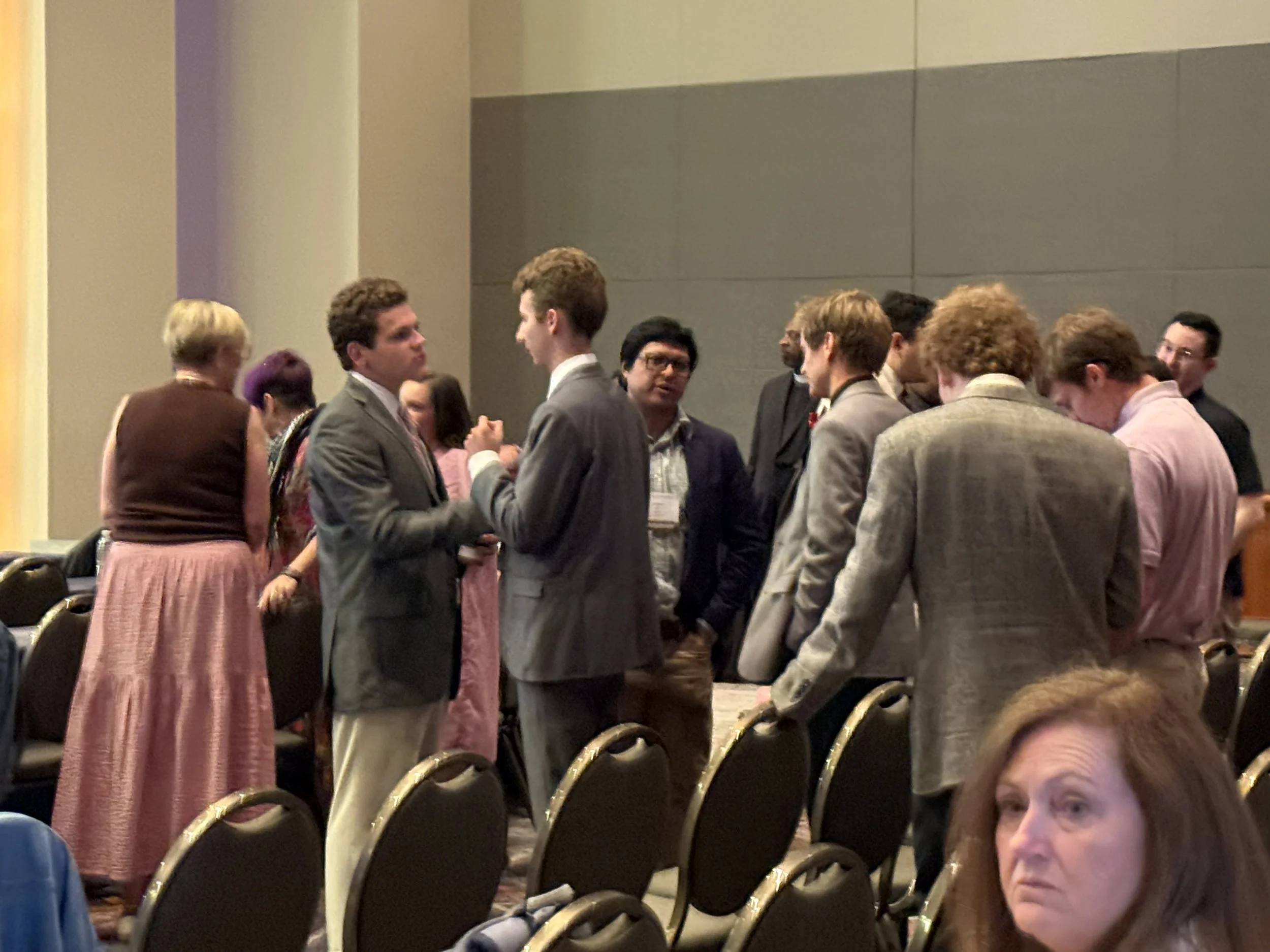
Presbyterians fit the Kingdom huddle at the 227th General Assembly. Photo: Gerald Farinas.
The online creator known as “Redeemed Zoomer,” Richard Ackerman, argued that Christians should actively seek political power, saying:
"Christians should seek earthly power. Not for themselves, but for Christ. If Christians don't, others will. Christianity improves every aspect of society. Christendom is how you love your neighbor. If Christians hadn't taken over the Roman Empire by doing just this, you'd most likely be a pagan."
When Ackerman attended the most recent General Assembly as an observer of Presbyterians for the Kingdom movement, this was the exact theology he was pushing. It's an argument that tries to tell believers that grabbing political control is our Christian duty and the way we love our neighbors.
But as a public theologian and a Commissioner to the 227th General Assembly of the Presbyterian Church (U.S.A.), I see this idea as a complete misunderstanding of Reformed theology, history, and our church confessions. More than that, the reality of what Ackerman is asking for is deeply dangerous.
Whenever the Church tries to grab political power, it ends up trading pastoral care for political force, creating systems that hurt our neighbors instead of helping them.
Some folks, even in my own congregation, might push back and tell me that when the Church makes public statements supporting undocumented immigrants or backing welfare programs, it's doing the exact same thing.
It is not.
There is a world of difference between seeking power over people and using your voice to defend people who have no power.
Advocating for the immigrant, the poor, and the hungry is not an attempt to take over the government or force everyone to adopt Christian doctrine. It's the Church doing its basic biblical duty to stand with the vulnerable and call the civil government to its God-given task of basic justice and mercy.
We aren't asking the state to convert people to Christianity, enforce religious dogma, or run church life. We are asking the state to protect human dignity, feed the hungry, and care for the stranger at the gate, which Scripture commands from Genesis to Revelation.
Seeking political dominion is about grabbing control and ruling over our neighbors. Biblical advocacy is about laying down privilege to protect our neighbors from harm.
The idea that Christians have to take over the government because otherwise someone else will comes straight out of fear, not trust in God. John Calvin dealt with this directly in his Institutes of the Christian Religion.
Calvin explained what we call the two kingdoms, showing the difference between the spiritual world and the earthly world. In the spiritual kingdom, Christ rules over our hearts, our faith, and our eternal life. In the earthly world, governments exist to keep public peace, make sure things are fair, and protect basic order.
Calvin saw government as a good and necessary gift from God to keep society running smoothly, but he made it very clear that politicians and judges have no business running the soul. Earthly leaders can't force true faith, they can't handle the Sacraments, and they can't make anyone believe the Gospel.
When governments try to control what people believe, or when Christians try to use the law to force religion on others, it ruins both the Church and the country. Real faith can't be forced by passing laws or building empires.
Chasing state power to make everyone Christian carries the dangerous risk of turning a Gospel of grace into a tool of political control.
Claiming that we're only Christian today because the early Church took over the Roman Empire gets history completely wrong. The early Church grew and changed lives across the world not because Christians had political power, but because they lived out the Gospel through self-giving love, taking care of the sick and the poor, and staying faithful even when the government persecuted them.
When the Church was later taken in by Emperor Constantine and tied to state power, it wasn't the high point of Christian faith. It brought privilege, but it also wrecked the Church's moral voice and tied the faith to the whims of politicians, creating a dangerous setup where violence was done in the name of Christ.
Presbyterians in America learned this lesson the hard way. When American Presbyterians adopted the Westminster Confession of Faith in 1788, the founders made a huge change to Chapter 23 about the civil government.
The original 1647 confession written in Britain gave the government power to step in, punish people for the wrong religious ideas, and run church meetings. American Presbyterians took that power away completely because they saw how dangerous it is when the state runs religion.
The 1788 revision made it clear that civil leaders can't interfere in matters of faith at all. The job of the state is just to protect people's safety, rights, and freedoms, making sure everyone can worship freely without being bullied or forced.
Our modern confessions set this boundary even more clearly against dangerous political movements. In 1934, when the German church tried to back the government and chase cultural dominance, brave Christian leaders fought back with the Theological Declaration of Barmen.
Barmen completely rejected the idea that the state should become the total ruler over human life, or that the Church should become a tool for the government.
It showed the terrible danger of confusing political power with the reign of Christ. Jesus Christ is the one Word of God we must trust and follow in life and in death, and no political party or ruler can ever take His place.
The Confession of 1967 keeps this going by telling us that the Church's job in the world is reconciliation, not taking over. We don't love our neighbors by trying to get power over them. We love our neighbors by standing with people who are hurting, working for real fairness, and following the humble way of Jesus.
Seeking earthly power while calling it love only creates division and hurts people.
Earthly power runs on force, control, and political wins. The Kingdom of God runs on grace, humility, and serving others.
When Christians try to run the world using the world's power plays, the Church doesn't win the empire for Christ. It creates a dangerous mess of faith and simply lets the empire run the Church.