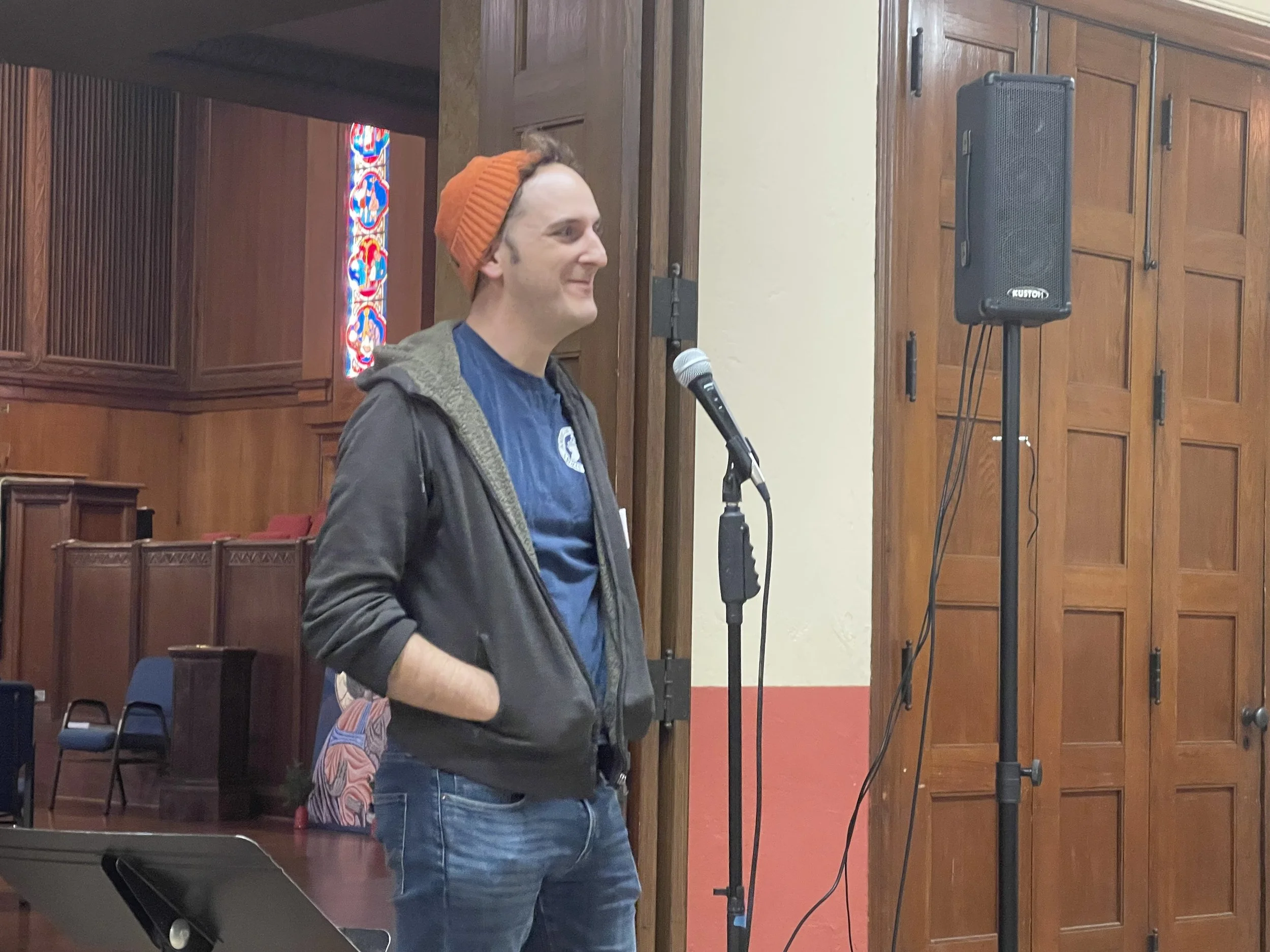
An organizer for Edgewater Mutual Aid Network explains to other space-sharers about their work. Photo: Gerald Farinas.
Restorative justice is more than a legal reform—it is a philosophy rooted in healing, accountability, and community restoration.
Rather than focusing solely on punishment, restorative justice seeks to repair harm by bringing together those who have caused harm, those who have been harmed, and the wider community to collectively decide how to make things right.
This approach asks not, “What law was broken?” and “How do we punish?” but rather, “Who was harmed?” and “How do we heal?”
This framework aligns profoundly with the theological and ethical commitments of the Presbyterian Church (USA).
As a denomination, the PCUSA has long emphasized reconciliation, justice, and the dignity of every human being as made in the image of God.
Through scripture, confessions, and social witness policy, the PCUSA affirms that justice must go beyond retribution and instead work toward transformation and healing—just as Christ reconciles us to God and to one another.
Biblical foundations
In both Old and New Testaments, we see glimpses of restorative justice.
The Hebrew prophets call for justice that restores the oppressed and brings balance back to society (Isaiah 1:17, Amos 5:24).
Jesus, in his ministry, practices a restorative ethic—eating with tax collectors, offering forgiveness to sinners, and calling communities to reconciliation (Luke 19:1–10, John 8:1–11).
The apostle Paul writes of the ministry of reconciliation entrusted to the church (2 Corinthians 5:18), encouraging communities to restore one another in gentleness and love.
Restorative justice is not about excusing wrongdoing. It is about the hard, holy work of accountability in relationship. It is about rebuilding the shalom—peace with justice—that God desires for all creation.
Why it matters in cities like Chicago
In urban areas like Chicago, the need for restorative justice is urgent and deeply personal.
Our city has endured decades of racialized policing, mass incarceration, systemic poverty, and disinvestment in Black and Brown communities.
Violence often arises from cycles of trauma and despair, not innate criminality.
Too often, our criminal legal system perpetuates that trauma rather than healing it.
Restorative justice offers a different path—one that can break those cycles.
In schools, it can replace zero-tolerance policies with healing circles that address conflict before it escalates.
In neighborhoods, it can provide survivors of violence with a voice and an opportunity to be heard—not just in court, but in community.
In courts, it can redirect youth from jails toward mentorship, service, and reconciliation with those they have harmed.
Programs across Chicago, such as those led by the Community Justice for Youth Institute, Circles & Ciphers, and Chicago Survivors, are demonstrating that restorative approaches can reduce recidivism, increase community trust, and foster the kind of deep healing that punitive systems rarely achieve.
A Presbyterian commitment
The Presbyterian Church (USA) is well-positioned to be a leading voice in this movement.
We are a Church of ordered justice and shared responsibility.
Our polity teaches us to sit in circles—committees, sessions, and councils—listening, discerning, and restoring one another when harm is done.
Our confessions, especially the Confession of 1967 and the Belhar Confession, call us to dismantle systems of oppression and live into a ministry of reconciliation.
Our General Assemblies have affirmed the importance of addressing systemic racism, reforming the criminal justice system, and building communities of peace.
To practice restorative justice is to embody the kingdom of God on earth—where mercy and truth meet, where righteousness and peace kiss (Psalm 85:10).
Local Witness: Edgewater Presbyterian Church
At Edgewater Presbyterian Church in Chicago, we have witnessed firsthand how this vision takes shape on the ground.
As a faith community rooted in justice, compassion, and hospitality, we are proud to share our building with several space-sharing organizations who actively promote restorative justice in their work.
Among them is the Edgewater Mutual Aid Network, which fosters community care, economic solidarity, and neighbor-to-neighbor support—values that mirror the core of restorative justice.
By building relationships of mutual accountability, empowerment, and radical generosity, our space-sharers are practicing a model of justice that begins not in the courtroom but in the living room, the community garden, the neighborhood assembly.
In partnership with these grassroots organizers, our church’s space becomes more than a sanctuary—it becomes a hub of healing, resistance, and renewal.
This is what it looks like when the Gospel takes root in local neighborhoods.
What churches can do
Presbyterian congregations in Chicago and beyond can support restorative justice by:
Partnering with community-led restorative justice hubs.
Hosting peace circles and community dialogues.
Advocating for criminal justice reform legislation.
Supporting returning citizens with housing, employment, and spiritual care.
Teaching restorative practices in youth and adult formation programs.
By rooting ourselves in Christ’s call to love our neighbor and repair the breach, we bear witness to a God who does not discard anyone, who always seeks the lost, and who calls us to do the same.
Restorative justice isn’t just compatible with Presbyterian values—it’s essential to them.
In cities longing for healing like Chicago, and in communities like Edgewater, the Church’s role is clear: To be a reconciling presence in the wounds of the world.