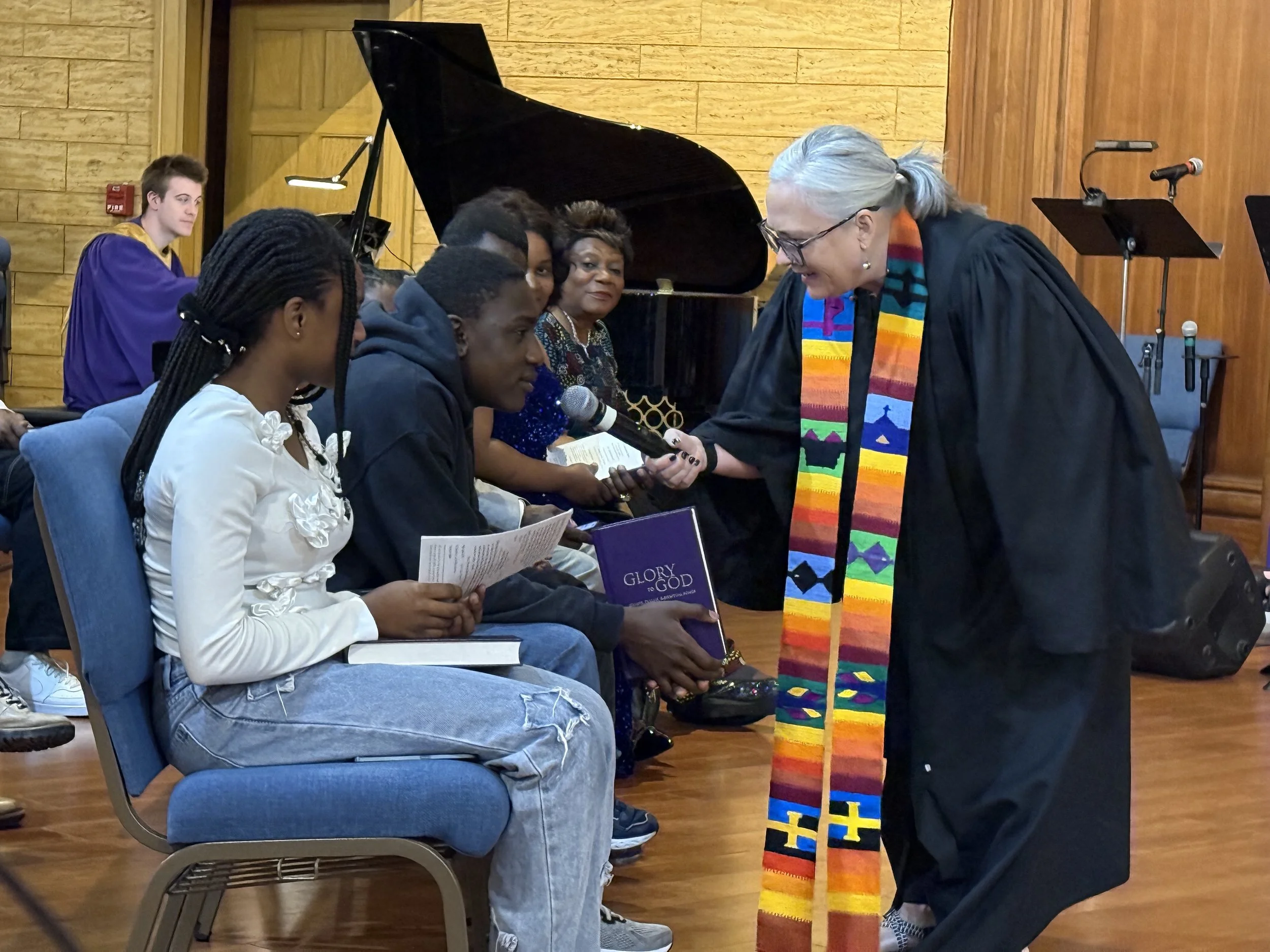
The Rev. Kristin Hutson welcomes newcomers worshipping at the Edgewater Kirk for the first time. Photo: Gerald Farinas.
In our conversations about why people are leaving the Church, the spotlight often falls on institutional failures—scandals, politicization, theological rigidity, or perceived irrelevance.
But sometimes the reasons are far simpler, and far closer to home.
Sometimes, what turns people away is not “the Church” as an institution, but the church—the local congregation where they once walked through the doors hoping to be seen.
There’s a deep and aching loneliness in being unnoticed.
Imagine visiting a church, maybe for the first time in years or maybe for the first time ever, and sitting down quietly in a pew.
No one greets you.
No one asks your name.
The announcements are insider-focused. The prayers are routine.
The smiles are surface-level.
You leave as anonymously as you came.
And you wonder if anyone even noticed.
This isn’t a hypothetical. It’s the real, lived experience of too many people.
As pastors, elders, and members of Christ’s body, we must take this seriously.
It is not enough to say, “We are welcoming.”
We must be welcoming.
We must show that every person who walks through our doors is not just a passive recipient of our hospitality, but a vital participant in the life of the Church.
Because here’s the truth: Every visitor who enters is a bearer of God’s image.
Their presence at the Communion Table matters.
Their voice raised in the hymns matters.
Their prayers, their grief, their hopes, their need for community—all of it matters.
When we don’t take the time to acknowledge that, we are not simply being forgetful or shy. We are missing an opportunity to live out the Gospel.
We are missing the possibility that God sent someone to us not only to receive, but to offer a word of grace we didn’t know we needed.
We are missing the chance to hear a story that could change our hearts.
We are missing the communion of saints in real time.
The early Church grew because it was radically inclusive.
It listened.
It lifted up voices that others dismissed.
It centered the table and gathered everyone to it.
That spirit must be rekindled—not by committees or strategic plans—but by real human moments of eye contact, of conversation, of invitation.
So this is a call to all of us in leadership and membership alike: Look up.
Look around.
Notice who is sitting alone.
Learn their names.
Ask them how they’re doing.
Let them know that their voice is wanted in the hymn, their hands are welcome in the work, and their soul is needed at the Table.
Because when we fail to do this, the people don’t just walk away from a building—they walk away from the very community that was supposed to reflect Christ’s love.
And that is not a failure of “the Church.”
That is a failure of us.
And it’s one we can correct.
All it takes is listening.
Really listening.
And meaning it.