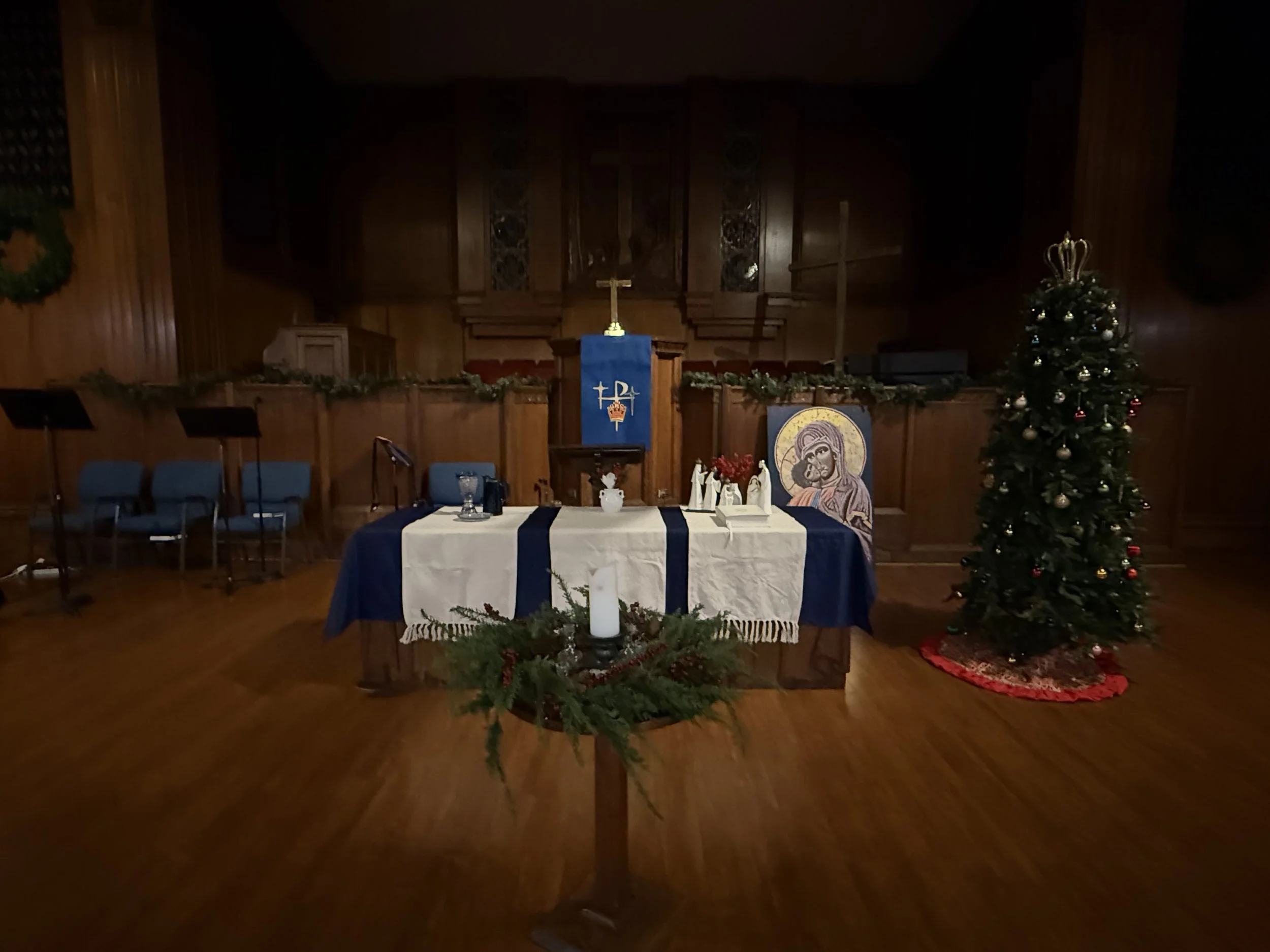
The darkened Sanctuary of Edgewater Presbyterian Church before the First Sunday of Advent. Photo: Gerald Farinas.
The season of Advent is the four-week time of serious waiting and preparation. This season has two main focuses: first, remembering and preparing for the historical birth of Jesus Christ, and second, looking forward to his promised return, or Second Coming, in the future. It is a time for the Church to look both backward in gratitude and forward in hope.
For many centuries, the main church color used during this time has been violet or deep purple.
However, for some traditions, especially older Presbyterianism, using any color at the pulpit or Communion table is a new practice. Historically, many Presbyterian churches preferred a simple, bare look, focusing instead on the Bible and the spoken word.
[When I preached Christ the King this past Sunday, I opted for the bare look and had no Communion table cloth.]
The modern choice of blue a very intentional one, giving it deep religious meaning.
Traditionally, the color deep purple (violet) means sorrow, fasting, and serious reflection. It is the color of royalty, pointing to Jesus Christ the King, but it also reminds us to look closely at ourselves before we celebrate his birth. This color often connects Advent closely with Lent. While Lent is about sorrow leading to the Cross, Advent is about joyful anticipation of Christ’s arrival.
The growing use of blue, sometimes called Sarum Blue or Mary’s Blue, helps show the difference between these two seasons. Blue is a color of hope, peace, and eager expectation.
This choice highlights Advent not as a period of regret, but as a time of looking forward with excitement to the coming Light of the World and the future kingdom.
The symbolism of blue has many layers of meaning. Most commonly, it is linked to the night sky, representing the darkness of the world just before Jesus was born. This huge, space-like symbolism emphasizes the great promise of God and the lasting nature of the heavenly covenant, particularly the fulfillment of the Second Coming.
Blue also often connects to the Virgin Mary, standing for her faithfulness and her special role as the human who carried the hope of the world.
[The Byzantine icon of the Virgin Mary and Baby Jesus that we display year round has a blue background common with Marian depictions.]
By using blue, churches underscore the theme of hope and the promise of a future kingdom, setting a distinct tone of eager waiting that is separate from the sorrowful feeling of Lent.
Whether a church chooses the deep tones of violet or the hopeful clarity of blue, the color serves the central purpose of marking Advent as a special time of pause.
For churches like Edgewater Presbyterian Church, the choice of blue emphasizes that the season is defined not by sadness, but by joyful expectation.
It is a powerful, visual sign of the basic promise that the light is coming, and that the faithful are called to watch and wait for its arrival with patience and hope.