After GA227: Palestine and the Kairos II document
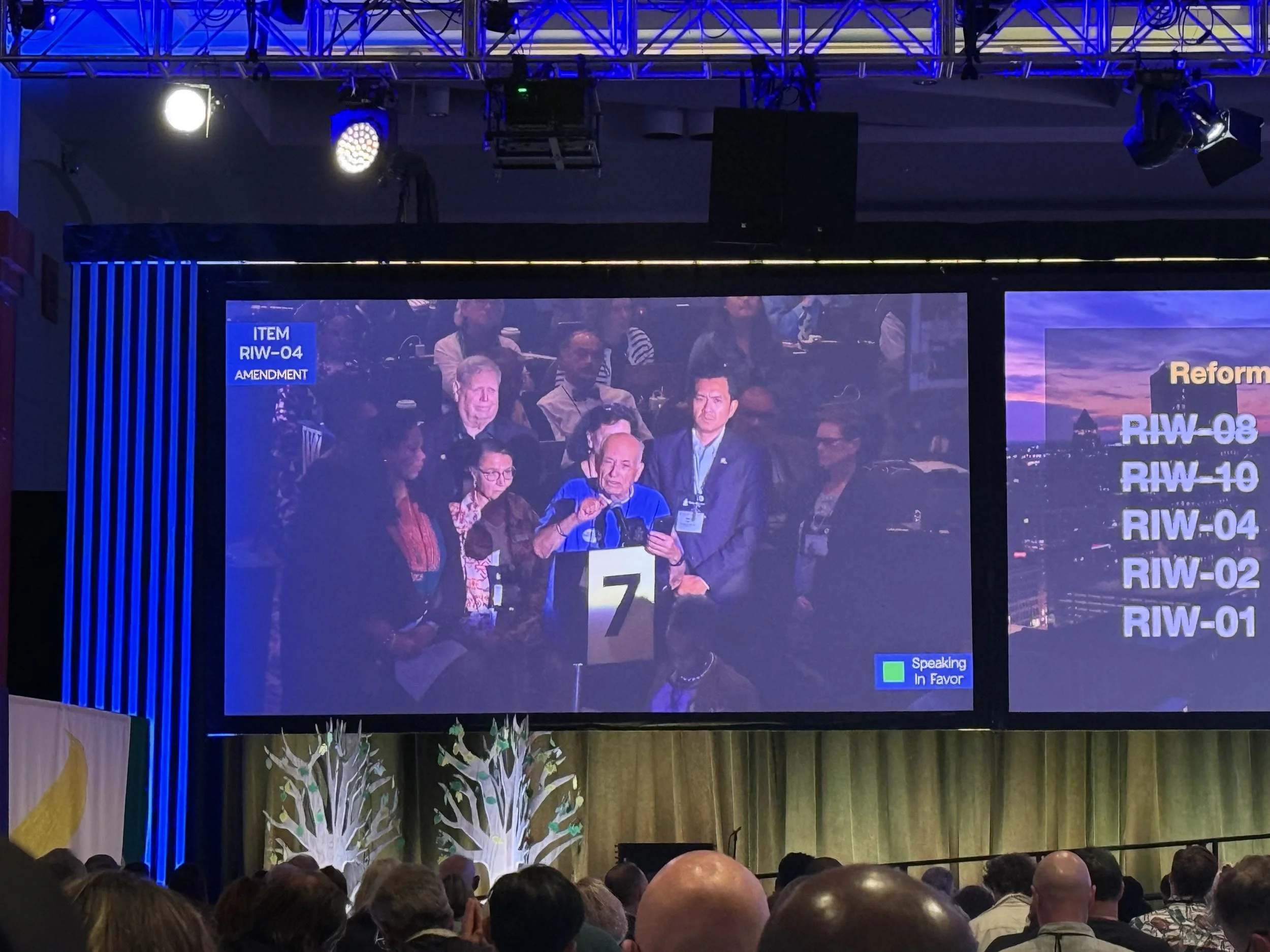
Photo: Gerald Farinas.
Imagine sitting down to read a letter from a community that feels it is facing total erasure. That is the gut-wrenching reality behind a highly charged religious text called Kairos II.
Officially titled “A Moment of Truth: Faith in a Time of Genocide,” this document was released in late 2025 by a broad coalition of Palestinian Christian leaders known as the Palestinian Christian Ecumenical Initiative.
The debate over this text has consumed religious bodies worldwide, and it hit incredibly close to home just last month in Milwaukee.
One of the most difficult discussions at the 227th General Assembly of the Presbyterian Church (U.S.A.) was whether to affirm Kairos II. As a Commissioner sitting in that room, it felt like a total minefield. It felt like whatever I would say would make me a bad guy on one side or the other. There simply was no middle ground to be found, and that intense gridlock is exactly what makes this text so polarizing.
To understand why it is making such massive waves, we have to look back to 2009. That was when the first Kairos Palestine document came out, urging Christians worldwide to stand against Israeli military occupation.
Kairos II is the intense, raw sequel to that letter, written out of the compounding devastation, displacement, and death that followed the events of October 7, 2023. It is a direct appeal from a tiny, ancient Christian population that feels entirely forgotten by the global Church.
The document quickly became a lightning rod for global controversy, a division that became starkly visible when the Church of England General Synod voted to formally "hear" the text rather than officially "receive" it. It is a subtle bureaucratic distinction, but it highlights just how divided the religious world is on how to handle the message.
At its core, Kairos II is a theological and political manifesto. In summary, it calls on the global Church to take immediate, active steps to end Palestinian suffering. It frames the entire conflict through the lens of liberation theology, arguing that standing with the oppressed is a core Christian duty.
The text explicitly names Zionism as a settler-colonial movement built on Jewish supremacy and directly accuses the Israeli government of committing apartheid, ethnic cleansing, and genocide.
It calls for a complete theological rejection of Zionism and strongly endorses the Boycott, Divestment, and Sanctions (BDS) movement, urging global churches to cut economic and political ties with Israel.
For supporters, the text is a necessary, unfiltered cry for help from a dying community.
Defenders argue that you cannot look at the current violence in isolation. From their perspective, the document does not justify the horrors of October 7, but it does contextualize them within decades of occupation.
Supporters maintain that true faith requires speaking truth to power, and they believe Western churches are simply too uncomfortable with the harsh realities on the ground, choosing to police the language of the oppressed rather than helping them.
On the other side, critics see the document as a dangerous piece of political propaganda cloaked in religious language. Mainstream Jewish organizations and many international theologians argue that by framing October 7 as a predictable consequence of colonization, the text dangerously minimizes atrocities against civilians. They are also deeply alarmed by how the document handles antisemitism. Kairos II explicitly rejects the widely used International Holocaust Remembrance Alliance definition, claiming the term is weaponized to silence Palestinian voices.
Critics argue that by telling Jewish people how to define their own identity and safety, the document destroys decades of interfaith progress. They argue that calling for a blanket boycott of anyone who supports Israel completely shuts down the possibility of dialogue.
This profound disagreement was on full display in Milwaukee, where the PC(USA) approaches to the document revealed the exact same internal tensions gripping the wider global Church.
The text did come up in committees, where it faced intense scrutiny and debate. Commissioners wrestled with how the denomination should respond to such polarizing rhetoric. While some committee members worried that formally endorsing the text would fracture long-standing Jewish-Christian relationships at home, the committee ultimately recommended the document for approval.
When the issue moved to the plenary floor, the debate grew even more intense. It was clear that Commissioners were deeply moved by the suffering in the region, but they were also wary of the geopolitical fallout of their vote.
In the end, the General Assembly voted to formally affirm Kairos II, explicitly calling it a prophetic cry from their Christian siblings in the Holy Land.
By passing this measure alongside other resolutions, like calling for a halt to military sales to Israel and labeling the military actions in Gaza a genocide, the PC(USA) took a far more definitive, public stance than the cautious approach seen in the Church of England right now.
Ultimately, Kairos II exposes a deep, painful rift within global Christianity. It forces churches to grapple with a devastatingly difficult question: How do you honor the urgent, desperate cries of an endangered Christian minority without alienating the Jewish community or oversimplifying one of the most complex geopolitical conflicts on Earth? As the recent floor fights in Milwaukee show, there are no easy answers, and the conversation around Kairos II shows just how far apart the two sides remain.