Did you know? Presbyterian ministers, congregations owned slaves
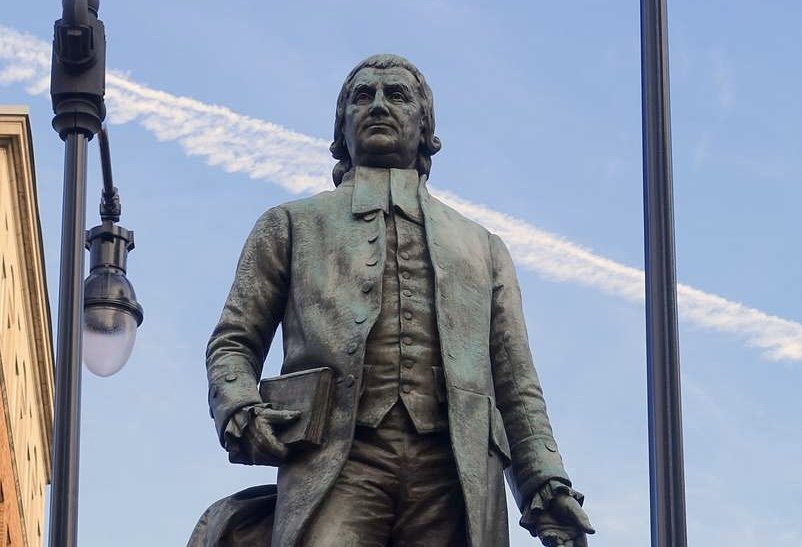
Statue of the Rev. John Witherspoon, first moderator of the General Assembly of the Presbyterian Church, signer of the Declaration of Independence, and slave owner. Photo: Wikimedia Commons.
I spent this past weekend reading Clay Cane’s new historical novel, "Burn Down Master’s House." It’s a brutal, searing piece of fiction, rooted in real accounts of enslaved people who resisted their captors across the American South.
One figure in particular stayed with me: Minister Woodward, a clergyman who uses his pulpit and open Bibles to justify holding human beings in chains.
Woodward is a fictional character, but he’s built on undeniable historical reality. Figures like him aren’t just fake villains. They’re part of our actual family tree as Presbyterians.
To look honestly at the history of the Presbyterian Church, we have to recognize that our theological ancestors were deeply involved in slavery. Clergy across the South, and many in the North, were active slaveholders. They didn’t merely tolerate it. They built their livelihoods, their estates, and their theology around it.
Consider John Witherspoon. He was a signer of the Declaration of Independence, the president of the College of New Jersey (which later became Princeton University), and the very first moderator of the General Assembly of the Presbyterian Church in the United States of America. He was also a slaveholder who owned enslaved people at his estate near Princeton.
This went far beyond individual ministers. Entire congregations owned human beings. In states like Virginia, churches such as Briery Presbyterian church directly bought, held, and leased out enslaved men, women, and children. The money made from hiring out their forced labor was put into permanent accounts used to maintain church property and pay the pastor’s salary. The preaching of the Word in those sanctuaries was literally paid for by the exploitation of enslaved people.
How did faithful, highly educated Presbyterians justify this? They used the tools they knew best: Scripture and systematic theology.
Because Presbyterianism has always valued the authority of Scripture, pro-slavery theologians built an elaborate biblical defense. They argued that because the Old Testament patriarchs held slaves, and because the New Testament contained instructions for servants to obey their masters, slavery was approved by God. They claimed that since Jesus never explicitly condemned slavery during his earthly ministry, people had no right to call it a sin.
Southern Presbyterian theologians like James Henley Thornwell and Robert Lewis Dabney promoted an idea called the "spirituality of the Church." They argued that the Church’s only mission was saving souls, not fixing civil society. They claimed social systems like slavery were strictly under the control of the state. By framing human bondage as a political matter outside the Church's job, ministers could own enslaved people while insisting they were staying true to the Bible.
They masked this cruelty under the idea of paternalism. They argued that God placed enslaved people under the care of white Christian masters to civilize and evangelize them. It was a self-serving theology designed to keep power while comforting the conscience of the enslaver.
Eventually, this moral failure tore the denomination apart. In 1861, as the country entered the Civil War, the Presbyterian Church split into Northern and Southern branches over slavery and loyalty to the Union. The theological damage caused by slaveholding clergy created a rift that took over a century to heal.
It’s easy to look back at 1861 and tell ourselves this is ancient history, or to assume that because the PC(USA) is widely seen as a progressive, social-justice-oriented denomination today, the work is done. But that perception hides a much more complicated reality inside our own pews.
Surveys consistently show that roughly half of PC(USA) members vote Republican or align with conservative politics. While our national assemblies pass progressive resolutions, a great many individual Presbyterians across the country still hold onto racist views, both conscious and unconscious. On any given Sunday, inside progressive urban congregations and rural traditional ones alike, there’s still deep, persistent pushback against racial equity programs started by the broader Church.
When national church entities propose anti-racism initiatives, reparations studies, or equity overhauls, the pushback from local congregations can be intense. Many members echo the same logic used by 19th-century slaveholders. They argue that the church should stay out of political or social matters, stick strictly to the Gospel, and stop bringing race into the sanctuary. The "spirituality of the Church" doctrine might go by a different name today, but its ghost still haunts our halls whenever we try to dismantle systemic racism.
Reading stories like "Burn Down Master’s House" forces us to confront these truths. We can’t inherit the gifts of our tradition, including its commitment to education, its rich theology, and its historical weight, without also taking responsibility for its sins and its ongoing failures.
For those of us at Edgewater Presbyterian Church and across the PC(USA) today, acknowledging that our institutions were built on the backs of enslaved people, and that racial bias remains entrenched in our pews, isn’t about wallowing in guilt. It’s about telling the truth. Only by understanding how previous generations distorted the Gospel to defend oppression, and how we continue to accommodate that legacy today, can we make sure we’re truly living out the Gospel of liberation, grace, and justice.