
The Saltire or x-shaped cross of Andrew the Apostle has long symbolized the Church of Scotland and the Presbyterian faith. It is featured in both the Scottish and Union Jack flags.
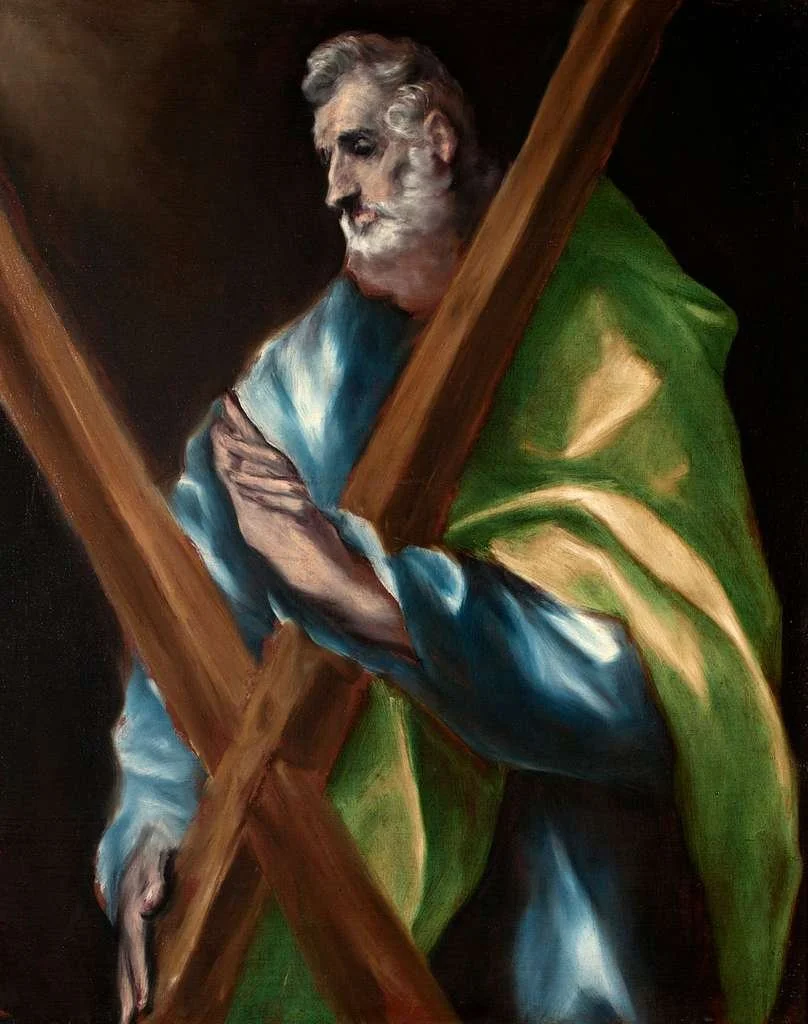
“The Crucifixion of Saint Andrew” by El Greco.
Today, I drove past the The Episcopal Cathedral of Saint Andrew in Honolulu. It’s one of the more famous statues of Hawaii—fronting the Anglican Church founded by King Kamehameha IV and Queen Emma.
Because of this statue, I grew up looking to Andrew the Apostle as one of the prime examples of living a Christian life.
Andrew is one of the most significant yet perhaps less frequently discussed figures in the Bible. His story is a powerful testament to the call of discipleship, the spread of the Gospel, and the ultimate sacrifice of martyrdom.
Andrew: The first-called
Andrew’s life began in Bethsaida on the Sea of Galilee, where he worked as a fisherman alongside his brother, Simon Peter. Andrew’s connection to Jesus is unique because tradition hails him as the first-called disciple.
Andrew was initially a follower of John the Baptist. The Gospel of John records that when John the Baptist pointed to Jesus and declared, "Behold, the Lamb of God!" Andrew immediately followed Jesus.
Andrew’s first action as a disciple was to find his brother, Simon, and tell him, "We have found the Messiah" (John 1:41). This introduction brought Simon, who would become Peter, into Jesus's inner circle.
Andrew is consistently portrayed as the one who brings others to Christ, whether it's his brother, the boy with the loaves and fish (John 6:8-9), or a group of Greeks (John 12:20-22).
Andrew was present for key moments in Jesus's ministry and is named among the twelve apostles. After Christ’s Ascension and the descent of the Holy Spirit at Pentecost, tradition suggests Andrew took the Gospel message far and wide, preaching along the shores of the Black Sea and eventually throughout parts of Greece.
The story of his crucifixion
Andrew’s missionary work ultimately led to his martyrdom in the Greek city of Patras.
The traditional accounts of his death, primarily from the apocryphal Acts of Andrew, depict a profound and inspiring end to his life. The local Roman governor, Aegeas, was enraged by Andrew's success in converting many people to Christianity including the governor's own wife and brother. When Andrew refused to stop preaching the Christian faith, Aegeas ordered him to be crucified.
The X-shaped cross or saltire
The most striking detail of Andrew’s martyrdom is the type of cross he was said to be placed upon. Tradition holds that he was crucified on a crux decussata, or an X-shaped cross, which is now famously known as Saint Andrew's Cross or the Saltire.
Accounts suggest two reasons for this distinctive cross. Andrew allegedly felt unworthy to be crucified on the same shape of cross as his Lord, Jesus. Furthermore, Aegeas reportedly ordered that Andrew not be nailed, but bound with ropes to the cross, to prolong his suffering and ensure a slow, agonizing death.
Despite his immense pain, the stories tell of Andrew preaching to the crowds for two or even three days as he hung upon the cross. He used his final hours to witness to the truth of Christ, urging the people to remain steadfast in their new faith. When he finally saw a heavenly light surrounding him, he prayed one last time and died.
His unwavering faith and final sermon serve as a powerful model of commitment to the Gospel, even in the face of death.
Andrew's symbol and the Presbyterian faith
Today, Andrew the Apostle remains a revered figure and is the patron saint of countries including Scotland, Russia, and Greece.
The Saltire or white X-shaped cross on a blue field, is not only the national flag of Scotland but also a very profound symbol within the Church of Scotland and many Presbyterian churches around the world.
Because Andrew's relics were supposedly brought to Scotland, he became the patron saint, and the Saltire became a central emblem.
In the Presbyterian tradition, which is historically rooted in Scotland, the Saltire often represents a connection to the historical Scottish Reformation and the enduring legacy of the apostles' evangelism.
It serves as a visual reminder of the sacrifice made for the Christian faith, linking the contemporary church back to one of Christ's first disciples and embodying the principle of steadfast faith under persecution.
Bible study questions
Questions on Andrew's calling and character
1. Read John 1:35-42. Andrew is called the "First-Called" disciple. How does his immediate action after meeting Jesus—bringing his brother Simon (Peter) to Christ—define his character and ministry? What does this teach us about our own calling to evangelism?
2. The article notes that Andrew is consistently portrayed as the one who brings others to Christ (e.g., Peter, the boy with the loaves, the Greeks). In what ways can we model Andrew's "bridge-building" approach in our modern lives and church communities?
3. Read John 6:8-9 (The Feeding of the Five Thousand). Andrew brings the boy with the loaves and fish to Jesus. What does this small action reveal about the importance of bringing what we have—no matter how seemingly insignificant—to Jesus?
Questions on suffering and faith
1. The article describes Andrew's legendary choice to be crucified on an X-shaped cross because he felt unworthy to die on the same style of cross as Jesus. What does this act of humility teach us about the disciples' reverence for Christ's sacrifice?
2. Andrew reportedly preached for two or three days while hanging on the cross. How does this ultimate act of witness exemplify the biblical mandate to be ready to "give an account for the hope that is in you" (1 Peter 3:15)?
3. Andrew’s martyrdom illustrates complete commitment to the Gospel, even unto death. How does knowing this story challenge your own understanding of commitment and sacrifice in your faith journey?
Questions on tradition and symbolism
1. The Saltire, or Saint Andrew's Cross, is an important symbol in Scotland and Presbyterian churches worldwide. How can the symbol of the cross, regardless of its shape, serve as a constant reminder of the Gospel message in your daily life?
2. Andrew's life demonstrates that Jesus often chooses seemingly ordinary people (like fishermen) for extraordinary tasks. How does this encourage you to recognize and use your own ordinary gifts and background for God's purposes?