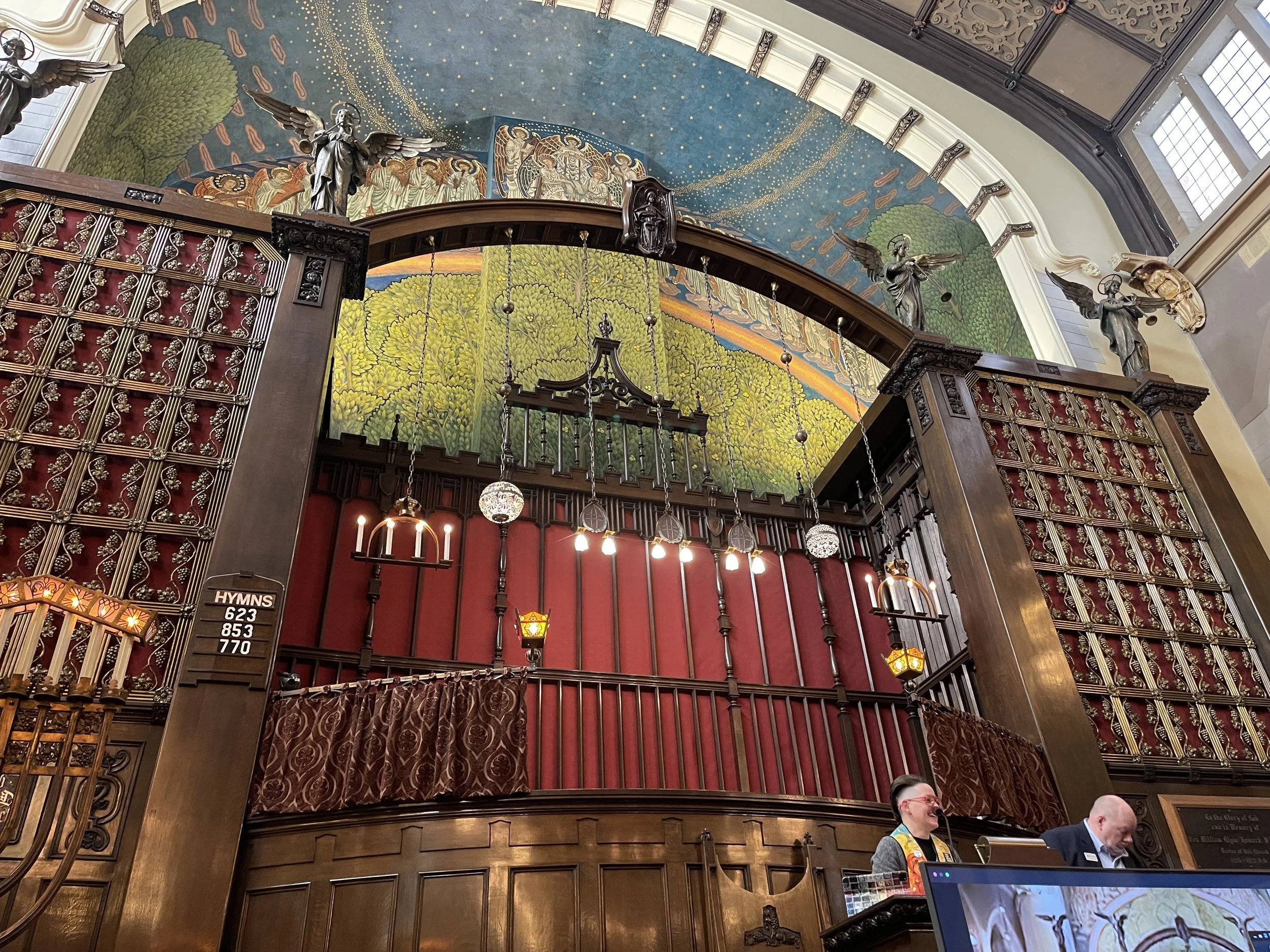
The Rev. Shawna Bowman of Friendship Presbyterian Church, moderator of the Chicago Presbytery, gavels a Presbytery Assembly into session at Second Presbyterian Church in Chicago. Photo: Gerald Farinas.
If you’ve ever wondered why so many Presbyterian churches have numbers in their names, it’s because the tradition reflects both history and growth.
The ordinal numbers—First, Second, Third, Fourth—mark the order in which each congregation was established in a city.
When Presbyterianism took root in Chicago, the first group of believers organized in 1833 as First Presbyterian Church, which still stands today as the city’s oldest religious congregation of any kind. It is now led by the Rev. David Black, whom you might have seen on TV news for his anti-ICE activism and being shot at with a pepper ball by federal agents.
As the city expanded southward, new congregations formed. Second Presbyterian Church, founded in 1842, served the booming South Side and became known for its civic engagement and Tiffany stained-glass windows.
After the Great Chicago Fire, more churches emerged to meet the needs of growing neighborhoods.
Fourth Presbyterian Church, founded in 1871, moved to N. Michigan Avenue in 1914 and became a landmark on the Magnificent Mile.
Each of these names—First, Second, Fourth—marks a chapter in the city’s religious and civic history, showing how faith communities kept pace with Chicago’s explosive growth.
By the late 19th century, Presbyterians began to identify churches not by number but by location and mission.
When our own Edgewater Presbyterian Church began in 1896 as a neighborhood mission of the Presbytery of Chicago, the era of numbered names was already passing.
The Presbytery had a vision to plant congregations in new and growing communities along the city’s North Side lakefront. The people who formed Edgewater Presbyterian wanted a church that was rooted in its neighborhood, welcoming to all, and responsive to the changing needs of the city.
Our name reflects not order but community. “Edgewater” points to our neighborhood identity and our continuing call to serve those around us. While “First” or “Fourth” may speak of legacy, “Edgewater” speaks of belonging—a church grounded in its place and people, still growing in faith, service, and love more than a century later.
So, what happened to Third Presbyterian Church in Chicago. The answer is, I don’t know. I haven’t gotten that far in my research. But it was likely absorbed into another congregation. The answer actually lies in the Presbyterian Historical Society in Philadelphia, Penn.