Sermon: The gifts we overlook
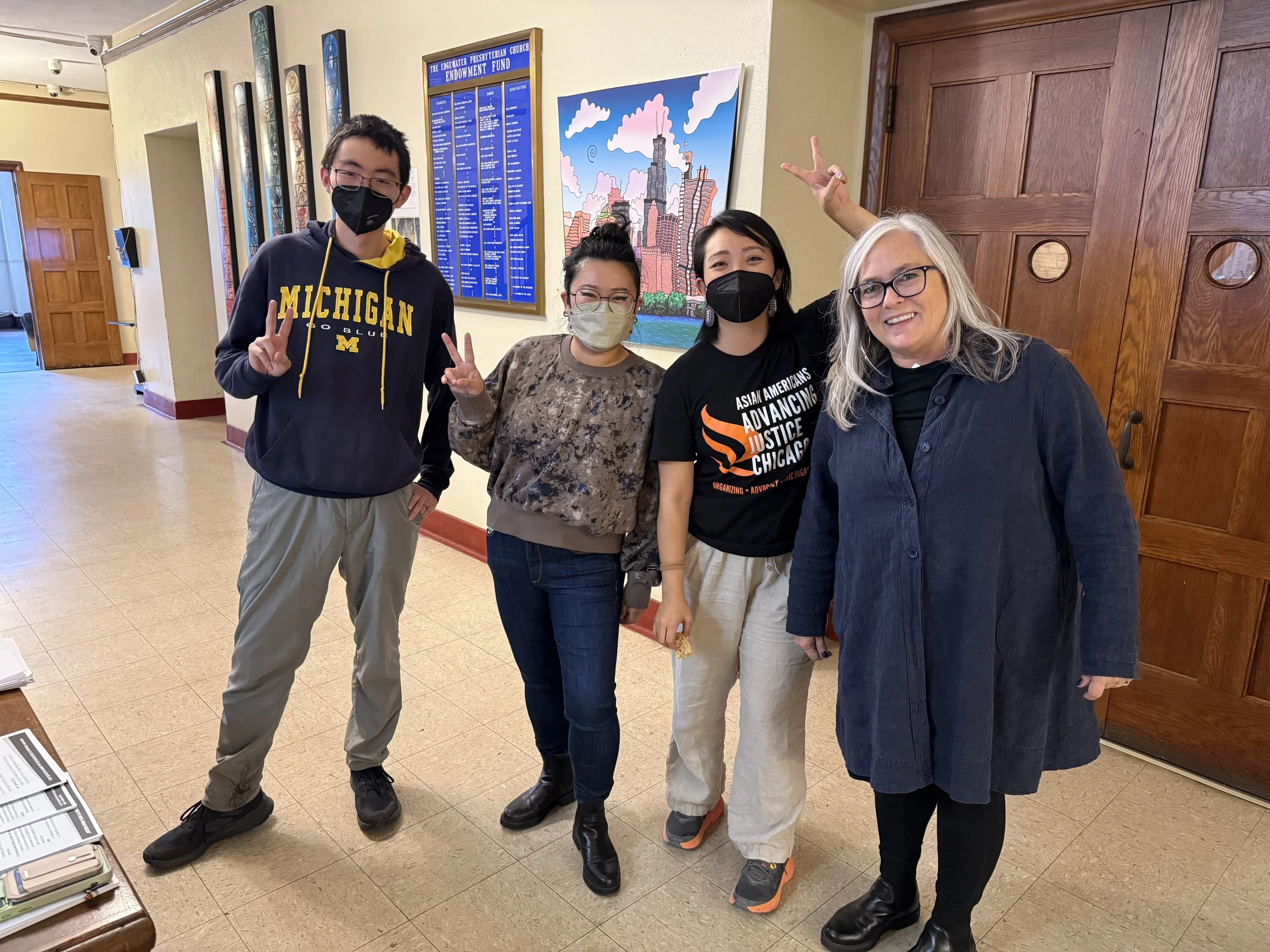
The Rev. Kristin Hutson made new friends from Asian Americans Advancing Justice Chicago. Photo: Gerald Farinas.
As delivered on Sunday, October 26, 2025.
Scripture: Luke 18:9–14 (NRSVUE)
“He also told this parable to some who trusted in themselves that they were righteous and regarded others with contempt: ‘Two men went up to the temple to pray, one a Pharisee and the other a tax collector. The Pharisee, standing by himself, was praying thus, “God, I thank you that I am not like other people: thieves, rogues, adulterers, or even like this tax collector. I fast twice a week; I give a tenth of all my income.” But the tax collector, standing far off, would not even look up to heaven, but was beating his breast and saying, “God, be merciful to me, a sinner!” I tell you, this man went down to his home justified rather than the other; for all who exalt themselves will be humbled, but all who humble themselves will be exalted.’”
This story that Jesus tells is simple but it strikes deep. Two people walk into the same temple to pray. One man, the Pharisee, lists his good deeds for God as though he’s reading off a résumé. The other man, a tax collector, can barely lift his head. All he can manage is “God, be merciful to me, a sinner.” And Jesus says it is the second man, the quiet, humble one, who walks away right with God.
Because God doesn’t look at how loud our prayers are or how impressive our titles sound. God looks at the truth of our hearts. God sees honesty, not ego. God blesses humility, not performance. Sometimes I think that if the Pharisee had a LinkedIn profile, it would have been very impressive, but God would still have clicked “ignore.”
Every single one of us here has a gift. Not a single person in this sanctuary is without one. The trouble is, we often don’t see our own worth. We assume someone else is more qualified, more talented, more important. But that’s not how God works. God uses all kinds of people: quiet ones, messy ones, struggling ones, doubting ones. God has never needed perfect people to do holy things. Some of us sing. Some of us fix things. Some of us know how to cook for fifty people on a church budget. Some of us bring laughter. Some of us bring calm. Some of us just show up every Sunday and sit beside someone who feels alone. All of those are gifts. Every one of them matters to the life of this church.
At one church retreat, we were all asked to share our spiritual gifts. People said things like “I have the gift of hospitality” or “I have the gift of prayer” or “I have the gift of teaching.” Then someone raised their hand and said, “I think my spiritual gift is napping. I’m really good at it. I nap anywhere, anytime.” Everyone laughed, but the more I thought about it, the more I realized they might be right. Because this world is anxious, angry, and exhausted. Maybe peaceful rest is a holy act in itself. Maybe being someone who brings calm into chaos is exactly what God needs right now. It was a funny moment, but it was also a reminder that no gift is too small. Even peace, even a smile, even rest can be a ministry.
There’s someone in our congregation who reminds me of the tax collector in Jesus’ story. He comes to church every now and then. He’s had a rough life. Sometimes he’s been in trouble, sometimes he’s spent nights in jail. He often comes to the church for snacks or a meal because he’s run out of money for the week. One Sunday, after worship, I was taking the offering plate upstairs to count it. He stopped me and said, “Wait, I forgot to put my money in.” He pulled out a twenty-dollar bill. I knew that was probably all he had left. So I said, “No, no, don’t put that in. You need this to eat. You’ve asked Pastor and Dwight for food before. Keep it for yourself.” His eyes filled with tears and he said, “But I need to give back.” He wouldn’t let me leave until I let him put it in. That twenty dollars meant more than any check written that morning because it came from the heart. He didn’t give out of abundance. He gave out of love and gratitude. That’s the kind of gift God treasures.
Not one person sitting in this sanctuary today is insignificant. Not one. Our congregation has been around for about 130 years. Our building has stood for over a century. And we are here today because generation after generation of people, ordinary and humble people, gave their gifts. This church was not built by celebrities or saints. It was built by neighbors. By teachers, carpenters, bakers, janitors, nurses, homemakers, immigrants, students, and elders. People who believed that God could do something beautiful with what little they had. And here you are, part of that same story. Maybe you think, “I just come and sit quietly.” Or, “All I do is help set up tables.” Or, “I just bake cookies once a year.” But you are part of the living history of this church. You are a link in a sacred chain that stretches back 130 years. You are part of the story of a people who refused to give up on community, who built and rebuilt, who prayed and hoped and served right here in this neighborhood. Without you, the story would be incomplete.
Sometimes we look around at the world, at fear, injustice, ICE raids, families being separated, violence in our streets, and it feels overwhelming. We think, “What can one person do?” But if you look through history, you’ll see that God’s biggest work has always begun with one person doing one small act of faith.
During World War II, there was a Japanese Christian diplomat named Chiune Sugihara. He was stationed in Nazi-occupied Lithuania. Every day, Jewish families came to his office begging for visas to escape. His government told him not to help them. He prayed for guidance and felt God telling him to act. So he began writing visas by hand, thousands of them. He worked all day and night, signing papers even on the train platform as he was forced to leave. He threw signed visas out the window to people waiting below. He and his wife saved about six thousand lives. After the war, he lost his job and lived quietly, almost forgotten. But when asked why he did it, he said, “I may have disobeyed my government, but I could not disobey God.” He had no army, no title left, but he had faith. And he used the gift he had: compassion.
Half a world away in Nigeria, another man used a very different gift. Fela Anikulapo-Kuti was a musician who created Afrobeat, a mix of jazz, funk, and African rhythm. But Fela didn’t play for applause. He used his music to confront dictatorship, corruption, and oppression. He sang about injustice when others stayed silent. His concerts were raided. His home was destroyed. His mother was beaten to death. Still, he kept playing. He said, “My music is not for entertainment. It is for liberation.” That was his gift, and he gave it without fear.
When I think about that man in our church with the twenty dollars, or Chiune Sugihara with his pen, or Fela Kuti with his voice, I realize they all had something in common: they each gave what they had. One gave compassion, one gave courage, one gave gratitude. None of them waited until they had more to give. They gave right where they were, with what they had, in the moment they were called to act. And so should we.
But this message is not just for inside these walls. This is something we need to think about outside of church too. Because the world around us is crying out for faith and courage. This past Thursday and Friday, ICE and CBP agents descended on Edgewater and our neighboring communities. They broke windows of cars when people refused to stop. They dragged people out of vehicles without even asking who they were or if they had documents. Near our sister churches in Lakeview, they threw teargas bombs into streets where white, middle-class families were walking their children midday. They did it without warning, in heavily tinted black and white SUVs, with illegally switched license plates, and with faces covered so they could not be identified. This is not the America you and I were taught to believe in.
And a question I keep hearing is, “What can I do? I can’t go protest. I can’t march. Look at me, they’ll get me. I have health issues. I can’t go out there in case something happens. What can I do?” And my answer is always this: you don’t have to march to resist. You just have to use your gift.
If your gift is writing, use your words to tell the truth. If your gift is cooking, bring food to those whose families are hiding. If your gift is organizing, connect people and share resources. If your gift is prayer, then pray like the tax collector did, humbly, honestly, and fiercely. If your gift is hospitality, open your home. If your gift is listening, listen to the pain and fear of others. If your gift is teaching, help others understand what is happening. If your gift is art, paint it, sing it, write it, tell it. Resistance does not always look like shouting in the streets. Sometimes it looks like refusing to let fear make us cruel. Sometimes it looks like keeping our hearts open when the world says to shut them tight.
Every act of compassion, every prayer, every letter, every meal, every song, every story that calls for justice is an act of holy resistance. Think of Chiune Sugihara in Lithuania, writing visas until his fingers cramped, saving thousands of lives. Think of Fela Kuti in Nigeria, singing truth to power even when soldiers beat him and burned his home. Think of the man here who gave his last twenty dollars because he needed to give back. None of them had power or safety, but they gave what they had, and God used it.
That is what it means to live faithfully in times like these. To trust that even the smallest act of love can still shake the powers of fear and hate. God is not asking us to be famous or perfect. God is asking us to be faithful. This old sanctuary has heard 130 years of voices say yes to that call. It has stood through wars, depressions, pandemics, and injustice. And it still stands today because people like you, ordinary and humble, kept giving their gifts. You are part of that same story now, and the world needs your gift.
So let us not be the Pharisee who boasts. Let us be the tax collector who simply says, “God, be merciful to me, and use me.” Let us be like Sugihara, whose compassion saved lives. Let us be like Fela, whose courage spoke freedom. Let us be like the man who gave his last twenty dollars because he believed in giving back. And let us be like all those who built this church with their hands, their hope, and their faith.
Because not one of you is insignificant, not to this church, not to this community, and not to God. Amen.