Be the Leaves: A tree doesn’t exist to be a trunk
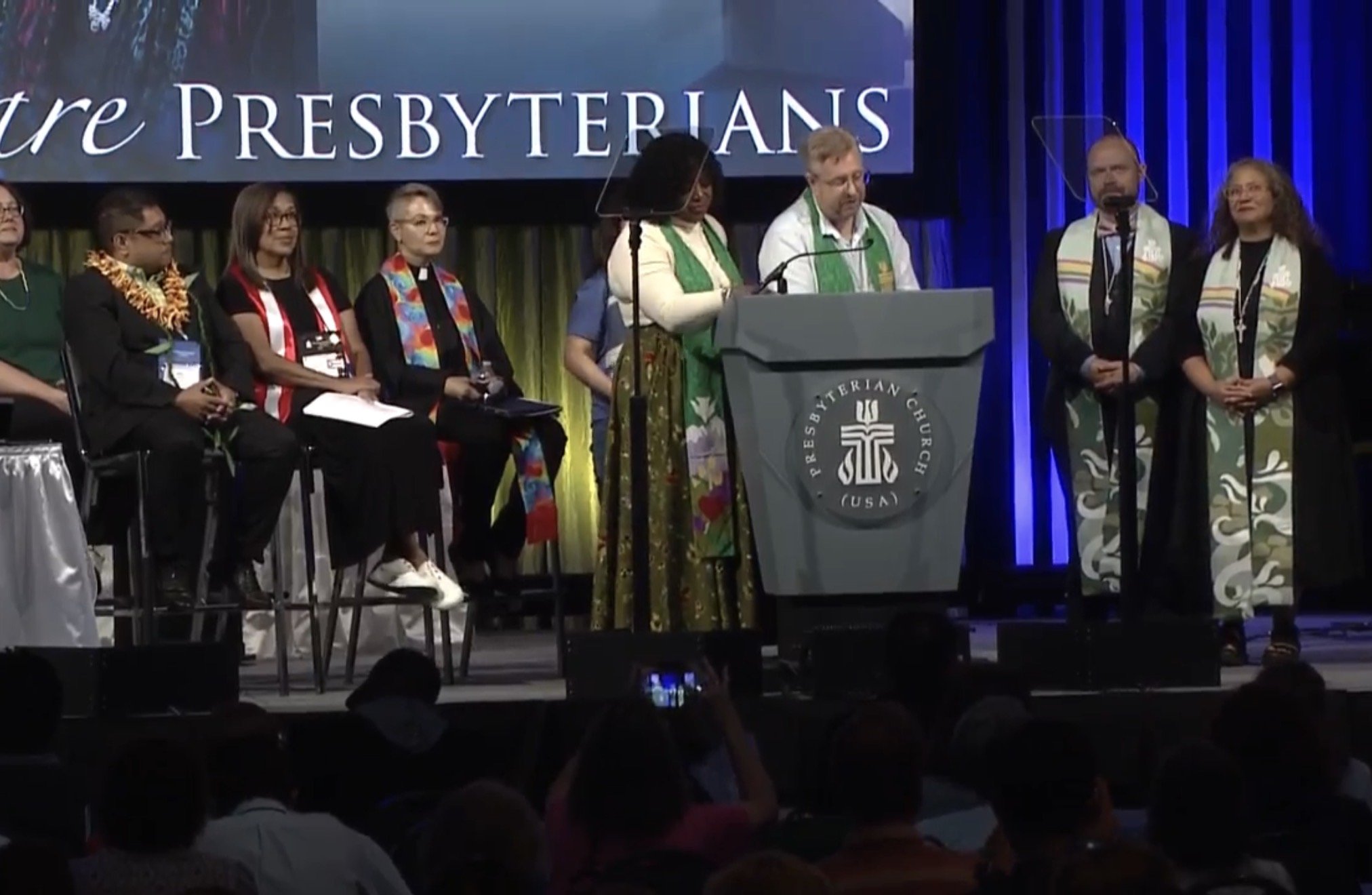
Photo: Presbyterian Church (U.S.A.) broadcast.
Standing on the dais at the 227th General Assembly, looking out at the room as the Rev. Marta Pumroy Cordero and the Rev. Dr. Kris Schondelmeyer were installed as the new Co-Moderators of the Presbyterian Church (U.S.A.). The air literally felt different.
There’s a unique energy that comes with moments like that, a sense of hope standing right next to the very real weight of our current reality. We all know the numbers by now. For the first time, membership in the Presbyterian Church (U.S.A.) has fallen below 1 million people.
It’s easy to let cynicism take root when you look at a milestone like that. It’s even easier to fall into the trap of looking backward, desperately trying to resurrect old church growth models from decades ago, hoping that if we just copy the past perfectly enough, the pews will magically fill up again.
It’s exhausting to even think about what it takes to change that trajectory. You sit awake at night trying to rack your brain for new ideas, scrolling through ministry resources, practically begging for a spark of inspiration, and, well, nothing.
The well feels completely dry. It feels like every good option has already been tried, exhausted, and filed away under "things that used to work."
When you do look for connection and ideas online, it often just makes the feeling worse.
Have you spent any time in those Church Growth Facebook groups lately? You check in hoping for a creative strategy, or at least a sense of shared purpose, but instead, it just feels like an endless grievance board.
It’s a non-stop parade of people venting about empty pews, complaining about the culture, arguing over hymnals versus praise bands, figuring out tech stuff, and mourning a ship that left the pier thirty years ago. It’s draining. You leave those spaces feeling more depleted than when you entered, suffocated by the collective anxiety of an institution staring into the abyss of its own metrics.
But standing up there with Marta and Kris, looking out at the Church we are right now, those old anxieties and that suffocating cynicism started to lose their grip.
They gave us a phrase to carry forward, "Be the Leaves."
At first glance, it’s a beautiful, poetic image, but it carries a radical challenge for the PC(USA) in this exact moment.
For years, we have been obsessed with the trunk of the tree. We have worried about the size of the institution, the strength of the structures, and the sheer volume of the mass.
When the trunk thinned, like when we laid off our mission co-workers and replaced the Mission Agency, we panicked.
The instinct of the institutional preservationist is always to look inward, to shore up the core, and to complain that things are not as large or robust as they used to be. We get stuck in that loop of despair because we are looking at the wrong part of the tree.
A tree does not exist just to be a trunk.
The purpose of a tree, its actual interaction with the world around it, happens at the very edge of the branches. It happens in the leaves.
To be the leaves means shifting our focus from institutional survival to active, living ministry at the margins. Leaves are the parts of the tree that reach out into the world. They absorb the sunlight, they breathe in the atmosphere, and they provide shade and healing to anyone standing underneath them.
In the book of Revelation, we are reminded that the leaves of the tree of life are for the healing of the nations. That is our charge.
When we stop obsessing over whether our total number is 2 million or 900,000, and when we close out of the Facebook groups that trade in panic and never ending list of grievance , we can finally see the vibrant, essential work happening right where we connect with our communities.
The Gospel is not a numbers game, and Church health is not measured by spreadsheets. It is measured by faithfulness. It is measured by how well we feed the hungry, stand with the marginalized, and offer a space of radical grace and welcome to a world that is bruisingly cynical.
The leaves are also seasonal. They change, they drop, they decompose, and they nourish the soil so that new life can break through. There is a beautiful humility in that.
If we spend all our energy trying to freeze-frame the Church of 1970 or 1990, we miss the sacred season we are actually in. We are being called to a leaner, more agile, and deeply relational way of being the Church.
Being on that dais reminded me that the spirit of the PC(USA) is not dying; it is transitioning. Marta and Kris are inviting us to stop staring at the rings of the tree trunk and start looking out the window. We need to look at the neighborhoods surrounding each church, the people who need a word of hope, and the communities longing for justice.
What do people need outside our church?
We don’t need to go backward to old ideas that no longer fit the world we inhabit. We don’t need to fixate on the lack of easy answers or get bogged down by the online choruses of defeat. We just need to extend our branches, open ourselves up to the wind of the Spirit, and be the leaves.