How to ‘Be the Leaves’ while encountering dissident conservative voices
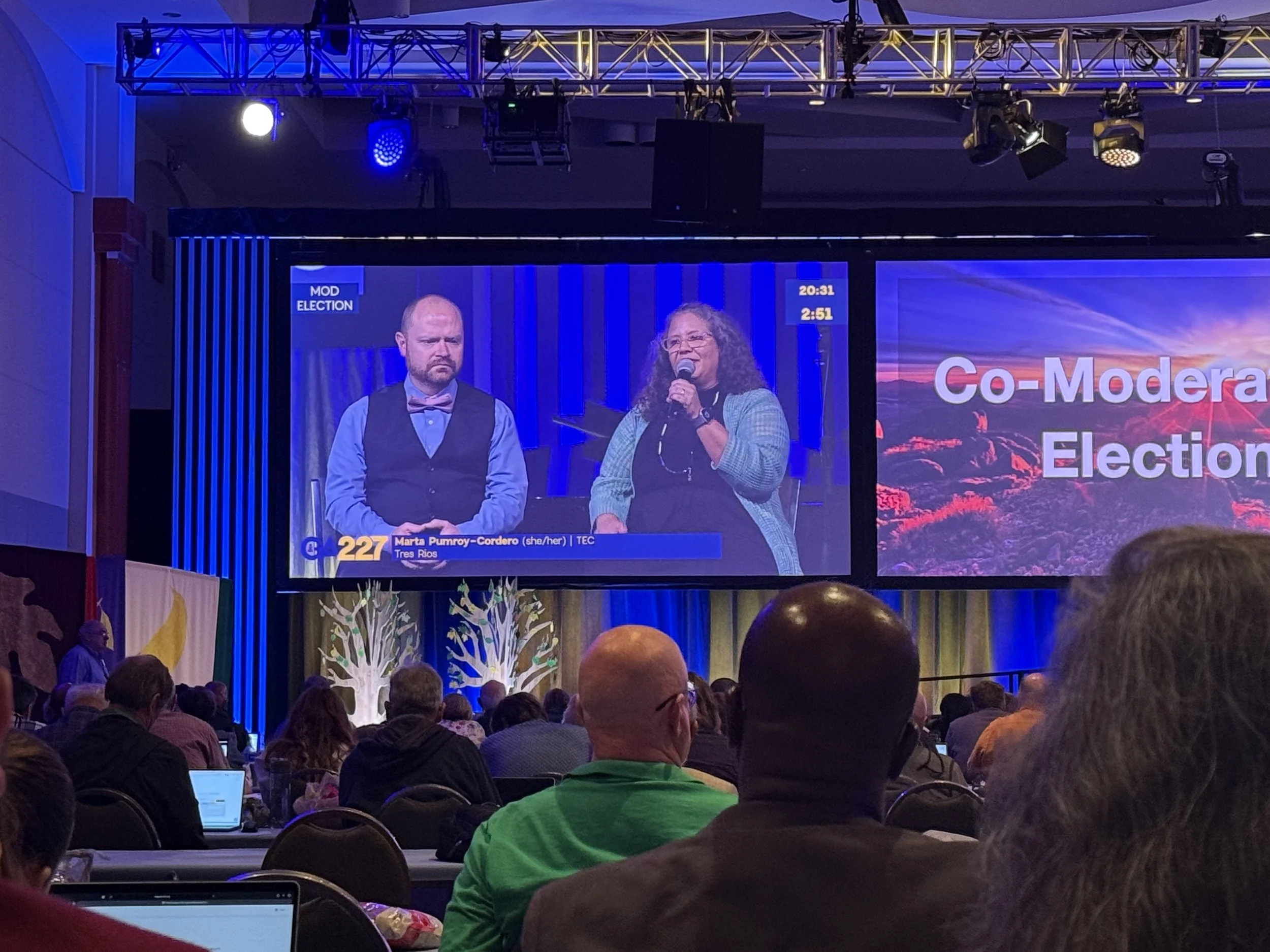
Photo: Gerald Farinas.
The vision of the Church has never been to build a fortress to hide from the world, but to offer a canopy where the world can find healing.
When the 227th General Assembly elected the Rev. Marta Pumroy Cordero and the Rev. Dr. Kris Schondelmeyer as our Co-Moderators, it felt like something shifted. For me, standing with them was not just about casting a vote. It was a direct nudge from the Holy Spirit that demanded action, conversation, and a real investment in what their leadership means for the Presbyterian Church (U.S.A.).
They stepped into this role with a simple, beautiful theme, “Be the Leaves."
That phrase carries a lot of weight. We are living in a time when people are completely exhausted by organized religion. Trust in civic institutions is gone, cynicism toward leaders is everywhere, and our daily news is a heavy mix of war, climate disasters, and economic stress. Hopelessness feels like the background noise of our lives.
It is easy to look at the world and think the best response is to pull back, protect our own properties, and focus on keeping our institutions afloat. But "Be the Leaves" invites us to do the exact opposite.
The imagery comes from the final pages of the Bible, where the tree of life stands by the river of life. The scripture says that the leaves of the tree are for the healing of the nations.
Leaves seem fragile on their own, but they are exactly what keeps the tree alive. They take in light and breathe out what the rest of Creation needs to survive. To be the leaves today means we stop trying to prove how grand our Church used to be and start focusing on our ability to offer shade, shelter, and comfort to a hurting world.
But if we are true about being a canopy for healing, we have to look closely at our own internal life as a denomination. A tree does not just face external storms; it has different branches, and not every branch grows in the exact same direction. We cannot talk about healing the nations if we do not know how to handle the deep disagreements right inside our own house.
At this assembly, we saw clear reminders that we are not all of one mind. We heard dissident voices and felt the tension of real theological differences.
We saw this plainly in the specific amendments proposed by Commissioner Bisham Singh, and we know it exists in the deeply held convictions of theologically conservative groups like Presbyterians for the Kingdom, which are championed by influencers like Richard Ackerman, most popularly known on social media as "Redeemed Zoomer."
As a gay person of color, I disagree with them a lot. I was not watching from a place of calm, detached neutrality. When those dissident voices stood up to make their case against our overtures, or when they introduced motions to amend and dilute them, I was right there gritting my teeth.
I found myself groaning with pure exasperation in my seat. In my frustration, I even labeled their motivations as “white Christian nationalist,”writing them off in my mind under a label that made it easy to dismiss them.
But as the dust settles, I have to ask myself, “What does that actually accomplish?”
Does giving in to that political reflex do anything to build up the body of Christ?
If I react with the same anger and tribal labeling that drives the secular world, I am not being a leaf for healing. I am just adding to the toxic atmosphere that makes everyone so cynical in the first place.
Dismissing people we disagree with might make us feel vindicated in the moment, but it leaves the tree fractured and the canopy torn.
That is not what I want for the Church.
If I truly believe that the Holy Spirit called me and brought me to the General Assembly for a reason, then I have to accept that the exact same Holy Spirit brought those conservative voices there for a reason, too. They did not just stumble into the room by accident, and they are not a mistake for us to try to erase.
Now, let me be get this straight. This does not mean we simply give in to what we know to be false.
Seeking unity with our conservative siblings does not mean we abandon our own deep convictions, stay silent in the face of harm, or pretend we agree on things where we clearly do not. We do not have to compromise on the truth of the Gospel as we understand it.
True covenant community is not built on fake agreement or hastily written statements. It is about staying at the table and refusing to tear each other apart, even when we are holding our ground against ideas we believe are wrong.
At least, that’s what I think deep down God is telling me.
Writing these words is incredibly difficult for me. It forces me to look at my own defensive reactions and challenge my own biases.
As I wrestle with this, I find myself thinking back to a challenge from one of my spiritual mentors long ago. He was a Jesuit priest who firmly believed that if you want to truly understand a conflict, you have to study the issues deeply from the point of view of the people you absolutely disagree with.
That intellectual and spiritual discipline is uncomfortable, but it is exactly the kind of stretching we need right now.
"Be the Leaves" challenges us to take a completely different approach.
If a canopy is going to be wide and resilient, it must be supported by a complex network of branches. The Holy Spirit does not call us to a forced uniformity where everyone speaks in one voice, but to a covenant community where we actually listen to each other.
When we encounter dissent or theological conservatism within the PC(USA), our first instinct should not be to build walls of exclusion or to engage in the same bitter political warfare that is destroying our civic institutions.
Instead, we have to approach these voices with a posture of genuine engagement and humility. We need to recognize that love for the Church and a desire to be faithful to the Gospel drive these perspectives, even when we disagree entirely on what that faithfulness looks like in practice.
To be the leaves means creating a space under the canopy where tension does not equal division, and where disagreement does not mean broken fellowship. We show the world a better way when we refuse to cancel or ignore the branches that look different from our own.
So what does all of this mean for our local congregations over the next two years?
It means our churches need to stop looking inward. A congregation should not be a museum dedicated to its own history. Instead, local churches need to become the literal places where healing happens in the neighborhood. If people in your community are lonely, the church should be a space for connection. If families are struggling with food insecurity or the fallout of local disasters, the church should be the canopy that protects them.
Congregations can live out this theme by making their spaces places of radical welcome, where people can bring their grief, their doubts, and their exhaustion without judgment. This hospitality must extend both outward to our neighbors and inward to our own members who might feel ideologically or theologically isolated. It means turning our focus away from maintaining budgets and structures for their own sake, and directing our energy toward quiet, resilient acts of love right outside our front doors.
As commissioners, our work did not end when the assembly closed. Under the leadership of Marta and Kris, our job is to bring this organic, life-giving model back home.
We are not expected to fix every broken global system on our own, but we are called to stay rooted in the Gospel and let the Holy Spirit work through us.
To be the leaves is to believe that even in a cold, cynical season, the tree of life is still growing, and its shelter is meant for everyone.