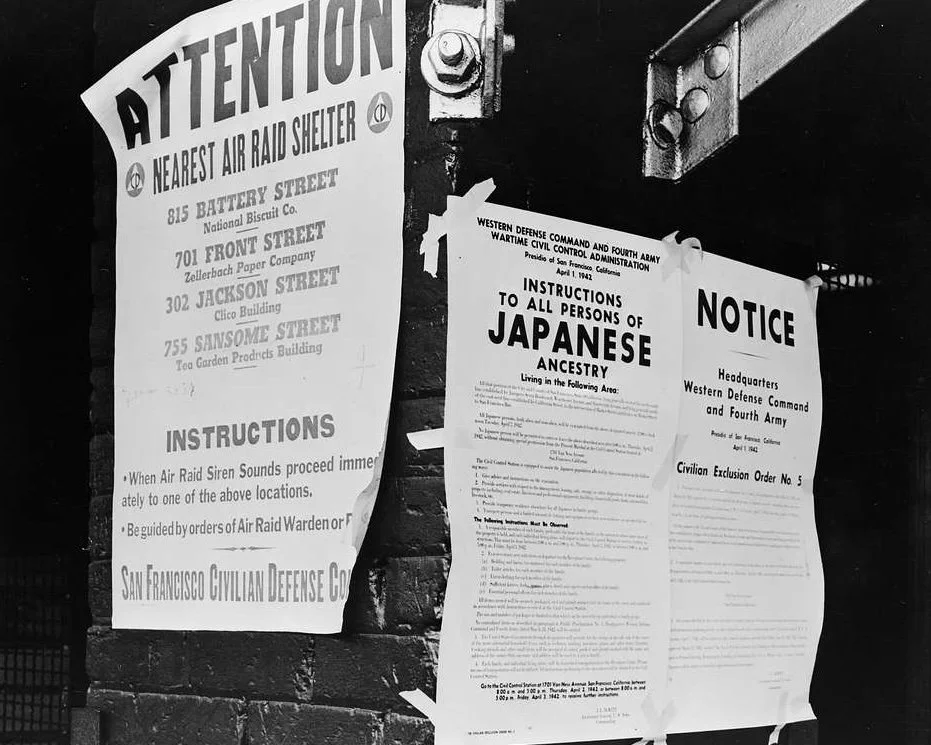
Photo: Library of Congress.
When Donald Trump was first elected in 2016, a friend of mine made a comment that stuck with me.
She said, “You know, those old Japanese internment camps are going to come back.” I remember thinking to myself, How could that happen? Our society has moved so far from that after learning the lessons of history.
At the time, I dismissed it as an exaggeration born of fear. But she proved me wrong.
This week, news broke that a new Immigration and Customs Enforcement detention center at Fort Bliss in El Paso, Texas, has opened. When it is fully completed in the coming months, it will be able to hold up to 5,000 detainees, making it the largest federal detention center in U.S. history.
Reading those words sent a chill through me.
What makes it even more sobering is the location itself.
Fort Bliss is not just another military base. It is a place with history. During World War II, it was one of the sites where people considered “enemy aliens” were once imprisoned. Now, the same land is being used to cage thousands of people again.
Japanese American advocates immediately saw the resonance.
Ann Burroughs, president and CEO of the Japanese American National Museum, put it starkly, “The use of national security rhetoric to justify mass incarceration today echoes the same logic that led to their forced removal and incarceration.”
Her words pierce through any attempt to minimize what is happening. Because that is exactly what is going on: mass incarceration justified by fear and by the language of “security.”
I think back to my friend in 2016 and I wish I could tell her she was wrong. But she was right.
This has been on my heart even more because just last week in my sermon at Edgewater Presbyterian Church, I reminded the congregation of our own history as a haven for former Japanese American internees released from imprisonment after World War II. That legacy of welcome is part of who we are as a community of faith.
And then, almost as if history itself was speaking to us, this week Pastor Kristin Hutson, Sexton Dwight Elmore, and I met with Christ Church of Chicago, a Congregationalist community founded by former Japanese American internees. Their story is one of resilience, rebuilding, and faith carried through unimaginable hardship.
I grew up believing America had confronted its past mistakes, that the internment of Japanese Americans had been a shameful lesson seared into our national memory. We built museums and memorials to make sure we would “never forget.”
And yet here we are, repeating the same logic with different people. Once again, we have a government willing to say that whole groups are threats by virtue of who they are, and once again, we are building prisons large enough to contain them.
It forces me to confront the uncomfortable truth that progress is never permanent.
The arc of history does not bend on its own.
We have to push it.
Otherwise, it bends backward into the very injustices we thought we left behind.