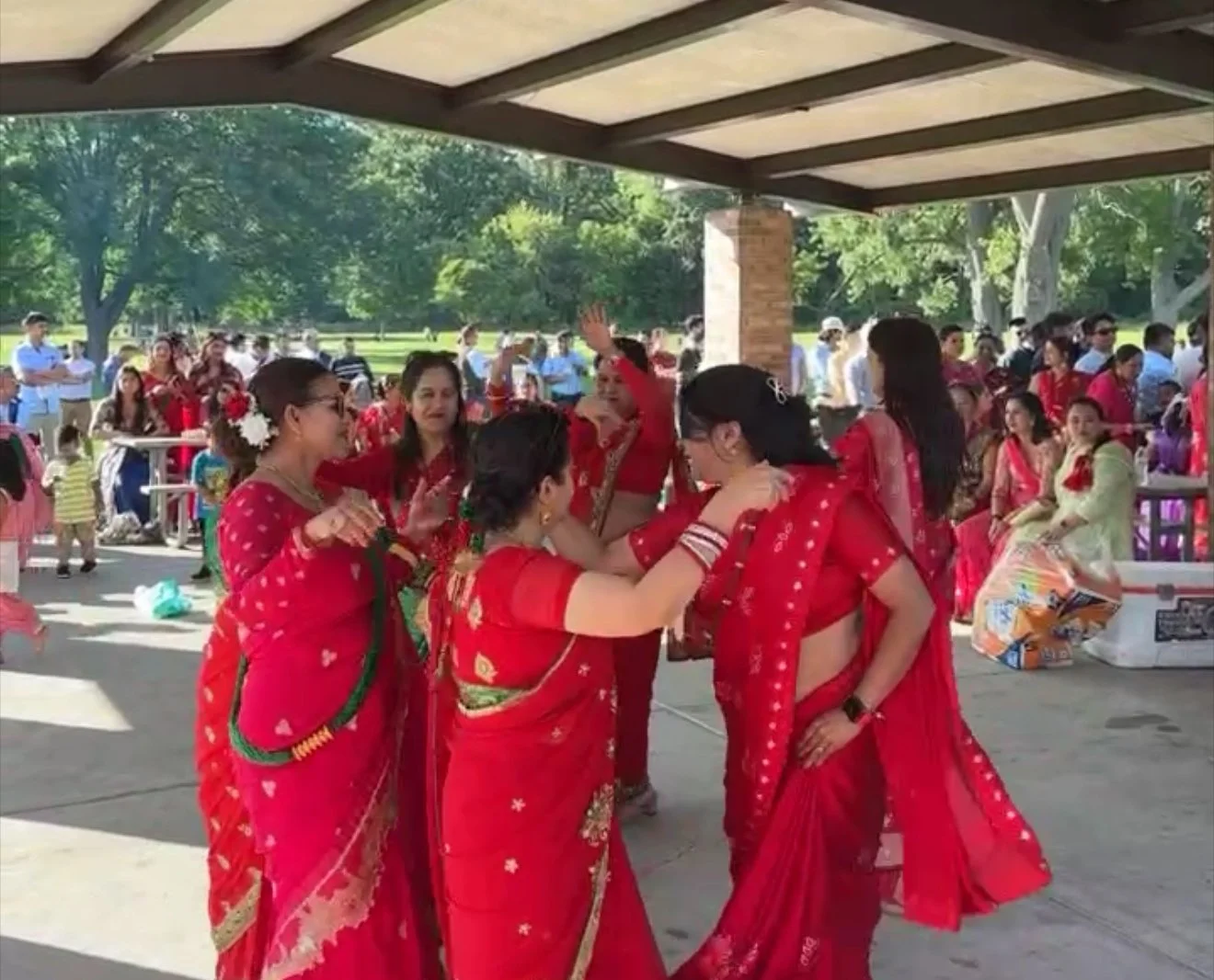
Today’s celebrations. Photo: Chicagoland Nepali Friendship Society.
At Edgewater Presbyterian Church, we have the blessing of sharing our New Community House with the Chicagoland Nepali Friendship Society.
Through their presence, our church building becomes more than a place of worship for Presbyterians. It becomes a gathering space for neighbors whose heritage is rooted in the Himalayas.
One of the most important festivals for our Nepali friends is Teej, a vibrant celebration that reveals both the depth of devotion and the joy of community.
What is Teej?
Teej takes place in late summer, usually in August or September during the monsoon rains.
It is primarily celebrated by women and is dedicated to Goddess Parvati and her union with Lord Shiva. In Hindu belief, their marriage represents devotion and faithfulness.
During Teej, women fast, sometimes refraining even from water, as an expression of spiritual commitment.
Married women pray for the long life and health of their husbands, while unmarried women pray for a good husband.
How it is celebrated
Teej blends solemn devotion with overflowing festivity:
Red attire: Women dress in bright red saris and jewelry, symbols of blessing, joy, and hope for marital happiness.
Songs and dances: Communities gather for traditional songs and dances, which are not only acts of worship but also spaces to share stories of women’s struggles and joys.
Temple worship: Many visit temples, especially the great Pashupatinath Temple in Kathmandu, to pray to Shiva and Parvati.
Dar Khane Din (The Feast Day): On the eve of Teej, families share a feast before the fast begins.
Beyond ritual it’s a social gathering
Teej has also grown into a cultural and social moment. Women find solidarity, laughter, and strength in gathering together.
In recent years, the festival has even been a platform to speak about gender equality and the everyday challenges women face.
It is devotion and justice woven together in song and dance.
A Presbyterian reflection
As Presbyterians, we see familiar threads in this celebration.
Fasting as a way to deepen spiritual focus.
Singing and dancing as a way to praise.
Gathering around a meal before or after holy observance.
These patterns resonate with our own faith journey, even if the form is different.
Teej also reminds us how often women have carried the heart of family and faith, across cultures and religions.
Their prayers, for blessing, for love, for God’s presence, mirror our own longings, whether voiced in Nepali temples or in Presbyterian sanctuaries.
Learning from Teej
To learn about Teej is not to adopt the rituals of another faith, but to listen for the echoes of devotion that run across humanity.
For us at Edgewater Presbyterian Church, it is also an invitation to hospitality. Sharing our building with the Chicagoland Nepali Friendship Society lets us glimpse a festival full of joy, discipline, and solidarity.
In celebrating our neighbors’ joy, we expand our own imagination of what it means to live faithfully.
Teej reminds us that God’s creation is wide and filled with diverse ways people seek the holy.