Dispatches from GA227: The different kinds of commissioner
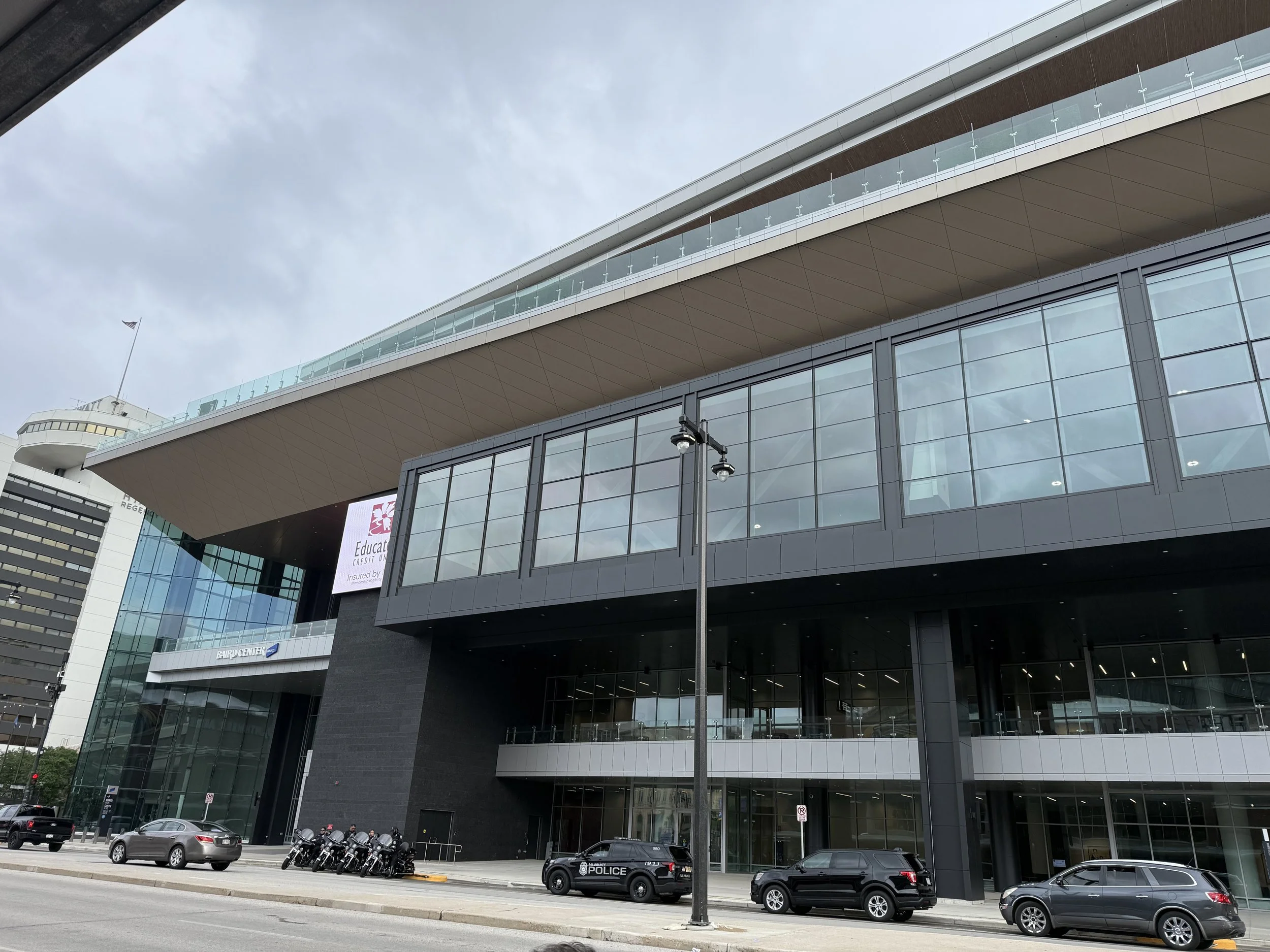
The Baird Center. Photo: Gerald Farinas.
I have a habit of compartmentalizing my surroundings. Someone told me recently that this is usually the trait of a scientific mind rather than a literary one like my own, but I tend to think of it as character-typing. When facing a massive, overwhelming crowd, breaking a room down into understandable archetypes is just how I track the plot.
I found myself doing exactly this as I looked around my own Theological Education and Ordination Committee and took a peek into the various committee debates across the Presbyterian Church (U.S.A.). The commissioners seem to fall into highly specific categories.
The first type are the ones who come ready to slay. They know exactly what they are here to do and are ready to make a difference. They truly believe in an empowered Church that takes to heart the words of Matthew 25 and the Christ of the Gospels who attends to the fringes of Roman society in a colonized land under the boot of empire. They want systemic transformation, and they want it now.
Then there are the traditionalists, the ones who want to conserve an older form of Presbyterianism that they remember from a generation or two, or three, or four ago. It was a time when liturgy was not the focus of worship, but rather the long sermon that dwelled on a discipleship of going to school, raising a family, and setting yourself on a career that was your part to do as ordained by God. This is a high church Presbyterianism that meant dressing in your Sunday best, following the advice of the pastor, and believing in a "silent majority" of people who do not care about the identity politics pervading every modern debate. Just eat your meatloaf and mashed potatoes, bring your Bible to church, be a good citizen, and mind your American values. The young adult Gen Z activist Richard Ackerman, known as Redeemed Zoomer, seems to fall squarely into this category.
A third category includes the people who just do not want to rock the boat too much. Yes, they value church growth and want to extend the mission and vision of the Presbyterian tradition, but they are not keen on joining the identity debates either. They value finding a middle ground on everything. They want to be inclusive, but they also do not want to alienate the more traditional members back home. They are the consensus builders, always searching for the compromise amendment that allows everyone to leave the room feeling like they did not completely lose.
But as the debates wear on, more distinct groups emerge from the floor.
I see the hyper-progressives, a contingent distinct from the initial group of reformers. They are the ones pushing the envelope even further, demanding that the Church move past institutional hand-wringing and fully dismantle old structures. For them, every overture is an opportunity to push the boundaries of language, equity, and inclusion, ensuring the Church is not just reacting to culture, but actively leading it.
Right alongside them, however, is a deeply cynical camp. These commissioners constantly question what the General Assembly is even doing. They look at the docket with a heavy sigh, believing that none of the overtures actually address church growth or, at the very least, stop the decline of attendance in our congregations. They loudly lament church closures and are dead set that reversing this trend should be our ultimate, singular goal. To them, the high-minded debates feel like arranging deck chairs on a sinking ship while the real crisis of empty pews goes ignored.
There are certainly more categories floating around in my head, but it is hard to put a name to all of them.
When it all comes down to it, this sorting mechanism is not unique to our denomination. Step back from our particular assembly, look across the wider landscape, and it becomes clear that every mainline denomination seems to follow these exact same categories. Whether you are sitting with the Methodists, the Lutherans, the Episcopalians, or the United Church of Christ, the same factions are running the same plays in different jerseys. The prophets, the traditionalists, the institutional pragmatists, the hyper-progressives, and the pragmatists worn down into cynics are all huddled in their respective corners.
And every single one of them is running out of time because they all face the exact same math.
We are arguing over the architecture of a house that is losing its foundation. Every mainline body is watching a steady, undeniable decline in butts in seats. That loss of bodies naturally triggers a financial domino effect. Money is becoming tighter by the year, because less numbers inevitably equals less cash in the collection plate. The institutional machinery is growing too expensive for the crowd left to fund it.
Even if a congregation has the money and the will to keep going, they run into the next systemic bottleneck: the leadership pipeline is drying up. Fewer and fewer people are going to seminary with the desire to be a pastor in a local church. The traditional master of divinity track is shrinking as the cost of theological education collides with the reality of low-paying, multi-church yokes or part-time calls.
But the deepest challenge we face is not institutional, financial, or procedural. It is cultural. A massive shift is happening right outside our stained-glass windows. More of the nation and the world is finding religion in secular humanism, or choosing to express spirituality in ways that do not involve a named god or gathering as a community each Sunday morning. The collective habit of churchgoing has broken.
For now, watching these factions collide and coalesce is how I make sense of the beautiful, frustrating, and complex narrative of the Church trying to discern its future. But as I look around the room, I cannot help but wonder if any of our categories are actually equipped to handle a world that has simply decided it does not need us anymore.