Good Friday and Winslow Homer’s slaves with the old mistress
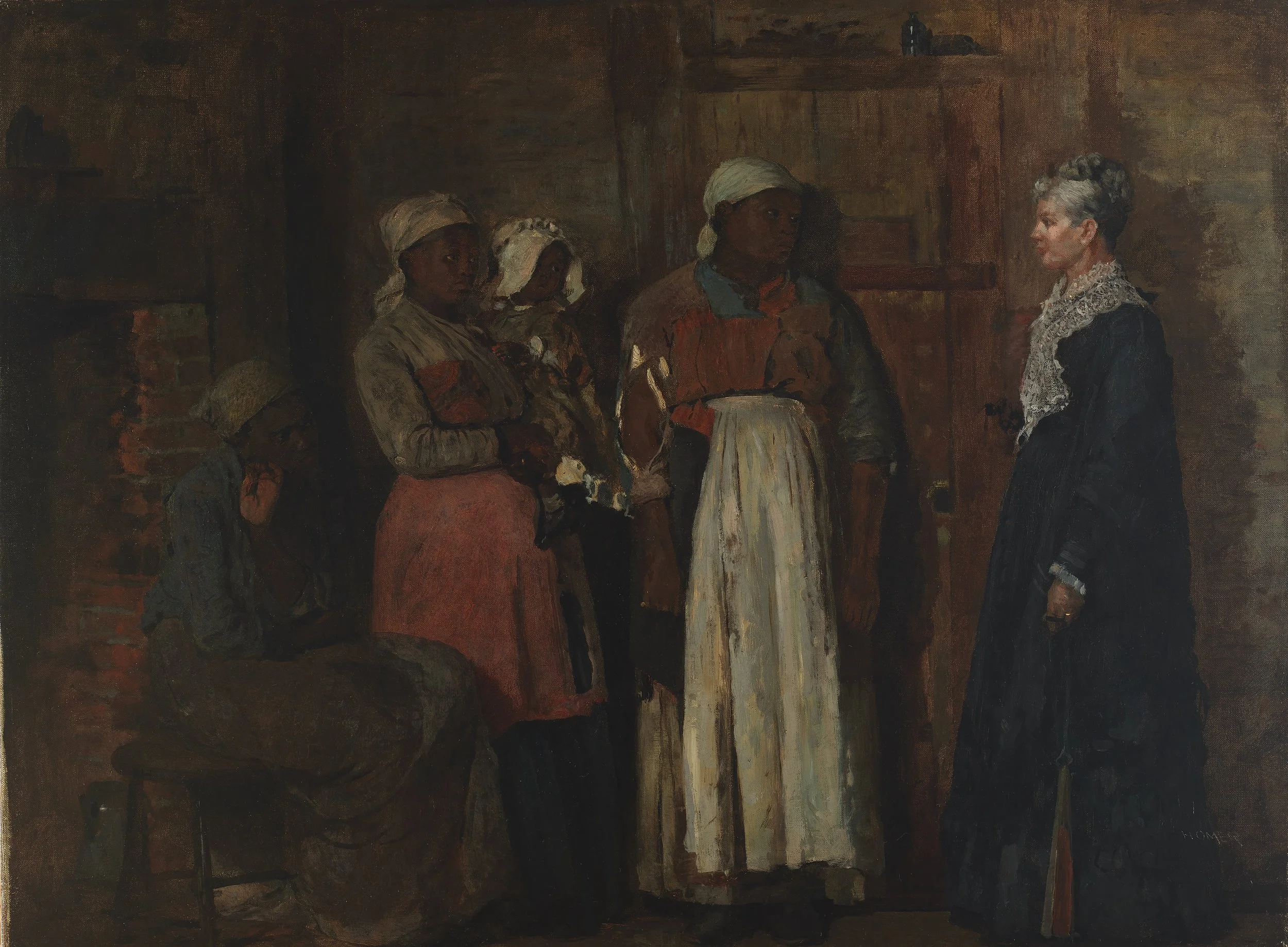
“A Visit from the Old Mistress” by Winslow Homer at the Smithsonian American Art Museum. Credit. Wikimedia Commons. Public domain.
It’s certainly not a traditional Good Friday painting. But to me, this painting is a Good Friday painting.
The floorboards in Winslow Homer’s “A Visit from the Old Mistress” always look like they are about to groan. It is a painting defined by a silence so heavy you can almost feel the air pressure in the room.
There are four Black women on the left, standing in the small space of their plantation shack, their home, and a white woman on the right, the mistress of the plantation, standing just inside the door.
Homer painted this in 1876, about ten years after the Civil War ended, but the distance between these women isn't measured in years. It is measured in the few feet of space between them, a space that feels like a deep gap.
There is no hugging, no crying, no big show of making up. There is only the hard, upright reality of two worlds forced to look at one another without the old laws of slavery to define the meeting.
It seems like a strange connection to Good Friday at first. One is a scene of post-war American tension; the other is the darkest day of the Church calendar. But the more I look at the eyes of the women in the cabin, the more the connection settles in.
Good Friday is often called "good" because of what we know comes next, but in the story itself, there is no Easter yet. There is only the weight of what has been broken.
It is a day of deep, uneasy waiting. It is the silence of the tomb before the stone rolls away.
In Homer’s painting, we are seeing a kind of "Sabbath of the soul." The old world has died. Slavery is legally over, but the new world has not yet fully arrived. These women are living in the "already but not yet."
They are free, but they are standing in a room that still has the shape of their hard past. The mistress is there, but she no longer owns the air they breathe.
There is a Sacramental stillness to it. In the Presbyterian Church (U.S.A.), we talk about the Sacraments as visible signs of a grace we cannot see, but Good Friday reminds us that grace often starts with a visible sign of a wound we cannot see.
The way the oldest woman sits, refusing to stand up for the visitor, is a quiet act of dignity that feels like a sad song. It is a refusal to pretend that things are "back to normal."
Good Friday asks us to sit with the pain of the cross without rushing to the joy of the resurrection. It forces us to admit the cost of our history and the depth of our splits.
Staring at this painting feels exactly like that. It is a picture of a peace that hasn't happened yet. It is the tension of being in the same room but in different universes.
Homer doesn’t give us a happy ending. He gives us the truth of the meeting. He gives us the shadow of the afternoon where the sun seems to have gone dark, and we are left to wonder how we will ever find our way out of the room. It is a painting of the watch, the long, quiet, and necessary wait for a morning that still feels very far away.