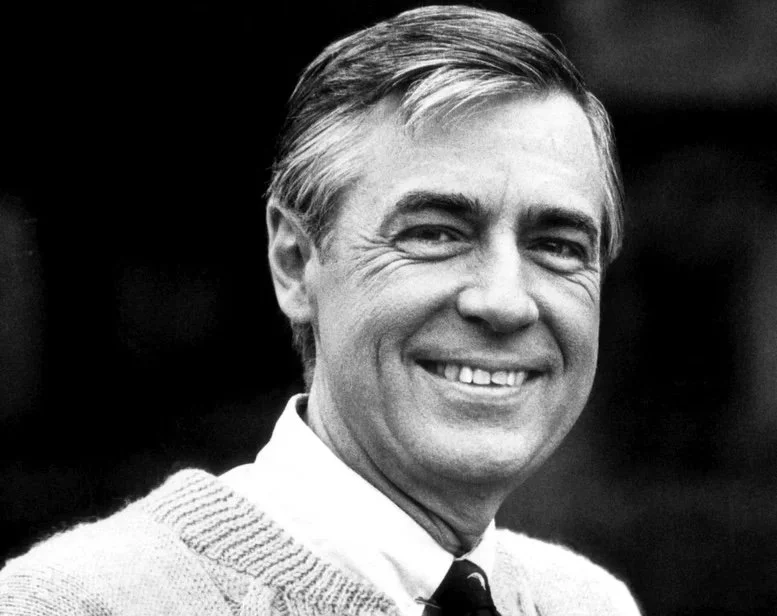
Photo: Mister Rogers’ Neighborhood press photo via picryl.com. Public domain.
Meghan McCain recently suggested that today’s children’s entertainers should follow the example of Fred Rogers and stay out of politics. She argued that he was a neutral figure who kept his show free from the culture wars of his day.
However, this view is a major misunderstanding of who Fred Rogers was and what he stood for. He was not apolitical. He was a man whose work was a quiet but powerful act of protest, rooted in his life as an ordained minister of the Presbyterian Church (USA).
To understand why McCain is wrong, you have to look at the values that guided him. As a minister in the PCUSA, Rogers believed that his faith required him to care about social justice and the way people are treated in public life. He did not see the neighborhood as a place to hide from the world’s problems. Instead, he used it to teach children how to navigate those problems with kindness and fairness.
His faith taught him that every person is a neighbor, and in the PCUSA tradition, being a neighbor often means standing up for the rights of the marginalized.
Rogers used his show to take a bold stand against the racial segregation of the time. In a famous 1969 episode, he invited Officer Clemmons, a Black man, to cool his feet in a small plastic pool with him. During that era, many public pools were still sites of racial conflict and discrimination.
By sharing that water on national television, Rogers was making a clear statement against racism. He was showing children that everyone, regardless of race, deserves a seat at the table or a spot in the pool.
This was a radical political act at a time when Black people were still being harassed and arrested for trying to swim in white spaces.
His commitment to social justice extended even to international relations during the height of the Cold War. In 1987, Rogers traveled to the Soviet Union to appear on the Russian children’s program "Good Night, Little Ones!" He was the first American to do so.
In a time when the "Evil Empire" rhetoric was common, Rogers chose to build a bridge. He sat with the Russian host and her puppets, speaking Russian phrases and singing about being neighbors. He brought Daniel Striped Tiger to meet Khryusha the piglet, proving that even enemies could share a space of kindness.
This was not the act of an apolitical man; it was the act of a diplomat for peace who believed that human connection could transcend iron curtains.
This tradition of social awareness was not limited to Rogers alone. He was part of a broader movement in educational television that recognized children as citizens who live in a complicated world. His contemporaries at "Sesame Street" were doing similar work.
From its beginning in the late 1960s, "Sesame Street" was designed to help inner-city children who were being left behind by the education system. It was the first preschool show to feature an integrated cast of Black, white and Latino actors living together in a diverse urban environment.
"Sesame Street" went even further by introducing characters and storylines that directly addressed social issues. They featured Buffy Sainte-Marie, an Indigenous activist, who breastfed her child on air and spoke about the history of her people. They introduced characters with disabilities and addressed the economic struggles of families in the neighborhood.
Like Rogers, the creators of "Sesame Street" understood that you cannot teach a child to be a good person without teaching them how to live in a diverse and sometimes unfair world.
Even in the face of national trauma, Rogers did not shy away. In 1968, just two days after the assassination of Robert F. Kennedy and only two months after the death of Martin Luther King Jr., Rogers produced a special episode to help children understand the word "assassination." He directly addressed the violence and fear gripping the country. He knew that shielding children from reality was less helpful than guiding them through it with a moral compass.
The idea that children’s media can be apolitical does not really make sense.
Every lesson about sharing, who is important and how we treat our neighbors is a political lesson. Rogers and his peers knew this. He chose to advocate for the vulnerable, teaching that every person has value just the way they are. This message of radical inclusion often went against the grain of the politics of his day.
McCain’s argument implies that modern entertainers are ruining things by being social activists. In truth, they are doing exactly what Fred Rogers and the pioneers of public broadcasting did.
Rogers never ignored the harsh parts of life. He just explained them with grace. To call him apolitical is to ignore his most important work for the Church and for society. He did not avoid politics; he just approached it with the heart of a minister who believed that the kingdom of God belonged to the little ones.