Pope Leo XIV has a great deal of importance to Presbyterians
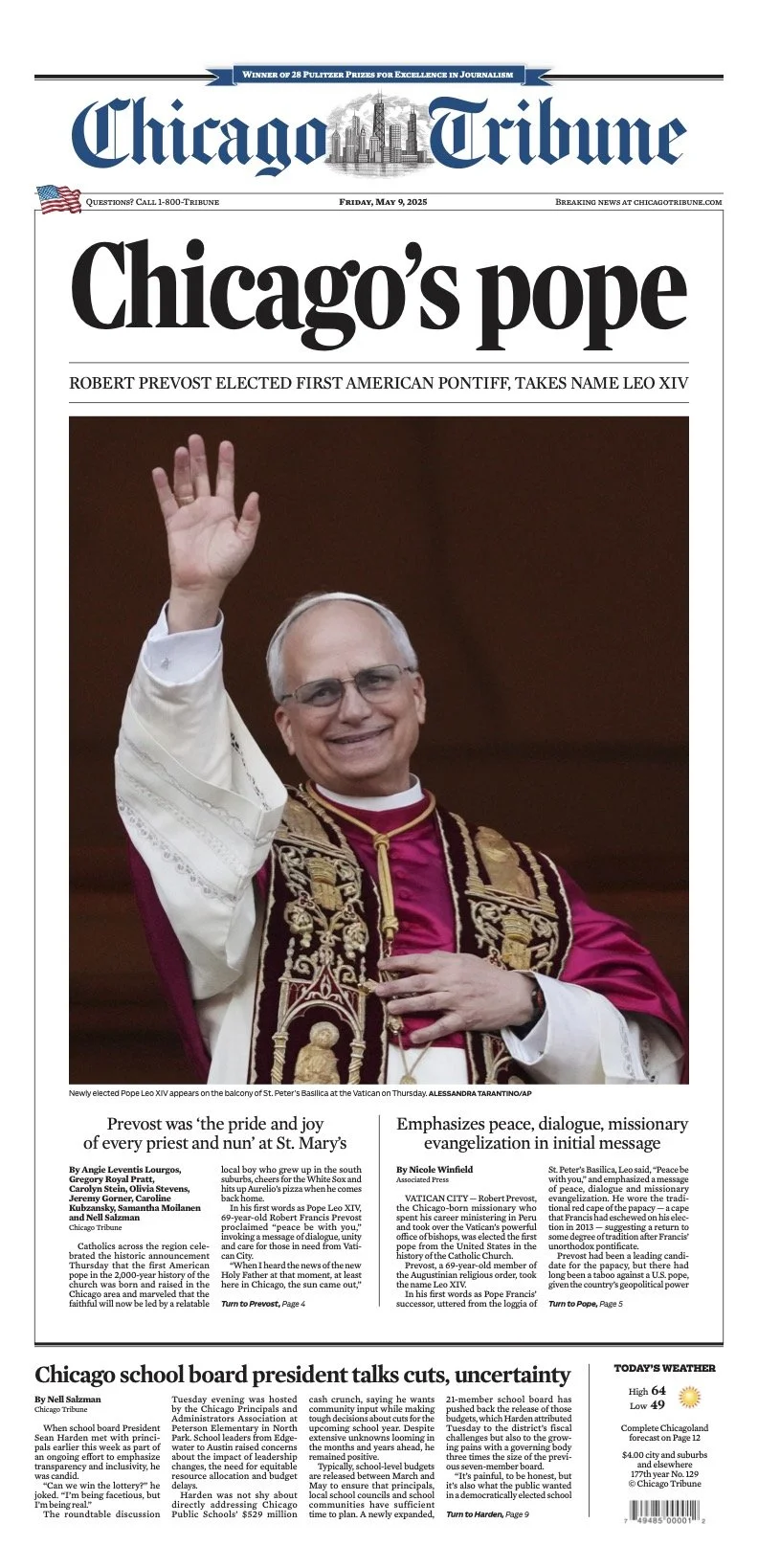
Pope Leo XIV, formerly Robert Francis Cardinal Prevost, 69, of Chicago, Ill. Image: Chicago Tribune front page.
Though the Presbyterian Church (USA) and other Reformed denominations do not recognize the spiritual authority of the papacy, the role of the pope remains deeply significant for our tradition—especially in our continued commitment to Christian unity and the healing of centuries-old wounds within the Body of Christ.
With the election of Pope Leo XIV, the Roman Catholic Church enters a new chapter, and so too must we reflect on the ecumenical promise and theological resonance this moment holds for Reformed Christians.
Our very identity as Presbyterians is entangled with the papacy, not in allegiance but in origin.
The Protestant Reformation, which gave birth to our tradition, was a direct response to abuses and theological concerns centered in the papal structure of the medieval Church.
Reformers like John Calvin challenged not just the doctrine of indulgences but also the unchecked authority claimed by the bishop of Rome.
Yet even as our ancestors broke from papal governance, they did not abandon the idea of catholicity—the universal Church, united in Christ across time and space.
That is why today, Presbyterians must understand the importance of the papacy not as an office of supremacy, but as a visible, global symbol of Christian witness.
The pope is still the bishop of Rome—and in Reformed theology, bishops are understood as elders, albeit with different ecclesial responsibilities.
In this light, the pope is a fellow presbyter, an elder within the larger communion of saints that constitutes Christ’s one holy, catholic, and apostolic Church.
His voice does not command us, but it does matter to us.
Pope Francis made that unmistakably clear during his papacy when he met with moderators of the Church of Scotland and welcomed the first permanent representative of the PCUSA to reside at the Vatican.
This was not mere hospitality—it was a recognition that we are part of the same spiritual family, even if our branches have grown apart.
These gestures were a tangible expression of the ecumenical movement’s hope: that one day, the Church may again be visibly one, even amid its diversity of governance, liturgy, and theology.
With Pope Leo XIV, that dialogue can and must continue.
His role as pope gives him extraordinary influence on matters of global justice, human dignity, and theological reflection.
When the Vatican speaks out on poverty, climate change, or peace, Presbyterians listen—not because we must, but because we care about the shared mission of the Church in the world.
We may not agree with every position, but we are bound to one another by the same Spirit, and the papacy often provides a unique platform to advance moral witness on a global stage.
Moreover, continued engagement with the papacy challenges us as Presbyterians to reexamine our own commitments to unity, governance, and mutual accountability.
It invites us to imagine what future reunification might look like—not a return to Rome under papal rule, but a reconciled diversity where churches can be in communion without uniformity.
The path toward that future is long, and it will not be paved by doctrinal compromise, but by shared mission, mutual recognition, and honest dialogue.
As Presbyterians, we affirm in the Nicene Creed our belief in “one holy, catholic, and apostolic Church.”
That is not a vague ideal—it is a living commitment.
And that commitment includes engaging with the Roman Catholic Church and its leadership, not as strangers or adversaries, but as siblings in Christ.
Pope Leo XIV, like those before him, holds a seat at that table—not over us, but among us—as one elder in the communion of believers, seeking God’s will for the Church universal.
In the end, the papacy will remain vital to us not because of authority, but because of relationship.
And relationship, in Christ, is the ground of our hope for unity.
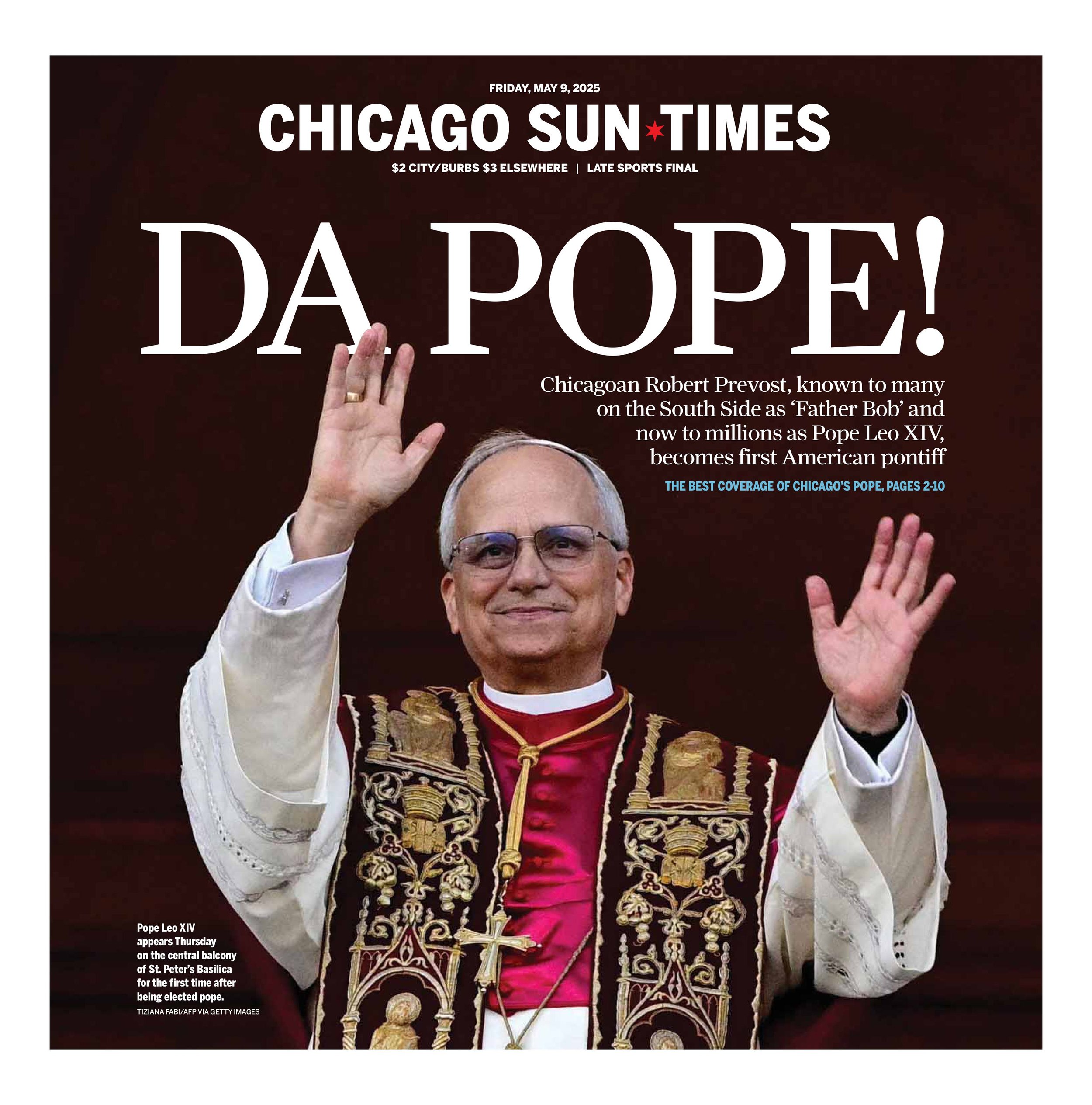
Image: Chicago Sun-Times front page.