Space: The final frontier
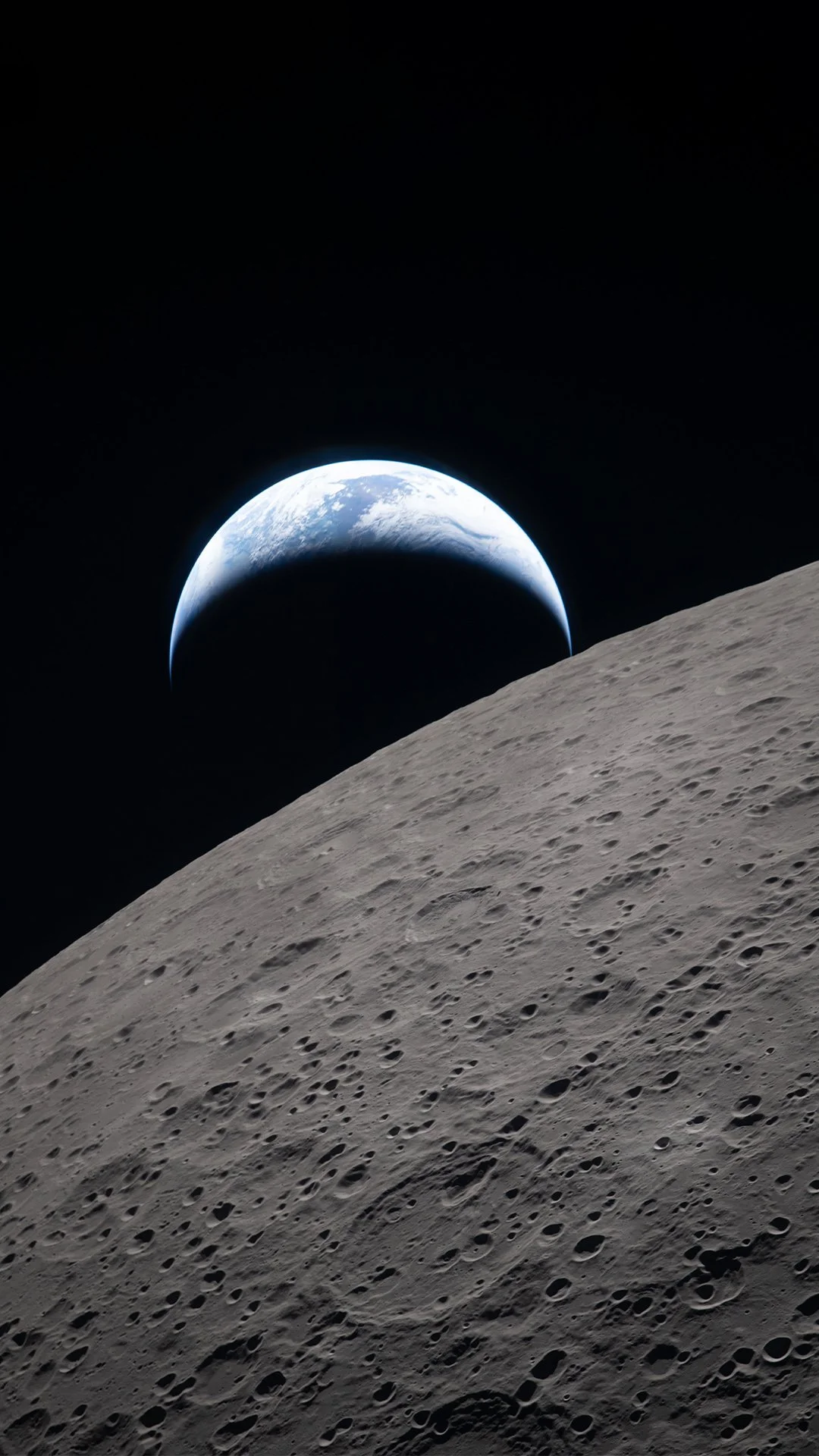
Artemis II image of the moon. Photo: NASA. Public domain.
Tonight, I find myself lying in bed, unable to sleep, just staring out the window. The moon is hanging right there, perfectly framed between two of the high-rise condo buildings along the Edgewater lakefront. It looks so bright and so close, and it immediately makes me think of those incredible Artemis II images that have been coming out lately.
Seeing the lunar surface in such sharp, high-resolution detail, the deep shadows in the Vavilov Crater and that stunning "Earthset" where our own blue planet looks like a tiny, fragile marble, really puts things in perspective. When you see the Universe like that, it’s hard not to start wondering about the bigger picture.
When we look up at the night sky, it is easy to feel a bit overwhelmed. We are standing on one planet, orbiting one star, tucked away in one corner of the Milky Way. When you realize there are hundreds of billions of stars in our galaxy alone and trillions of galaxies beyond ours, it can make human life feel pretty small.
For some people, that vastness is proof that we are just a happy accident in a random, indifferent cosmos. But for many others, the sheer scale and the incredible order of the Universe are the strongest pieces of evidence that an intelligent Creator is behind it all.
The argument for a God who built the entire Universe often starts with what thinkers and scientists call fine-tuning. Think of the Universe like a massive, complex machine with millions of different dials and settings. If even one of those dials, like the strength of gravity or the expansion rate of space, were turned just a tiny bit to the left or the right, the whole thing wouldn't work.
If the Big Bang had been slightly more powerful, matter would have flown apart so fast that stars could never form. If gravity were just a fraction stronger, the Universe would have collapsed back on itself before anything interesting could happen. The odds of all these settings being exactly right for life to exist are so small that it feels less like a lucky roll of the dice and more like a deliberate design.
This brings us to a very old idea called the cosmological argument. It is basically a look at cause and effect. Most of us agree that if something starts to exist, something else had to cause it. Since science tells us that the Universe had a definite beginning, it makes sense to ask what started the clock.
Because the "First Cause" created space and time, that cause has to exist outside of space and time. This leads to the conclusion that a powerful, personal being chose to set the galaxies in motion.
Within the tradition of the Presbyterian Church (U.S.A.), this infinite scope is a huge part of how people understand the sovereignty of God. In this view, God isn't just a local figure focused on our little planet. Instead, the Creator is the author of every nebula, every black hole, and every distant sun.
The Church teaches that the vastness of space isn't just empty room. It is a way to see how prolific and creative God really is. When we talk about the Gospel, we are talking about the message of that same Creator reaching out to us. The Sacraments are seen as physical signs of a divine grace that is just as real and constant as the laws of physics that keep the planets in their orbits.
For a lot of people, this isn't about choosing between science or faith. It is about using both to get the full picture.
Science is the tool we use to figure out how the Universe works, the mechanics of how stars burn and how galaxies move. Faith is what we use to ask why it’s all here in the first place. By studying the movement of distant planets, we are basically looking at the blueprints of a divine mind.
From this perspective, every time a telescope or an Artemis mission finds a new galaxy or a fresh angle on the moon, it isn’t a reason to doubt. It is just another chapter in a much bigger story of Creation.