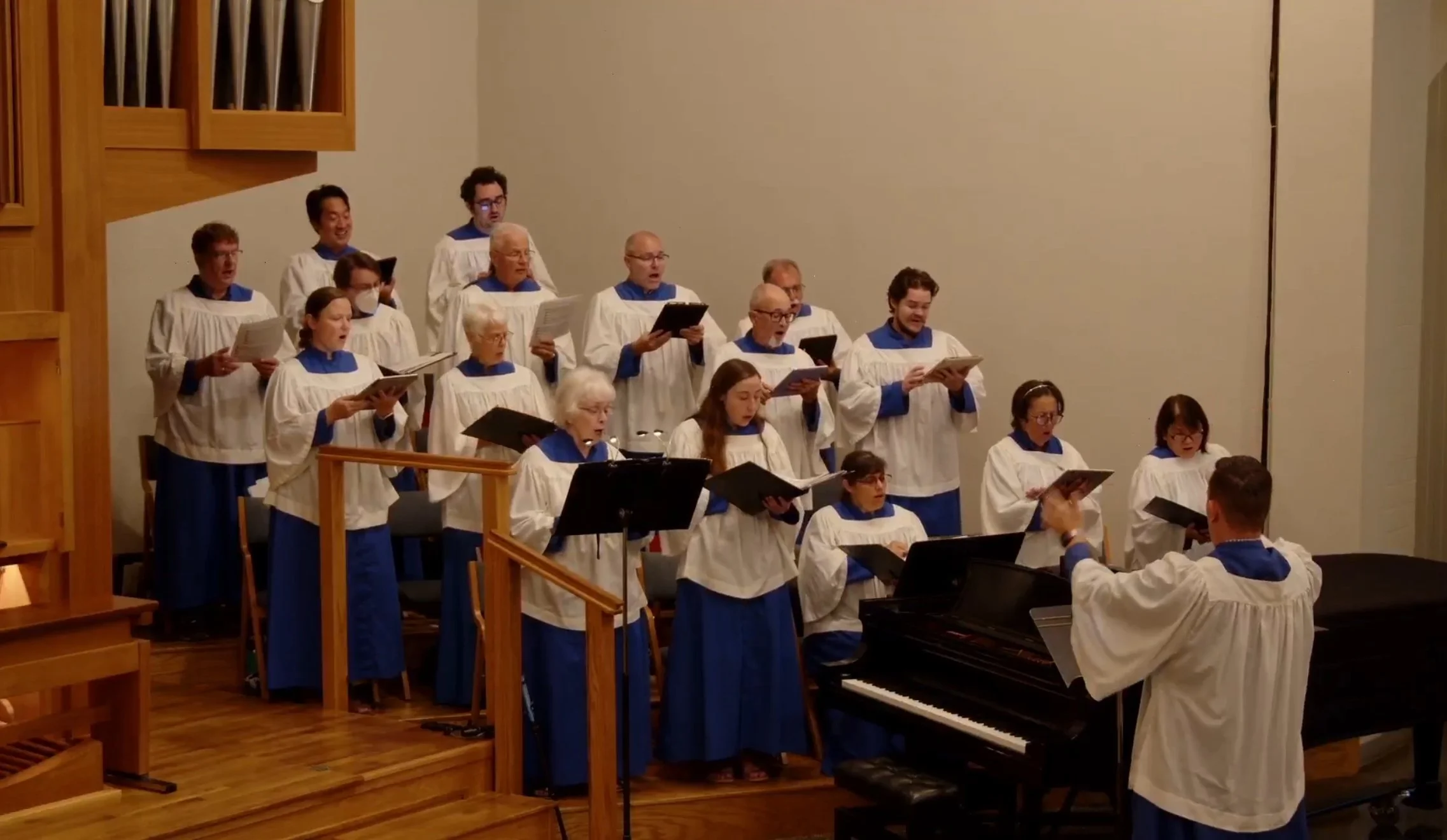
The choir of Lutheran Church of Honolulu under the direction of Dr. Barry Wenger. Photo: Lutheran Church of Honolulu.
Today, the experience of hearing "The Dream Isaiah Saw" performed by the choir of the Lutheran Church of Honolulu—one of my hometown churches—under the direction of Dr. Barry Wenger held a unique gravity.
The anthem's powerful climax was enough to bring me to teary eyes, a visceral reminder that this music touches something deep and unsettled within the collective memory.
For those who remember the world shifting on September 11, 2001, this performance was a moment of profound recognition.
For an 18 year old freshman, newly navigating the vastness of a mainland city like Chicago, away from the familiar embrace of an island home, that day was more than a national tragedy; it was a deeply personal coming of age, etched in fear, confusion, and sudden, stark independence.
This anthem, born from the very same rupture, speaks directly to that intensely felt moment.
Composed immediately following the attacks, "The Dream Isaiah Saw" is not merely a memorial; it is an urgent theological response. It draws its strength and vision from the appointed Scripture for the Second Sunday of Advent—the season of hopeful waiting for the Prince of Peace.
The prophet Isaiah lays out a vision of a redeemed world, where the enmity of nature is overcome and true peace reigns. The song connects the historic horror of 9/11 with the timeless biblical longing for the end of violence.
The central, aching refrain captures this intense yearning, "Little child whose bed is straw, Take new lodgings in my heart. Bring the dream Isaiah saw: Life redeemed from fang and claw."
This is a prayer for intervention. It is the plea of a generation that saw the world's supposed stability crumble, asking the Christ Child not just to appear in history, but to settle in the personal, messy core of one's own life and bring His promised peace. It is the recognition that the ultimate cessation of conflict must begin at the smallest level, within the human heart itself.
The potency of this anthem, written in response to a singular American tragedy, is that its vision of peace is not limited to that event. It is a peace desperately sought in the continuing "tumults of our lives and the world at large."
In a major metropolitan area like Chicago, where the freshman version of me first faced the world alone, that tumultuous yearning is vividly present in the daily lives of the city's inhabitants.
The dream of peace Isaiah saw must be applied to the constant, paralyzing fear endured by immigrants, both documented and undocumented, who live under the shadow of family separation and deportation. The presence of ICE and CBP patrols, raids, and detention introduces a daily terror that undermines the very concept of sanctuary and security. This is the "fang and claw" of systemic anxiety applied to those simply seeking a better life.
Furthermore, this systemic violence touches U.S. citizens targeted because of the color of their skin, experiencing daily aggressions, bias, and sometimes fatal confrontations that contradict the nation's highest ideals. The hope for the Christ Child to take new lodgings in the heart becomes a prayer for the city itself to become a place of safety and true belonging for all who call it home.
The powerful verse, "Peace will pervade more than forest and field: God will transfigure the Violence concealed Deep in the heart of systems gain, Ripe for the judgment the Lord will ordain," lunges forward from personal tragedy into a profound critique of the world's structure.
The "violence concealed" is not just found in the fear on Chicago's streets; it is the engine driving conflict across the globe.
To sing this song today is to think of the desperate strife that consumes lives in Cameroon and Nigeria, where internal conflicts create displacement and humanitarian crises. It is to acknowledge the environmental and political stresses in places like Nepal and Bangladesh. And most pressingly, it is to hold in one's heart the overt, devastating warfare in Ukraine and Gaza, alongside the suffering in "everywhere in between," which reminds us that war, injustice, and state violence remain the central tragedy of the human experience.
The lyric validates the shock of 9/11 while simultaneously placing it within the context of all war, all injustice, and the relentless march of human conflict. It serves as a stark reminder that true peace is not simply the absence of loud explosions, but the transformation of the quiet, dangerous mechanisms of "systems gain" that perpetuate violence globally.
For those who heard this anthem while grappling with the memory of 9/11, and while witnessing the turmoil of today, it offers not closure, but direction.
It transforms the memory of a chaotic and terrifying day into a renewed dedication to the Advent vision: the hope that the Peace of Christ, in His birth and in His promised return, will finally realize the "dream Isaiah saw"—a world where the human soul, and the systems it creates, are truly "redeemed from fang and claw."
It is a song that asks us to carry the memory of tragedy not as a scar, but as a commitment to that final, profound peace.