The Gospel according to Charles Dickens
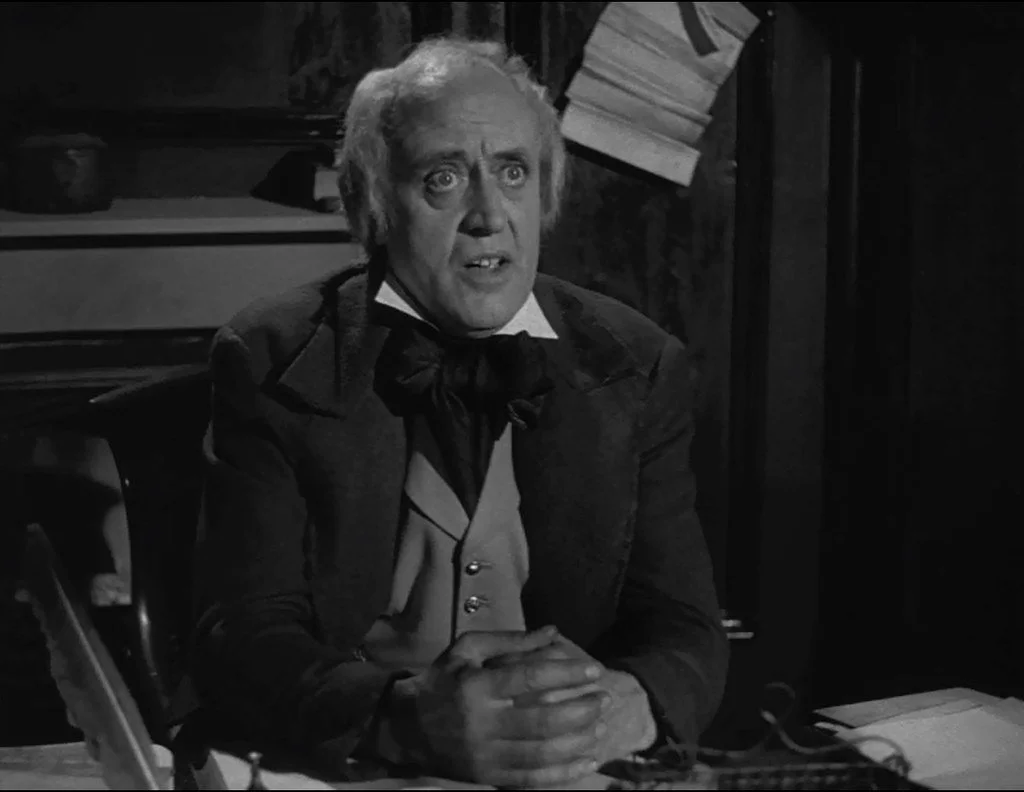
Alastair Sim as Ebeneezer Scrooge. Photo: Screenshot.
Last week at Edgewater Presbyterian Church, we commended the Eld. Elizabeth J. Stake, longtime Clerk of Session and Treasurer of our congregation, to eternal rest.
Liz was probably the biggest Charles Dickens fan we’ve known in our various individual circles in our Kirk. In fact, she belonged to an internationally-affiliated local Dickens society and traveled the world to important Dickensian sites.
It was probably poetic we would commend her to Christ with a Sanctuary decorated for the season most connected to Dickens—through his most famous novella.
A Christmas Carol is a Gospel story unto itself with lessons that go beneath its most obvious lessons. But like the theology of our actual Scripture, there are subversive messages that we need to get into to truly understand why we even have this text.
We often tell ourselves that Ebenezer Scrooge is the ultimate bad guy in A Christmas Carol. He’s the miserable boss, the miser who refuses to spend money, and the man whose heart is as cold as the counting-house he works in.
It’s a comforting idea, because if Scrooge is the villain, then his change of heart fixes everything. It allows us to believe that the solution to immense social suffering is merely the conversion of a few bad apples.
[Do you truly think converting the President of the United States will solve all of our current problems today?]
But the real, chilling truth is that Scrooge is not the true enemy. He is a symptom, a perfect creation of a broken system, and that system is the real, deeply entrenched villain. To focus all our moral energy on Scrooge is to miss the larger, more terrifying machine that built him and continues to operate long after his redemption.
Think about the most famous image of their workplace: the pitiful, meager fire.
Bob Cratchit has a tiny lump of coal, and Scrooge forbids him from adding more. This is clearly cruel to Cratchit, who shivers at his desk, but look closer at Scrooge's behavior. Scrooge himself is cold. He sits bundled in his own layers, warming his hands over a candle, stubbornly refusing to use the ample coal in the cellar. This is a profound moment of self-imprisonment.
If Scrooge were merely a greedy, self-interested individual, he would certainly indulge in the coal to make himself comfortable while denying it to Cratchit. But he doesn't. Scrooge is so perfectly molded by the values of his economic system—extreme self-reliance, the relentless accumulation of wealth, and the fanatical rejection of all non-essential expenditure—that he starves his own needs.
He has internalized the system’s cruelty so thoroughly that it hurts him, too. He is a prisoner, just like Cratchit, only his cage is constructed of strict accounting principles and the hollow virtue of thrift.
This demonstrates that the problem is bigger than one man’s mean spirit. The problem is a structure that rewards, enshrines, and even demands this kind of behavior. The economic laws of the day praised men who saved every penny, even to the point of denying themselves basic warmth and human connection.
In the eyes of the burgeoning industrial society, Scrooge was not a villain; he was a successful, even moral, man. He was following the rules of the market to their logical, inhumane conclusion.
So, when the Ghost of Christmas Present shows Scrooge the poor, the suffering he sees is not just the result of Scrooge’s low wages. It is the result of a vast, flawed societal structure.
The system’s failures are multifaceted. There is the flawed government that offered the poor only workhouses and prisons, not genuine relief or opportunity. There is the flawed new industrialized Victorian economy that allowed a dedicated, hardworking man like Bob Cratchit to earn so little that his family starves in the midst of commercial plenty.
Most insidiously, there is the flawed societal belief that taught people poverty was a personal moral failing, a consequence of laziness or vice, rather than a structural disaster caused by unequal distribution and exploitation.
[We saw repeats of this argument when SNAP benefits were halted during the last government shutdown.]
Dickens is saying, Look at Tiny Tim. His sickness and eventual death are not caused by Scrooge alone. They are caused by the lack of food, the lack of heat, and the lack of decent medical care, all consequences of an unjust system that values profit over people.
Tiny Tim’s grave is an indictment not of a single man, but of the entire, unforgiving social architecture.
Scrooge’s personal journey is undoubtedly important because it shows that a person can reject those cruel, systemic values. He converts, he uses his wealth for good, he raises Cratchit’s wages and becomes a kind benefactor.
But one converted man, no matter how generous, does not fix an entire society. The void of justice remains for everyone else living under the same cold principles.
The lasting power of A Christmas Carol is its demand that we look past the convenient, individual villain. It challenges us to see the powerful, invisible structures that truly determine who is warm, who is fed, and who is successful.
Scrooge is just one cold man; the true villain is the structural chill that permeates and freezes an entire society.