Look for anchors when the boat feels adrift
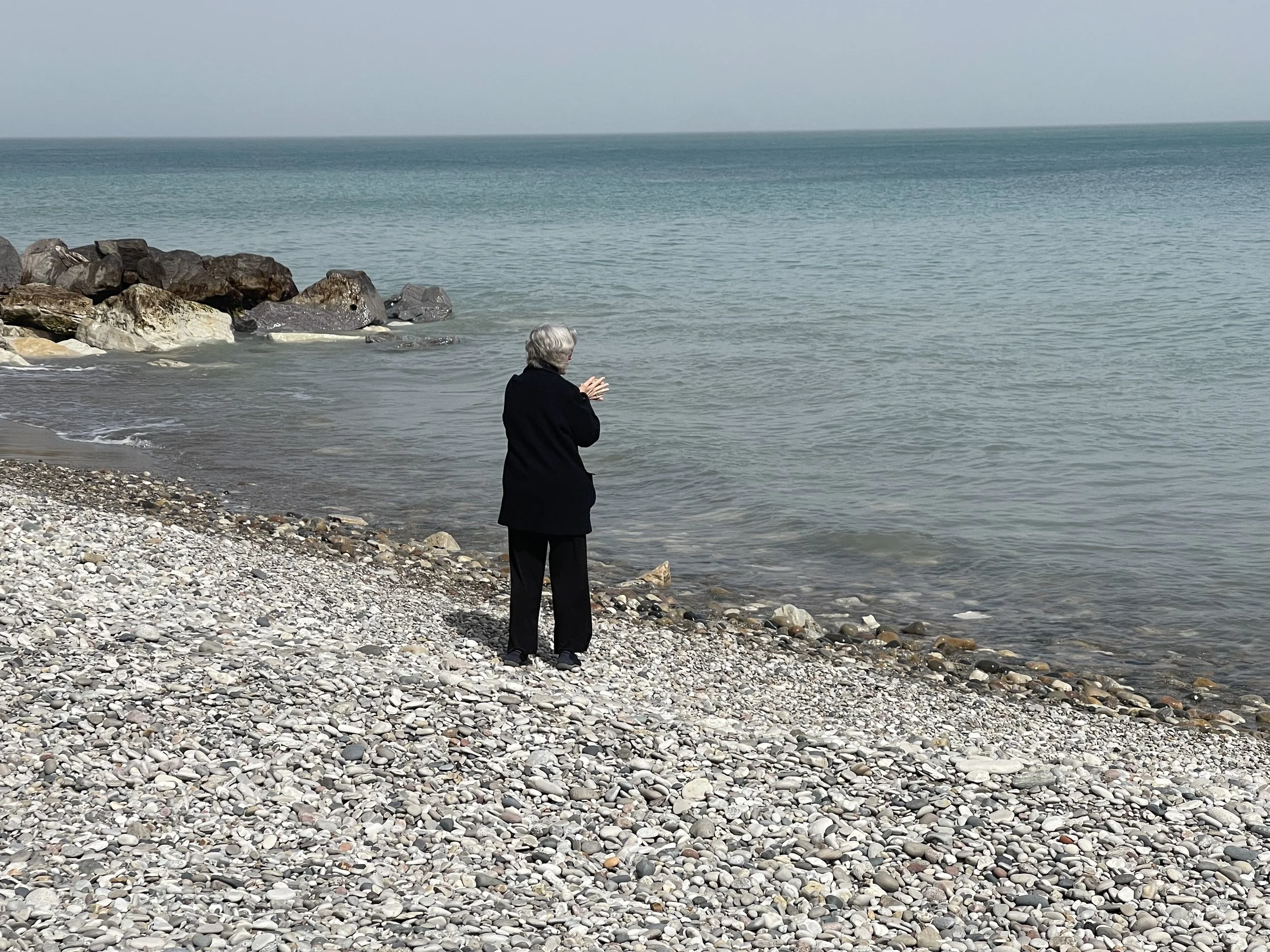
Rev. Vicky Curtiss at the lakefront at Siena Retreat Center in Racine, Wis. Photo: Gerald Farinas.
There is a specific kind of exhaustion that sets in when we feel like we are constantly bracing for the next wave to break over us. We start to look at our lives through a lens of scarcity, wondering if the reservoir of "good things" has simply run dry.
When hope feels like it is slipping through your fingers like lake water, the first thing to realize is that you do not have to white-knuckle your way back to the surface. Sometimes, the most faithful thing we can do is stop treading water for a moment and admit that we are tired of fighting the current.
Because we’re a water-oriented church on the Chicago lakefront, let me use water imagery.
When I was a student at Loyola, facing undiagnosed, unmedicated depression, I often would slip away from folks and sit on the boulder promenade in front of Madonna Della Strada Chapel, listening to the lapping of lake water thinking. In those moments, the lake didn't offer answers, but it offered a rhythm. It reminded me that the water has been hitting those rocks long before I started suffering these bouts and would continue long after.
In our spiritual lives, we often mistake hope for a feeling of certainty or a sunny day on the pier. But true biblical hope is closer to an anchor.
An anchor is most useful not when the lake is glass, but when the gale is blowing and the tide is pulling hardest against the boat. If you feel like your hope is receding, it may be because you are trying to be your own lighthouse rather than leaning into the steady light that is held for you by something much larger than your current storm.
We live in a culture that demands quick resolutions and testimony moments where the clouds part and the sun shines instantly. However, much of the life of faith is lived in the middle of the lake, in the space between the shore we left and the one we cannot yet see.
When good things seem to be disappearing beneath the surface, it is helpful to look at the tradition of lament found throughout the psalms. These prayers do not ignore the crashing waves or pretend the boat isn't taking on water. They are raw and honest. They remind us that God is big enough to handle our fear of drowning and our worry that the depths are all that remain.
When the big hopes feel out of reach, it is time to narrow your vision to the immediate shoreline.
We often look for God in the massive swells or the total transformation of the landscape, but when we are in a season of loss, or just aimlessness, we find God in the small ripples.
It might be the warmth of a cup of coffee, the reliability of a friend's text, or the way the morning light reflects off the water in the park. These are not distractions; they are evidence that the source of all life is still flowing and that you are still being sustained.
By shifting our focus to these small graces, we begin to rebuild our capacity for trust. We learn that even when the big good things are being pulled out to sea, the foundational goodness of the Creator remains beneath us. This is not a way of ignoring reality, but a way of grounding ourselves so that we are not swept away by the undertow of despair.
Even when the horizon looks empty, the water that sustains us is still there, holding us up until the tide turns.