The palms of the anxious and hopeless
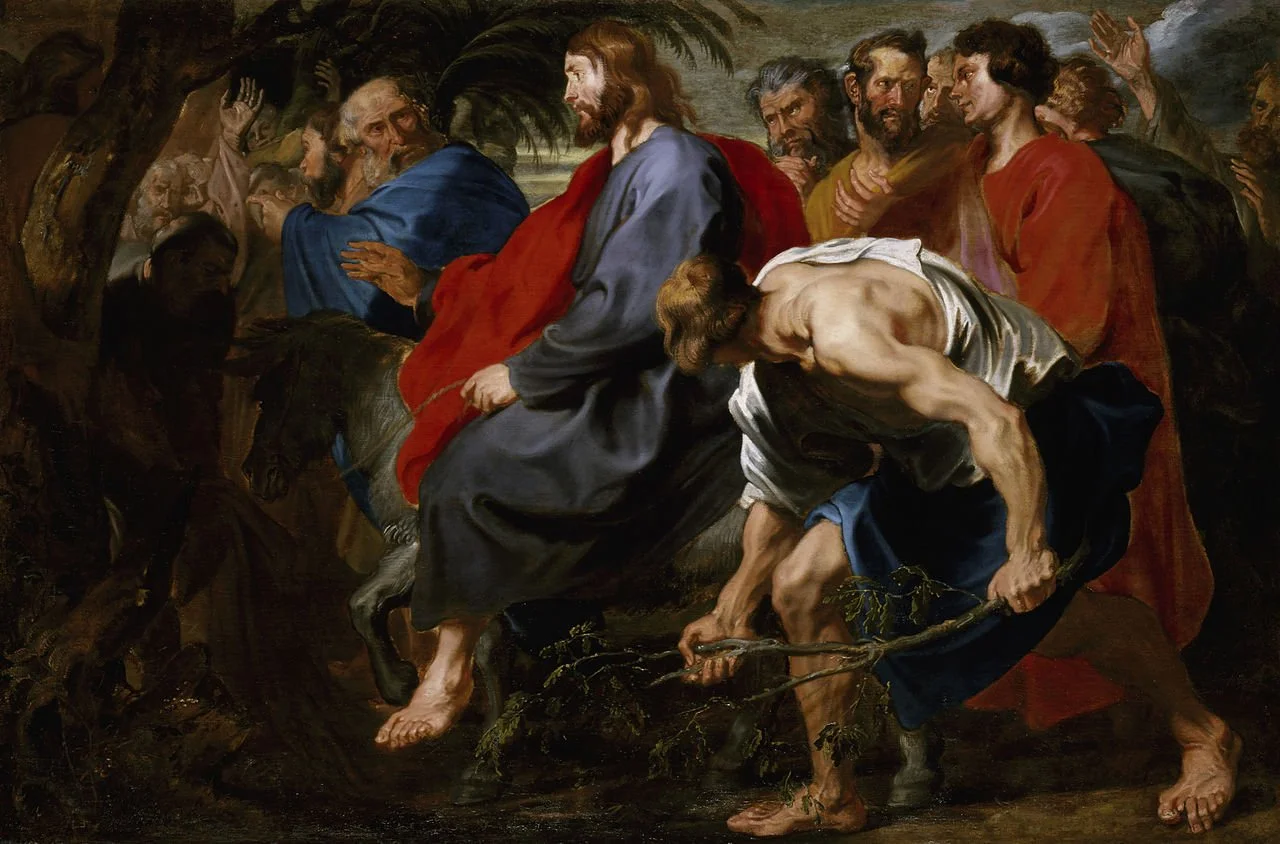
Entry of Christ into Jerusalem by Baroque painter Anthony Van Dyck. Painting: Wikimedia Commons.
We stand today in a long line of people who know what it feels like to be holding a branch while watching a heavy storm gather on the distant horizon. When we gather for Palm Sunday, we often try to dress it up in a parade-like cheer with kids running down the aisles. But the original scene in Jerusalem was thick with the kind of tension we feel in our bones right now. The air was heavy with the scent of a military occupation. You could hear the clanging of Roman shields and the marching of boots. There was a terrifying realization among the people that the systems meant to keep "law and order" were actually designed to keep them down and make them submit.
For many of us, the current moment in the United States feels like a mirror of that ancient anxiety. We see the rise of a brand of Christian nationalism that tries to hijack the Gospel. It attempts to use the Name of Jesus to bless exclusion and hate. We watch as populist claims are used to tear down the very rules of our democracy. Leaders use these claims to turn neighbors against neighbors, saying they are "taking back" a country that was always meant to be big enough for all of us.
As an Asian American-Pacific Islander, I find myself looking back at the landmark civil rights laws of the 1960s with a new, sharper sense of grief. I realize now how much I took for granted. I assumed the rights signed into law by LBJ and the presidents who followed were permanent. I grew up believing the old saying that the arc of the moral universe is long but bends toward justice. I thought it was a steady upward climb. Now, I see that progress is not a mountain we finish climbing. It is more like a garden that we have to weed and defend every single day, or the thorns will take over.
The Gospel of Luke tells us about this entry into the city:
"As he was now approaching the path down from the Mount of Olives, the whole multitude of the disciples began to praise God joyfully with a loud voice for all the deeds of power that they had seen, saying, 'Blessed is the king who comes in the name of the Lord! Peace in heaven, and glory in the highest heaven!' Some of the Pharisees in the crowd said to him, 'Teacher, order your disciples to stop.' He answered, 'I tell you, if these were silent, the stones would shout out.'" (Luke 19:37-40, NRSVUE)
When we see the backsliding of rights for women, Black people, and the LGBTQ community, the weight of it feels like it might crush us. It feels like the air is being sucked out of the room. We look at people in power who ignore constitutional rights to get what they want. We wonder if the tools of justice have simply been broken and cannot be fixed. We ask ourselves what can possibly be done when the tide of authoritarianism seems to be rising faster than we can pile up sandbags at our doors.
It is not just the people in the pews who are feeling this weight. Even those of us standing in the pulpits are tired. I look at my fellow preachers and see a profound exhaustion. We are tired of trying to find new ways to say the same thing. We cannot fathom what else could be said to help our congregants and followers who are asking, pleading, "What else is there to do?" There is a limit to how many times you can preach hope when the headlines feel like a constant assault on our shared humanity. We feel the pressure to have all the answers, but sometimes, like you, we are just standing there with a palm branch in a trembling hand, wondering if the wind is about to blow it away.
We worry that our words are becoming a "noisy cymbal" because the problems feel so much bigger than a twenty-minute sermon. We hear the cries of "How long, O Lord?" and sometimes the only honest answer we have is to cry right along with you.
Yet, even in our tiredness, the Church is moving. This summer, the General Assembly of the Presbyterian Church (USA) will be meeting in Milwaukee. They will be discussing and deciding on an overture that takes an official stand against Christian nationalism. This isn't just a piece of paper or a theological debate. It is a vital step in defining what it means to live out our faith in public policy and daily life. It is an effort to say clearly that the Gospel cannot be used as a tool for authoritarianism. By naming this ideology for what it is, the PC(USA) is attempting to reclaim the story of Jesus from those who would use it to build walls instead of tables.
This cry for justice is echoing across the world. Even the Pope has entered the conversation with a force we haven't seen in a long time. He has demanded an end to ICE raids and immigration operations that tear families apart. He has called on leaders to back off the undocumented and to tone down the dehumanizing rhetoric against people whose only "crime" is seeking safety. He has even gone so far as to plead for an end to the war in Iran, calling for a ceasefire and warning that violence only creates a spiral that leads to an "irreparable abyss." When the highest voices in the Church are shouting for peace and dignity, it reminds us that our "Hosanna" is part of a global chorus.
This is where the shout of "Hosanna" meets us. We often think of that word as a happy shout of praise, like "Hooray!" But the literal meaning is a desperate, gut-level plea: "Save us, we pray." It was not a polite request. It was the roar of a people who were exhausted by the boot of the empire on their necks. They were tired of religious leaders who stayed silent while people suffered.
To shout "Hosanna" today is to admit that we cannot fix this mess all by ourselves. It is an admission of our own limits and a demand for a different kind of power. Notice that Jesus did not enter Jerusalem on a massive warhorse to fight the violence of Rome with more violence. He entered on a donkey. This was a deliberate choice. It was almost funny—a way to mock the "strongman" image that leaders love to project. He wasn't there to grab the handles of power and pull them. He was there to show that those handles are attached to a machine that leads to a dead end.
The Palm Sunday procession was a piece of protest theater. It made fun of the self-importance of the governors and the high priests. It was a reminder that the ultimate authority does not belong to those who use religion to push people to the margins.
So, what the hell do we do when it feels like it cannot be made better?
First, we refuse to let the exhaustion of the empire become who we are. The whole goal of authoritarianism is to make you feel like trying is a waste of breath. They want you to give up and stay home. But the Gospel tells us that even when the government kills the Truth on Friday, Sunday still has a word to say. The story isn't over just because the people in power say it is.
We do the work of the Sacraments in the streets. This means we protect one another. We build communities where the "backsliding" of rights is met with a surge of local love. If the law fails to protect our neighbor, we become the protection. We practice mutual aid and fierce, protective care for the vulnerable.
We shout "Hosanna" not because the news looks good, but because we refuse to worship the idols of power and nationalism. We stand in the tradition of a Christ who was an outsider. He was a person of color living under a mean imperial rule. He knew that the only way through the darkness was to walk directly into it with his friends by his side.
We hold our branches high today. They aren't just decorations for a church service. They are a sign that we are staying present. We are staying loud. We will never mistake the loud noise of a populist crowd for the quiet, steady heartbeat of the Kingdom of God.