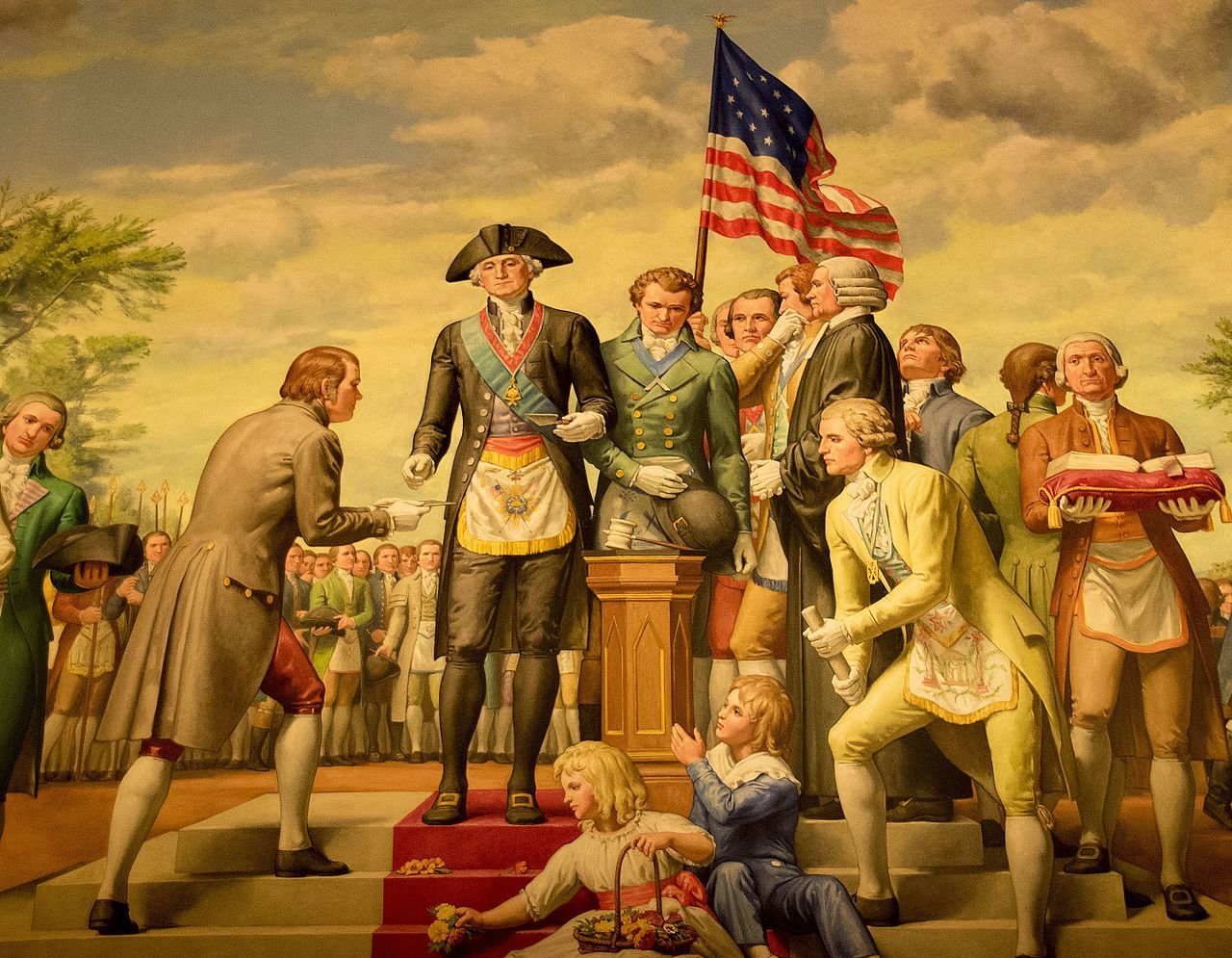
Mural by Allyn Cox of President George Washington laying the cornerstone of the U.S. Capitol in 1793 is a feature of The George Washington Masonic National Memorial in Shuter's Hill Alexandria, Virginia. Photo: Ron Cogswell via Wikimedia Commons.
In the Presbyterian Church (USA) there is no official rule that forbids members from joining the Freemasons.
This might surprise some, especially because other Christian traditions, like the Presbyterian Church in America and the Orthodox Presbyterian Church, have strong opposition to Freemasonry.
Presbyterians in the PCUSA believe in the authority of Scripture and the freedom of conscience guided by the Holy Spirit.
Because of this, membership in civic or fraternal organizations like the Masons is left to individual discernment rather than a strict church-wide policy.
A Presbyterian perspective
Presbyterians hold that salvation and discipleship are based on faith in Jesus Christ, not on membership in other organizations.
While we are called to live in a way that reflects Christ’s love, there is no statement in the Book of Order or other PCUSA teaching documents that bans Freemasonry.
A Mason who is a faithful Christian can fully participate in the life of the Church, including serving as an elder, deacon, or pastor.
Presbyterianism has always placed a high value on conscience. The Westminster Confession of Faith says, “God alone is Lord of the conscience” (WCF 20.2).
This means that decisions like joining a fraternal organization are to be made in prayer and in conversation with Scripture, rather than by imposing blanket rules.
Why other churches oppose Freemasonry
Some Christian denominations have taken a harder stance.
The Roman Catholic Church has condemned Freemasonry since the 18th century because of its secrecy and teachings that conflict with Catholic theology.
In 1983, the Congregation for the Doctrine of the Faith reaffirmed that Catholics who join the Masons are in a state of grave sin.
The Southern Baptist Convention does not outright ban Mason membership, but many Baptist leaders warn against it because of teachings they see as incompatible with biblical Christianity.
The Lutheran Church Missouri Synod also teaches that Freemasonry conflicts with the Christian faith and forbids its members to join.
Their concerns often focus on secrecy, oaths, religious rituals not centered on Christ, and morality teachings that may feel detached from Scripture.
A biblical lens
The Bible does not mention Freemasonry by name, but it offers principles for evaluating any group.
In 2 Corinthians 6:14-15 (NRSVue), Paul writes, “Do not be mismatched with unbelievers. For what partnership is there between righteousness and lawlessness? Or what fellowship is there between light and darkness? What agreement does Christ have with Beliar? Or what does a believer share with an unbeliever?”
This teaches Christians to be cautious about affiliations that compromise their faith.
In Matthew 5:34-37, Jesus says, “Do not swear at all… Let your word be ‘Yes, Yes’ or ‘No, No’; anything more than this comes from the evil one.”
Some churches see Masonic oaths as violating this teaching.
Exodus 20:3 says, “You shall have no other gods before me.”
Belonging to any group should never overshadow allegiance to God.
Historical Context: Freemasonry and the Knights of Columbus
Freemasonry has a long history in the United States. Many Founding Fathers, including George Washington and Benjamin Franklin, were Masons.
In the 18th and 19th centuries, Masonic lodges became influential social and charitable centers. This influence worried religious groups that feared secret societies could undermine Christian teaching.
The Roman Catholic Church in particular strongly opposed Freemasonry, teaching that its rituals and beliefs conflicted with the Gospel.
In response, Catholics formed their own fraternal organization, the Knights of Columbus, in 1882.
The Knights provided a Catholic alternative to Masonic lodges, offering men a way to build community, grow in faith, and do charitable work without joining an organization condemned by the Church.
Presbyterians, on the other hand, never issued a blanket prohibition against Masonic membership.
In fact, many early American Presbyterians were also Masons, seeing no conflict between their faith and lodge membership.
The PCUSA’s emphasis on freedom of conscience has kept that stance consistent.
Discernment for Presbyterians
The PCUSA encourages believers to prayerfully consider their involvement in any organization. If someone is a Mason, the central question is whether their commitment to Christ is primary.
Membership in groups like the Freemasons is not forbidden, but it should never take the place of belonging to Christ and his Church.
While some traditions see Freemasonry as a threat, Presbyterians focus on the heart of the Gospel.
Our identity is not built on earthly lodges or titles but on Jesus Christ, who calls us into loving community with one another.