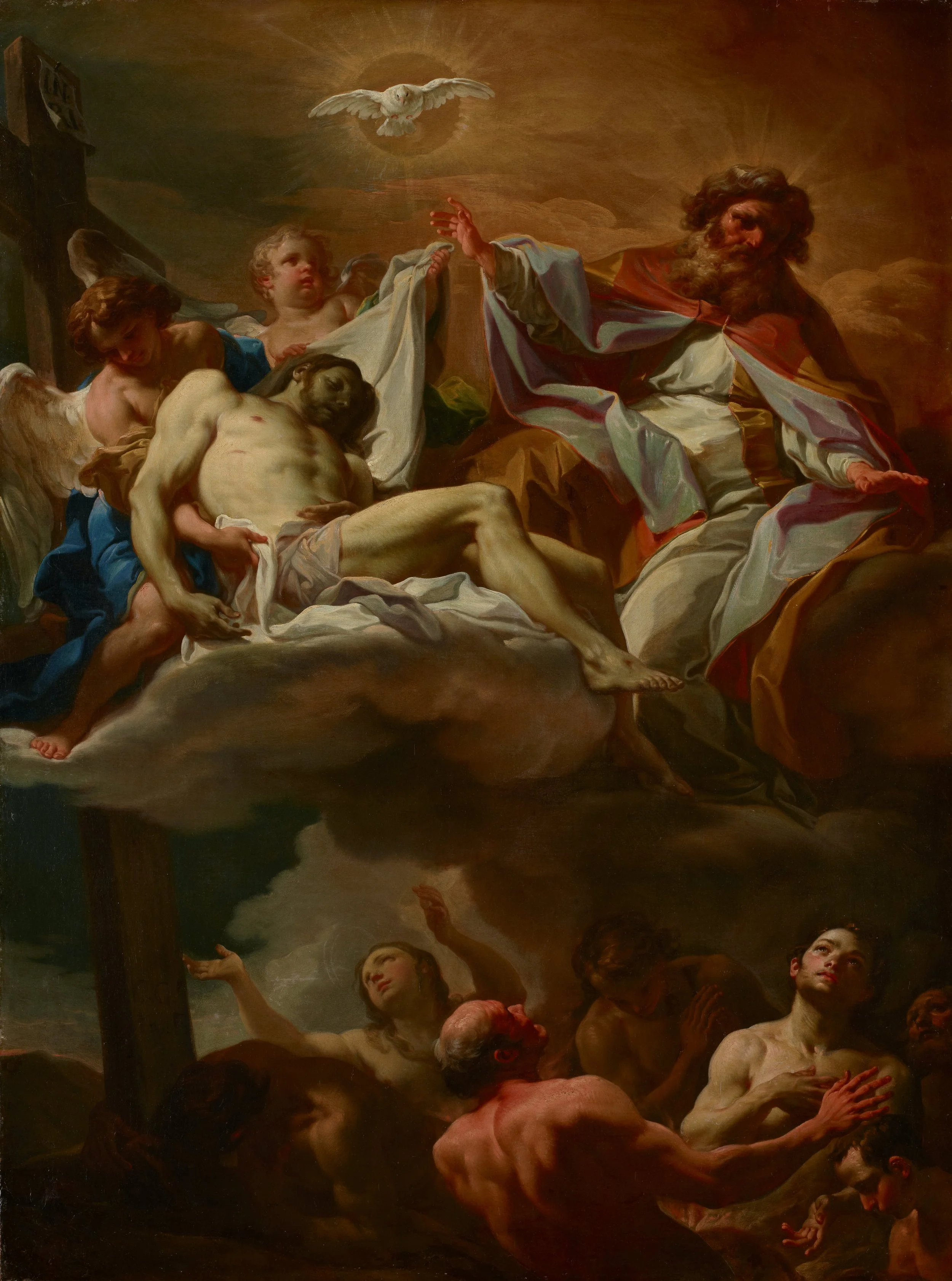
“The Trinity with Souls in Purgatory” by Corrado Giaquinto was painted in the early 1740s. The work is in the Minneapolis Institute of Art. Image: Rawpixel.com.
Christians have been asking questions about life after death for centuries.
What happens when we die?
How does God prepare us to be fully in His presence?
One of the biggest differences between the Catholic and Presbyterian traditions (and mainline Protestant denominations) is how we answer these questions.
Catholics teach the idea of purgatory, while Presbyterians do not.
Here is a simple look at what both groups believe and how these ideas developed.
Catholic teaching
Catholics believe purgatory is a place or state where God purifies believers who have died but are not yet completely holy.
They see this as an act of God’s mercy.
It is not a second chance for salvation. Instead, it is a way for God to finish His work in a person’s soul so they are ready for heaven.
Catholics point to passages like 2 Maccabees 12:45 (NRSVue):
“But if he was looking to the splendid reward that is laid up for those who fall asleep in godliness, it was a holy and pious thought. Therefore he made atonement for the dead, so that they might be delivered from their sin.”
They also look at 1 Corinthians 3:15:
“If the work is burned up, the builder will suffer loss; the builder will be saved, but only as through fire.”
Another key verse is Revelation 21:27:
“But nothing unclean will enter it, nor anyone who practices abomination or falsehood, but only those who are written in the Lamb’s book of life.”
Catholics (our Christian ancestors) have prayed for the dead since the earliest days of the Church. Over time, this became part of official teaching.
The Catholic Church formally taught purgatory at a council in 1439 and confirmed it again during the Reformation.
Presbyterian teaching
Presbyterians (and mainline Protestants) do not believe in purgatory.
Instead, Reformed theologians teach that Jesus’ death and resurrection fully save those who believe in Him.
In their view, no extra purification is needed after death because Jesus has already made believers holy.
They point to Hebrews 9:27 (NRSVue):
“And just as it is appointed for mortals to die once, and after that the judgment.”
They also cite Hebrews 10:14:
“For by a single offering he has perfected for all time those who are sanctified.”
Presbyterians believe that when Christians die, they are immediately welcomed into God’s presence.
They also use a Bible that has a shorter canon than the one Catholics use. Reformed versions do not include the Books of Maccabees, so they do not see it as a source for doctrine.
A look at history
During the Middle Ages, purgatory became a central part of Church life and was linked to practices like indulgences and pilgrimages.
Reformers like Martin Luther and John Calvin argued that purgatory was not clearly taught in Scripture.
Protestants rejected the idea, while the Catholic Church kept it. This difference remains today.
Where we agree
Even with these differences, both Catholics and Presbyterians share many beliefs.
Both trust in God’s grace for salvation.
Both believe heaven is the final home for those in Christ.
Both agree that God is holy and calls believers to live holy lives.
Understanding these differences helps us appreciate the richness of Christian history and faith. It reminds us that while we may not agree on every detail, our hope is still found in Jesus Christ, who conquered death and offers eternal life.