Thomas Robb, ‘Christian identity’ theology makes comeback; says people of color can’t be saved by Jesus
Note: This article is NOT about our locally beloved Thomas “Tom” Robb who was Executive Director of Care For Real—the food pantry we helped established and housed in our church building. He is of no relation to the subject of this article.
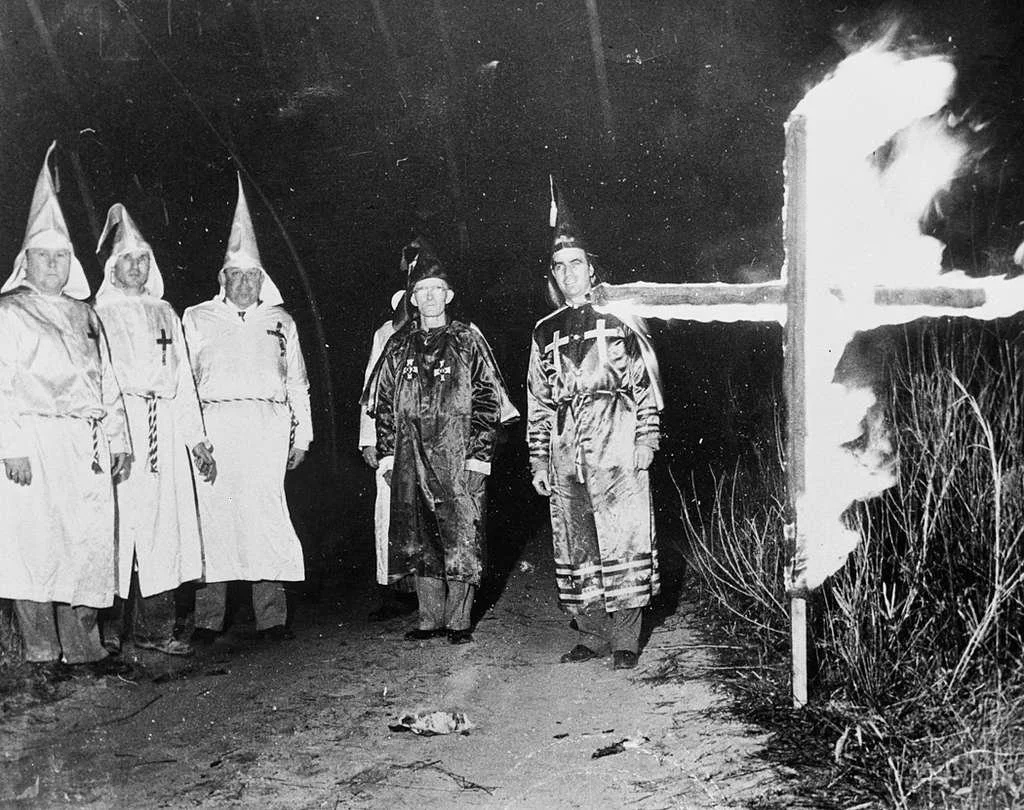
Klan cross burning in earlyJanuary 1958 in East Lumberton and south of St. Pauls, NC. Photo used as state's evidence in North Carolina Supreme Court Case Number 722, State vs James Garland Martin, Spring Term 1959, and Case Number 723, State vs James Cole, James Garland Martin and others to the State unknown by name, Spring Term 1959. Photo: Public domain.
Deep in the Ozarks, near the town of Harrison, Arkansas, a gate stands as a barrier between a quiet mountain community and a compound that has long been a symbol of American extremism.
For decades, Thomas Robb has operated from this space, serving as the national director of the Knights of the Ku Klux Klan and the pastor of the Christian Revival Center.
While his brand of white supremacy and his Christian Identity theology once seemed like a fading relic of the 20th century, the landscape is shifting. We are seeing a resurgence of interest in these old, radical ideas, fueled by a modern wave of Christian nationalism that is finding a surprisingly young audience.
The theology Robb preaches is known as Christian Identity. It is a radical interpretation of the Bible that claims the true Israelites of the scripture are actually people of Anglo-Saxon and Germanic descent.
In this worldview, the covenant of God is a racial inheritance, not a spiritual one. This leads to the staggering claim that has recently recirculated in documentaries and online forums: the idea that Black people and other people of color are literally incapable of being saved because they are outside of God’s intended plan. It is a doctrine that replaces the universal message of the Church with a narrow, exclusionary focus on racial purity.
For a long time, many believed this movement was on its deathbed. Robb himself tried to rebrand the Klan years ago, trading the title of Imperial Wizard for National Director and swapping hoods for business suits in an attempt to make hate look like heritage.
Today, that strategy has evolved into the creation of Heritage Village, a meticulously maintained compound in Zinc, Arkansas. By moving away from the overt, archaic symbols of the past, Robb is creating a space that feels more like a historical retreat than a training ground for extremism.
This rebranding is a core part of his strategy to appeal to a younger demographic that might be repelled by old-fashioned hoods but is increasingly drawn to traditionalist or heritage-based identities.
In the mid-2020s, the rise of broader Christian nationalist rhetoric has provided a new bridge to these extremist fringes. As the lines between faith and political identity blur on social media, young men in search of a hardline identity are stumbling upon Robb’s rhetoric.
They aren't finding him in dusty pamphlets, but through viral clips and edgy online spaces that treat these old prejudices as rediscovered truths. Robb and his followers utilize these alternative platforms to disseminate content that frames their worldview as a forbidden truth, using the language of modern conservative grievance to bridge the gap between mainstream politics and radical theology.
Inside the compound, this recruitment takes a personal turn. Robb has been known to host events and leadership seminars designed to mentor the next generation. These gatherings are not just about theology; they are about building a community that reinforces the idea of racial and spiritual exceptionalism.
By providing a physical space where these ideas are treated as normal, he creates an environment where radicalization can happen through social bonding. The goal is to turn online curiosity into lifelong commitment, ensuring that his exclusionary vision for the Church and the nation does not die with his generation.
The community in Harrison has spent years trying to wash away the stain of being called the most racist town in America due to Robb’s presence. They have put up billboards promoting love and inclusion, attempting to show that a single compound does not define a whole region.
Yet, as Christian nationalism continues to gain traction across the country, the influence of figures like Robb is proving to be more resilient than we hoped. It serves as a reminder that these ideologies rarely disappear; they simply wait for a new generation to find them, repackage them, and give them a seat at the table once again.