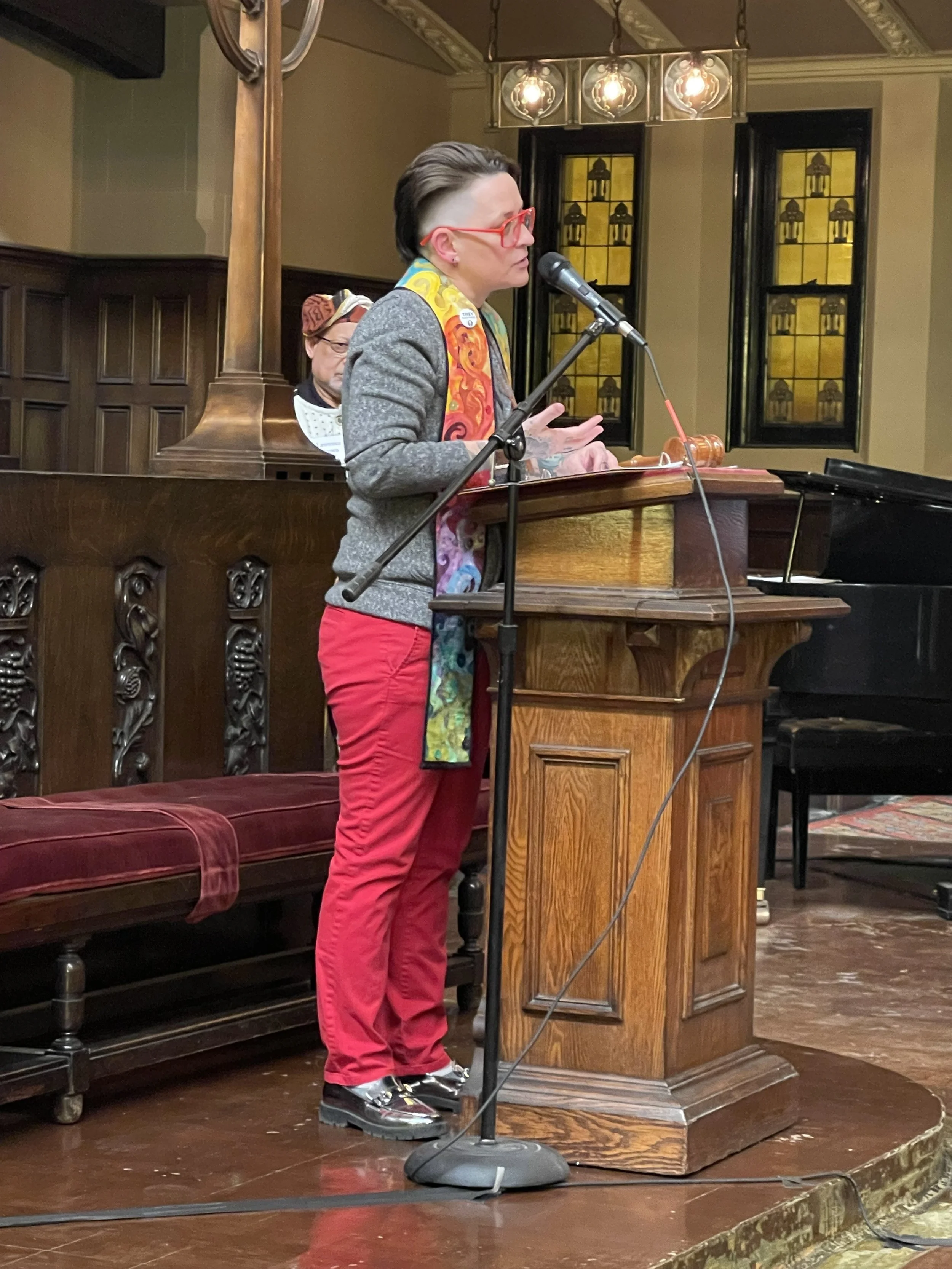
The Rev. Shawna Bowman convenes the Chicago Presbytery Assembly at Second Presbyterian Church. Photo: Gerald Farinas.
The Church is facing a crisis. Not just a crisis of empty pews or people walking away—but a deeper problem.
The way we talk about God, the questions we ask, and the answers we give are stuck in the past.
For centuries, theology—the study of God—has mostly come from the minds of White European men: Thomas Aquinas, Martin Luther, John Calvin, John Knox, John Owen.
Their ideas have shaped what the Church teaches and how it sees the world. But that worldview has limits. It ignores voices that have been silenced for too long.
Now more than ever, we need new voices. Theologians who are Black, Brown, Indigenous. Women. Queer. People who come from communities that have suffered under the Church’s old ways of thinking.
These theologians will ask questions that have never been asked. They will shake up the system. And that is exactly what the Church needs.
The old way is broken
Christian Nationalism is on the rise. It tries to mix Jesus with flags, guns, and White power.
This twisted version of Christianity doesn’t come from the Gospel—it comes from fear and control.
And the truth is, the Church helped create this.
Over centuries, it used the Bible to justify slavery, colonization, the silencing of women, the persecution of queer people, and the destruction of indigenous cultures.
All in the name of God.
The old theology was built to serve those in power. It didn’t question racism, patriarchy, or empire. In fact, it blessed them.
That’s why we need theologians today who do ask those hard questions. Who aren’t afraid to disturb the peace if that peace is built on injustice.
Science is speaking—where is theology?
Science today shows us that being gay, bi, or trans is a natural part of human life.
It’s not something to “fix” or fear.
But the Church has been slow to respond.
Too many leaders still use ancient verses and outdated beliefs to shame and hurt people. They call it “biblical truth,” but really it’s just fear wrapped in religion.
For centuries, the Church used the Bible to justify violence against anyone who was different—especially queer people and women.
It called them witches, sodomites, abominations.
It taught that God hated them. That kind of theology is not holy. It’s deadly.
We need theologians who will stand up and say: God made queer people.
God made trans people.
God loves them.
Period.
My own story of God, ancestors, and the sacred
I grew up with both Christian faith and deep respect for my ancestors and culture.
As an ethnic Ilocano and someone born and raised in Hawaii immersed in Hawaiian culture and spiritual traditions, I learned to honor the spirits of those who came before me.
We believed in more than one way of seeing the world.
We believed the land was alive.
That the ancestors still guide us.
That there were other spiritual beings—not to replace God, but to help us understand the divine.
And yet, I also believe in one loving and powerful God.
I am shaped by Reformed (Presbyterian) faith.
Some people think these native beliefs and Reformed Christianity can’t go together. But they do. They are both part of who I am.
And that helps me ask different questions about God—questions that come from a place of survival, memory, and love.
A Church that listens, learns, and changes
The Church has a choice to make.
It can keep clinging to old, broken ways of thinking.
Or it can open its ears and heart to new voices.
This means making room—not just for show—but truly giving space to Black, Brown, Indigenous, female, and queer theologians.
People who have been told for too long that their faith didn’t count.
Their ideas didn’t matter.
Their questions were too dangerous.
But the Gospel itself is dangerous.
Jesus flipped tables.
He broke rules.
He lifted up the outcast and called out the powerful.
If the Church wants to follow Jesus, it must do the same.
We don’t need to protect the old theology.
We need to let it go—so the Spirit can breathe new life into the Church through voices it once ignored.
Because God is still speaking.
And this time, She might sound like someone we never expected.