53 years since Philippines martial law is reminder democracy is fragile
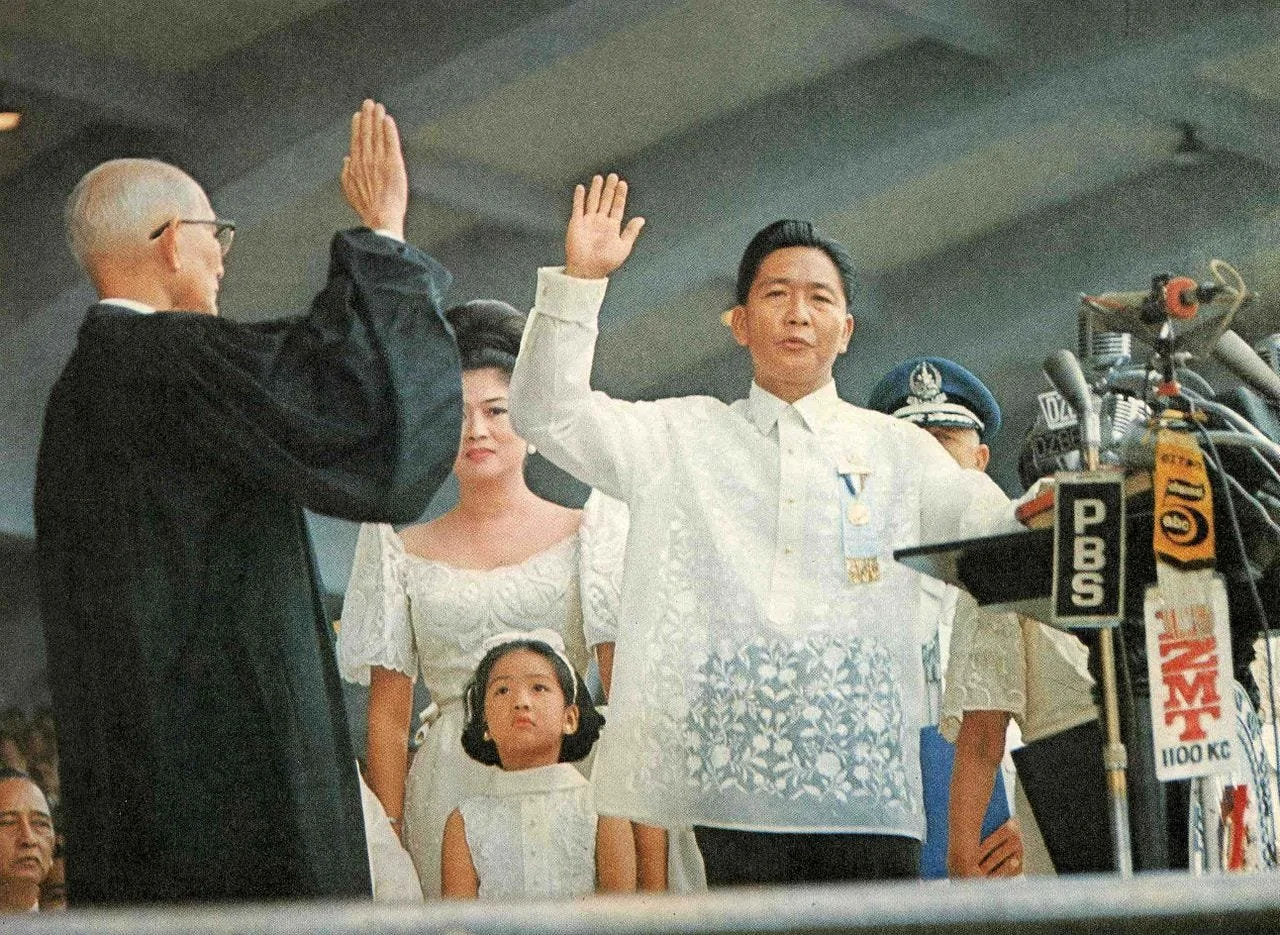
Philippines President Ferdinand Marcos takes his second oath of office. Photo: Wikimedia Commons.
You can listen to the original podcast: https://gerfarinas.substack.com/p/podcast-53rd-anniversary-of-marcos
Today marks the fifty-third anniversary of Ferdinand Marcos’ declaration of martial law in the Philippines—the most famous case of martial law in a democratic country in modern times.
For many, this is history in a dusty textbook. For me, it is family history—blood, language, and memory.
I am Ilocano, the same minority tribe Marcos was. That meant my family could not escape the story. Many of my relatives supported him, even served in his Administration at the cabinet-level, as governors and mayors, and down the ranks, believing in the myth of the strongman. They thought discipline and order would save a fractured nation.
But others resisted. They saw the brutality, the theft, the silencing of voices. Some fled the country to save their lives.
My family’s divide is the Philippines’ divide. And I stand firmly with those who resisted because I cannot stand with fascism.
I have spent a lot of time writing and speaking, unmasking colonialism and empire in my articles and in my podcast.
Martial law was one of empire’s most poisonous fruits. It was not born in a vacuum. It grew out of the soil of American colonial rule, Cold War paranoia, and the idea that strongmen could protect the world from chaos. And once planted, it spread fast.
The danger is not just what happened then. The danger is what I see now. Because the shadows of martial law are stretching across America today.
Marcos closed ABS-CBN, the country’s largest broadcast network, on the very night martial law began. He silenced journalists so only his voice remained.
Today in America, books are pulled from shelves because they tell uncomfortable truths about race, sexuality, and history.
The idea is the same: control the narrative, and you control the people.
Marcos jailed Senator Ninoy Aquino and hundreds of opposition leaders. Dissent was criminalized. Today in America, we hear chants of “lock her up” becoming real calls to jail political opponents.
After Charlie Kirk’s assassination, people who criticized him were fired from private companies—as if dissent itself were treason.
That is how authoritarian cultures grow, when silence becomes safer than speech.
Under martial law, activists were tortured, disappeared, and murdered. In America, we are not there yet, but the seeds are being watered.
Protesters face harsher penalties, demonstrations are criminalized, and critics of government policy are branded as enemies. The ground is being prepared.
Marcos even feared laughter. Comedians and cartoonists were silenced because satire exposes the absurdity of power. Today, late-night hosts like Jimmy Kimmel and Stephen Colbert have been suspended or silenced for mocking those in power.
Authoritarianism cannot survive the sound of a joke, so it does everything it can to stamp out laughter.
And yet, every time I raise these parallels, someone says: You’re just using scare tactics. You’re overreacting. You’re overreaching. That could never happen here. The Constitution won’t allow it. America’s system is too strong to be trampled on.
To those voices, I say: you are wrong.
Because constitutions are only as strong as the people willing to defend them.
The Philippine Constitution—modeled after the U.S. Constitution—also guaranteed rights and freedoms. It promised free speech, a free press, the rule of law.
But when martial law was declared, those promises became paper shields. Marcos rewrote the rules, bent the courts, and stacked the institutions.
What use is a constitution if the leaders who interpret it no longer honor it?
America is not immune. Already we see Supreme Court rulings ignored when inconvenient.
Already we see presidents openly stating they will ban rainbow flags, criminalize flag burning, and punish those who dissent.
The Constitution cannot enforce itself. It is words on parchment. It is not a fortress. It is only as resilient as the people who breathe life into it.
Marcos proved that a constitution, left undefended, can be trampled into dust. And those who say “it can’t happen here” forget that every nation who fell into dictatorship once thought the same.
Germans once thought the Weimar Constitution too strong to fail. Filipinos once thought democracy too entrenched to be stolen. Americans now risk repeating their mistake.
The banning of books, the jailing of opponents, the silencing of satire—these are not abstractions. They are happening. And they are happening here.
To dismiss thoughts of dictatorship in America as scare tactics is to silence the alarm bell while the fire spreads.
My family once lived through this. Some cheered it on. Some resisted it with their lives. And I carry their story as a warning.
Martial law did not descend like a thunderclap—it crept in, normalized little by little, until people woke up one day and realized their freedom had been bargained away.
This is not overreaction. This is recognition. This is memory. And this is resistance.
Because if we do not heed the lessons of martial law, America may find itself relearning them the hard way. And rebuilding a democracy, once it is broken, takes generations of suffering.
The question is: do we resist now, or do we wait until the silence is complete?
And so, here is what we must do:
We must defend libraries and keep banned books in circulation, because knowledge is always the first target of authoritarianism.
We must protect local journalism, because without a free press there is no democracy.
We must march, as Filipinos once marched in the streets of Manila during the People Power Revolution, because collective bodies standing shoulder to shoulder have always shaken the grip of strongmen.
We must run for office at every level—school boards, city councils, legislatures—because democracy cannot be defended from the sidelines.
We must vote, not just for presidents, but for every local candidate who can strengthen or weaken our institutions.
We must create art—poems, songs, murals, podcasts—because art can keep memory alive when tyrants try to erase it.
One of my favorite singer-songwriters, Sasha Allen (an openly trans artist), recently produced a song called “Fire in America”—about how Charlie Kirk was turned into a mythic martyr deserving of honors. Go and find that song and listen to the lyrics.
We must speak, even when silence feels safer, because freedom dies not only by the hand of the dictator, but by the silence of the people.
We must. We must. We must.
This is the lesson of martial law. This is the lesson of the Philippines. And it is the warning for America. The shadow has already fallen. What remains is what we do with it.
And I tell this story not only as a Filipino whose family lived through dictatorship, but as an American in Chicago, standing here in Edgewater.
From my vantage point near Loyola’s lakefront, from the sanctuary of Edgewater Presbyterian Church, from a neighborhood built by immigrants who came seeking freedom, I refuse to let history repeat itself.
The memory of martial law runs through my blood.
The promise of democracy runs through this city I love.
And I will not sit silently while the shadows creep in again.

In 1966, President Lyndon Baines Johnson hosted President Ferdinand Marcos at The White House. Photo: Marion S. Trikosko. Public domain.
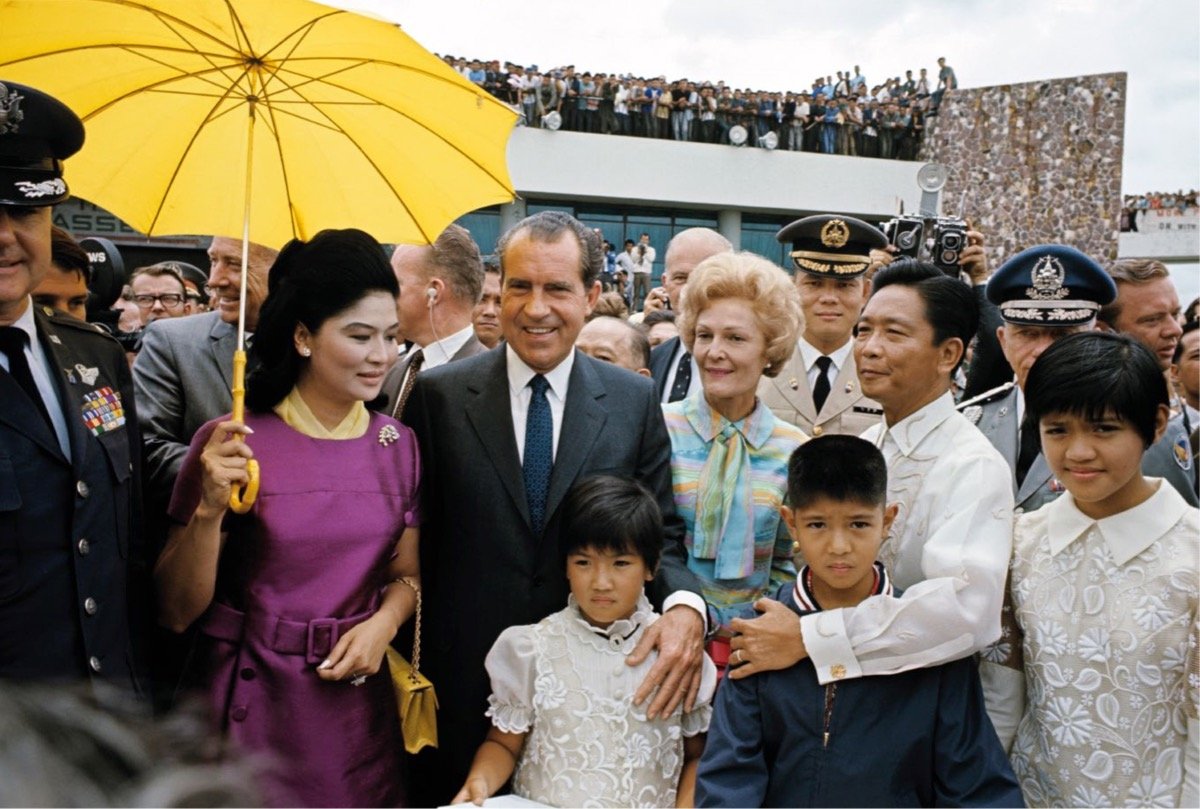
In 1969, President Ferdinand Marcos hosted President Richard Nixon and First Lady Pat Nixon. Photo: White House Photo Office. Public domain.

President Ferdinand Marcos arrives at Andrews Air Force Base in Maryland for a visit with President Ronald Reagan in 1983. Photo: A1C Virgil C. Zurbruegg via Combined Military Service Digital Photographic Files. Public domain.