Theology 101: Theologians you should know for Presbyterians
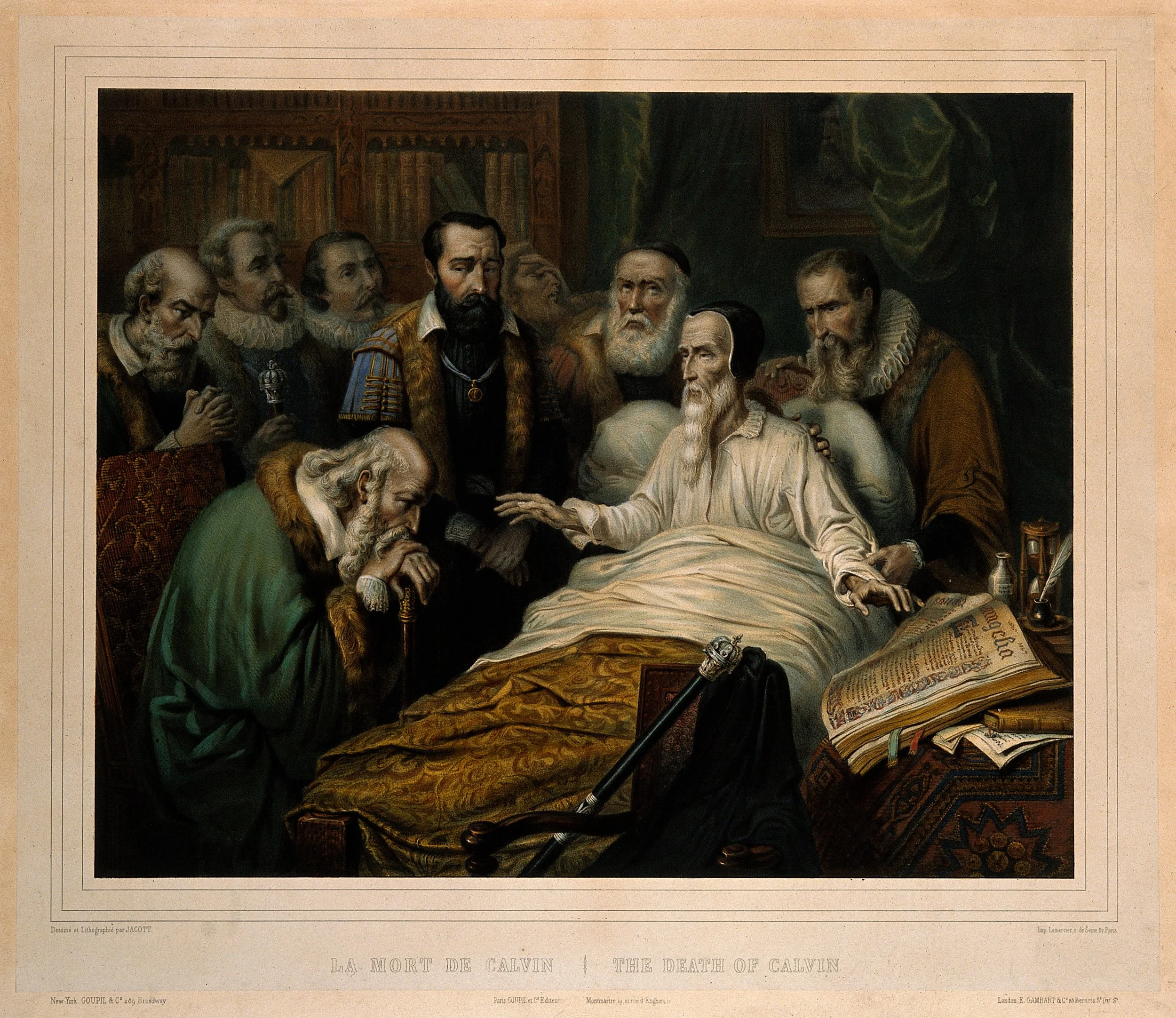
The death of John Calvin. Image: Wikimedia Commons.
The Presbyterian Church (USA) does not have saints or Doctors of the Church in the Roman Catholic sense, but we do honor and learn from key theologians—past and present—whose teachings have helped shape our Reformed identity.
These thinkers have offered insights into Scripture, ethics, worship, justice, and discipleship that continue to guide our faith and practice today.
So who are the most important theologians in the PCUSA, and why do they matter?
John Calvin (1509–1564)
As the foundational theologian of the Reformed tradition, Calvin shaped much of what Presbyterians believe about God, grace, and the church.
His Institutes of the Christian Religion systematized theology in a way that emphasized the sovereignty of God, the authority of Scripture, and salvation by grace through faith.
While we don’t treat Calvin as infallible—he is not and does have problematic beliefs on women in Church leadership and belief in strict theocratic government—his influence remains deep in our worship, polity, and theological reflection.
John Knox (c. 1514–1572)
A Scottish reformer and disciple of Calvin, Knox brought Reformed theology to Scotland and helped establish Presbyterianism as a distinct Church structure.
His emphasis on representative leadership by elders and congregational participation laid the foundation for the Presbyterian form of government we use today.
The United States Government actually takes its structure from the one Knox created for the Church—with separation of powers between co-equal branches of leadership with their own purposes; with levels of governance from the most local entity (congregation and municipality), a mid-level entity (presbytery and state), and a national body (general assembly and federal government).
Knox’s ideas recently resurfaced in the Roman Catholic tradition when Pope Francis introduced the idea of restructuring the Church’s decision making processes through a synodal approach—putting more decisions in the hands of locals including people who are not ordained priests.
Karl Barth (1886–1968)
Though not Presbyterian himself, Barth deeply influenced 20th-century Reformed theology worldwide, including in the PCUSA.
He helped the Church resist Nazism in Germany and re-centered theology around the person of Jesus Christ.
His Church Dogmatics reinvigorated our understanding of grace, revelation, and the living Word of God.
Shirley Guthrie (1927–2004)
A beloved theologian and teacher in the PCUSA, Guthrie’s book Christian Doctrine remains one of the most accessible and influential introductions to Reformed theology in modern times.
His teaching emphasized justice, humility, and the need to relate theology to contemporary life.
Katie Geneva Cannon (1950–2018)
As the first African American woman ordained in the PCUSA, Cannon was a pioneer of womanist theology.
Her work asked vital questions about race, gender, power, and faith.
She challenged the Church to take seriously the lived experiences of Black women and to pursue justice as a core part of Christian discipleship.
Frederick Buechner (1926–2022)
Though more of a preacher and storyteller than a systematic theologian, Buechner’s reflections on faith, doubt, grace, and meaning have profoundly shaped generations of Presbyterians.
His gift was in bringing theology into the language of ordinary life.
Reinhold Niebuhr (1892–1971)
A public theologian with Reformed roots, Niebuhr offered a clear-eyed, often prophetic vision of Christian responsibility in politics and society.
His Christian realism influenced generations of PCUSA members and leaders trying to balance justice with humility.
Why do these theologians matter today?
Because Presbyterians believe that faith is not static—it must be reformed and always reforming.
These thinkers help us engage Scripture, tradition, and culture with wisdom and courage.
They remind us that theology is not just about doctrines—it’s about how we love God, love our neighbor, and live faithfully in a complex world.
In short, they help us think deeply, act justly, and walk humbly with our God.