You don’t need to leave Protestantism to find the ancient church
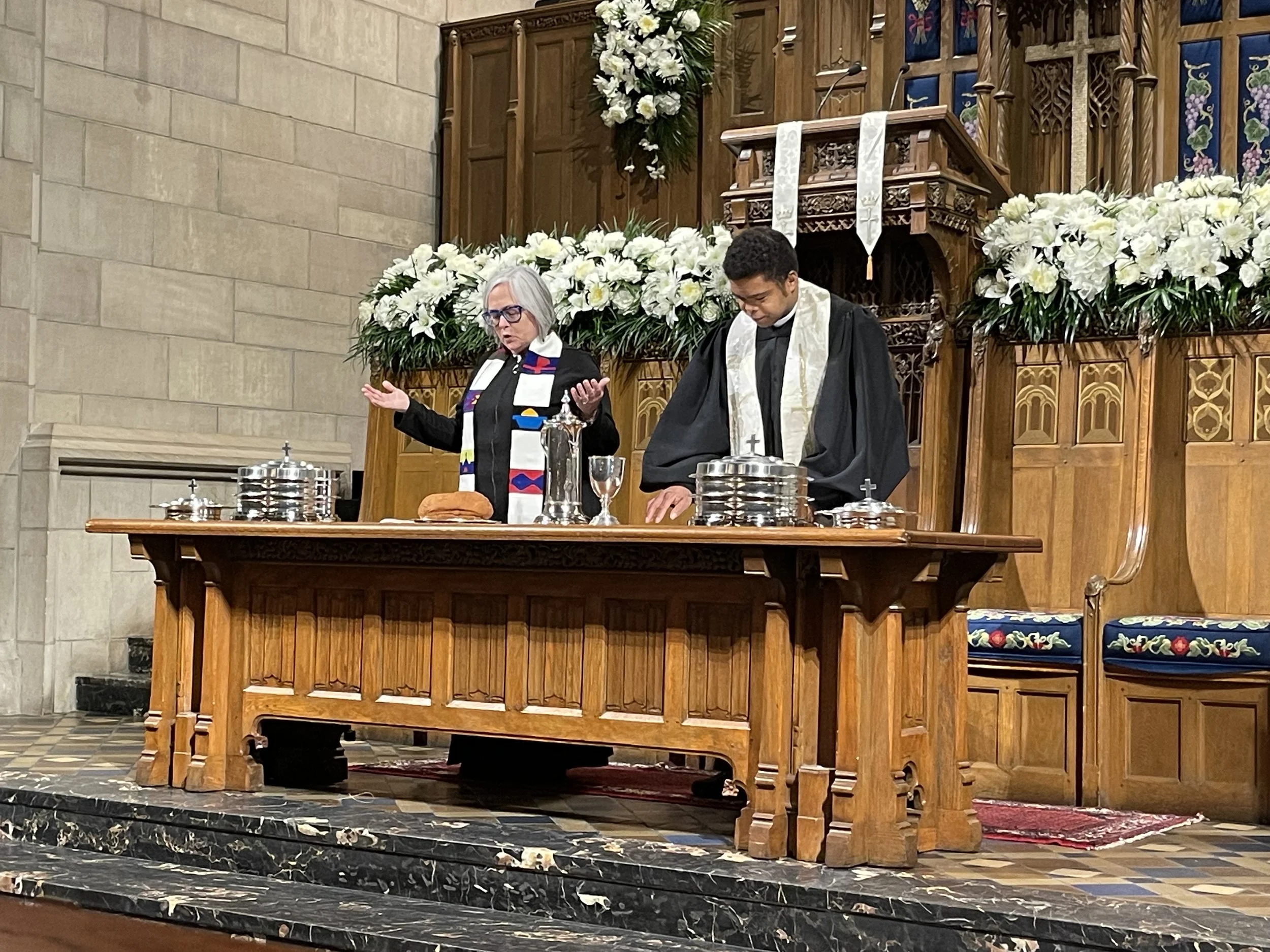
Fourth Presbyterian Church, Chicago, Illinois with the Revs. Kristin Hutson and Joseph Morrow. Photo: Gerald Farinas.
Have you seen that Christianity Today piece making the rounds again (it’s from 2024 but keeps getting shared) about folks leaving non-denominational churches to swim the Tiber to the Pope or head toward Eastern Orthodoxy?
People on the feeds keep talking about how they’re desperate for liturgy, hungry for creeds, and looking for actual beauty in worship. They write as if mainline Protestantism completely dropped out of the picture. It’s kind of wild to watch everyone act like the Presbyterian Church (U.S.A.), or other Reformation-era mainline denominations, are not right here doing all of those things every single Sunday.
If you grew up or hang out in the PC(USA), you already know we hit every single one of those marks. Take our Sunday morning service. It follows the exact same ancient, historic rhythm as the Roman Rite.
You gather, you confess, you hear the Word read and proclaimed, you move to the Table, and you are sent back out into the world. The mechanics of the worship shape are right there. The main difference is just our theology of Communion, not a lack of structure.
We do not hide from our history either. We embrace our creeds so much that we literally put them in a massive book as part of our constitution. We do not just dust off the Apostles Creed once a year; we weave these historical confessions into our worship life, connecting us to the wider Church across the centuries.
And as for beauty, anyone who thinks Protestant spaces are just plain white walls needs to step inside a traditional sanctuary like at First, Second, and Fourth Church in Chicago.
We have rich paraments dressing the pulpit and the Communion table in the colors of the liturgical season. We have stained glass windows catching the morning light, and we have pipe organs that shake the floorboards when the hymn starts.
Did you know? Presbyterians invented the tradition of the white clerical collar that Catholic priests wear?
The Reformation did not throw out beauty, liturgy, and creeds. It just cleaned the windows and let the ancient roots grow right back through.
The funny thing is watching people rediscover what was already sitting in the pews down the street. Non-denominational churches have done amazing things for community building, but when they strip away the historic guardrails of the Church universal, worship can start to feel a bit… improvised. You end up with a stage instead of a chancel, a worship band instead of a choir, and a sermon series that feels more like a TED talk than a wrestling match with the text.
Now, I’m not saying those are bad things. We do have newer PC(USA) congregations that do have this feel hybridized with the traditional order of worship. Some people do get more out of a contemporary style than a traditional liturgy.
But in the end, psychologically, some folks do get tired of the endless novelty found in non-denominational Evangelical churches and the pressure to produce a spiritual high every single week. Those folks are looking for something older than themselves, something that connects them to a tradition that has been breathing in and out for two thousand years.
When those folks finally wander into a Presbyterian church, and some do, they’re often genuinely surprised by what they find. They walk in expecting the stripped-down, unornamented vibe of a contemporary mega-church chapel, only to find themselves handed a bulletin that lays out a centuries-old liturgy.
They hear the corporate confession of sin, the assurance of pardon, the passing of the peace (a really long one sometimes), and the reading of scripture from the old, new, and prophetic testaments.
They realize that the liturgy is not a Roman invention that the reformers threw out in a fit of iconoclasm; it is the common inheritance of the Western Church.
Our order of worship is built around the two great movements of the service: the Word and the Sacrament. We come together to hear God speak through scripture and preaching, and then we turn around and respond at the Table.
That rhythm has kept the Church grounded through plagues, wars, and cultural upheavals. It takes the focus off the personality of the preacher or the slickness of the production and puts it back on the corporate worship of God.
You do not have to wonder what is coming next because the Church has been doing it for generations, and there is a deep, quiet comfort in that kind of shared rhythm.
And then there is the matter of our confessions. People talk about the creeds as if mainline Protestants are allergic to dogma, but the PC(USA) has one of the richest collections of historical theology in Christendom. Our Book of Confessions includes everything from the early ecumenical creeds like the Nicene and Apostles Creeds to the Scots Confession, the Heidelberg Catechism, the Westminster Confession of Faith, and modern statements like the Confession of 1967 and the Brief Statement of Faith.
These documents do not sit on a shelf gathering dust. They remind us that we do not get to make up the faith as we go along. We are part of a conversation that spans centuries, wrestling with the same hard questions about grace, justice, and redemption that our forebears faced.
We also take our aesthetic life seriously, even if we do not always brag about it. The architecture of a historic Presbyterian sanctuary tells a story. The pulpit sits centrally because the proclamation of the Word matters immensely, but it shares the focal point with the Communion table, reminding us that Word and Sacrament belong together like two lungs breathing for the body of Christ. The paraments change with the liturgical calendar, shifting from the deep violet or midnight blue of Advent to the bright white of Christmastide, the green of Ordinary Time, and the stark black or purple of Lent. Every color marks time, orienting the community around the life, death, and resurrection of Jesus rather than the secular calendar of the commercial world.
Of course, the PC(USA) is not the only place where this rich heritage has been quietly kept alive while the internet was looking the other way. Walk down the street to the nearest Evangelical Lutheran Church in America (ELCA) congregation or an Episcopal Church parish, and you will find the exact same thing.
These traditions have spent centuries safeguarding historic liturgies, chanting the psalms, wearing albs and chasubles, and anchoring their common life in ancient creeds and sacramental worship.
The broader mainline Protestant family has always preserved the beauty, the structure, and the historical depth that these online commentators are currently mourning as lost.
So when observers online throw up their hands and lament that the Protestant world has lost its architectural and liturgical soul, it is usually because they are only looking at one specific slice of the American religious landscape. They are staring at the stripped-down auditoriums of the nondenominational congregations and assuming that is all Protestantism has ever been. They forgot about the deep, sturdy, beautiful roots of the mainline.
The doors are unlocked, the organ is tuned, and the ancient liturgy is waiting right where it has always been.