Remember the scholars who proved women held pastoral roles in early Church
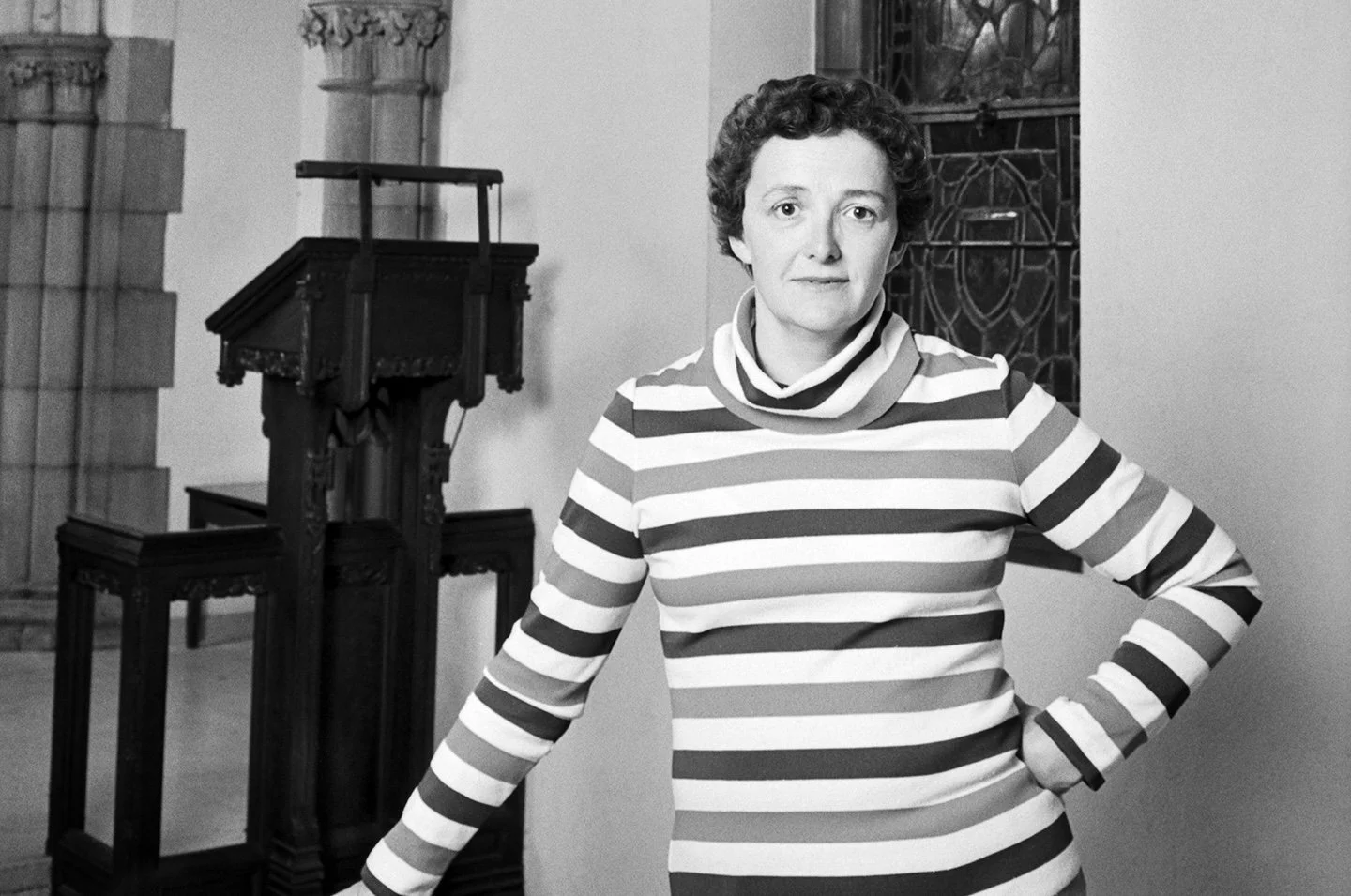
Rosemary Radford Ruether on March 31, 1978. Photo: Lynn Gilbert via Wikimedia Commons. This file is licensed under the Creative CommonsAttribution-Share Alike 4.0 International license.
I remember the first time I sat in a Session meeting as an ordained elder, looking around the room and realizing that the women surrounding me weren't just a modern addition to the Church.
At my own congregation, Edgewater Presbyterian Church, we have been blessed by a line of formidable leaders who have proven that pastoral work is exactly where women belong. From the pioneering leadership of the Rev. Dr. Barbara Cathey to her co-pastor Rev. Amy Pagliarella, and now with the Rev. Kristin Hutson, we see the real results of a long and difficult struggle.
This was not always the case. The theological fights to reach this point were intense, and they happened not that long ago.
We often talk about our history in the PCUSA as if it started in the 1500s or perhaps in 1930, when the first woman was ordained as an elder. But the deeper we dig into the work of scholars like Rosemary Radford Ruether and Elisabeth Schüssler Fiorenza, the more we realize that pastors like Barbara, Amy, and Kristin aren't doing something brand new. They are actually part of a long, often hidden history of the early Church.
The research into women in the first few centuries of Christianity has completely changed how I see my own role as a presbyter or elder. For a long time, the common story was that the Church started with only men in charge and that letting women lead was a modern invention. Ruether and other historians proved that wasn't true by uncovering three specific types of evidence.
First, they looked at archaeological and epigraphical evidence. They found physical proof in stone. They identified tomb inscriptions and mosaics across the Mediterranean that used the female versions of clerical titles.
For example, they found markers for women like Letoris, who was explicitly called presbytera, meaning elder or priest, and others labeled as diakonos or deacon, or even episcopa, an elder in hierarchy.
Before this research, many male historians simply assumed these women were the wives of clergy. Ruether and her peers argued that the grammar and placement of these titles showed these women held the offices in their own right.
Second, they re-examined ancient literary texts like the Didascalia Apostolorum, a third-century document that provides a window into how essential women were to the daily functioning of the Church. This text explicitly outlines the duties of women in leadership, describing them as vital for reaching parts of the community that male leaders could not easily access.
These women leaders were responsible for the pastoral care of other women, presiding over their baptisms to ensure modesty and visiting the sick in households where men were not permitted to enter.
The document even instructs the bishop to honor these women, stating they should be respected as a type of the Holy Spirit, reflecting their role as the nurturing, guiding presence of the community.
They also looked at the writings of early Church Fathers who actually complained about women teaching, baptizing, and leading worship. While these Fathers were trying to stop the practice, their complaints inadvertently proved that women were active, respected leaders in many regions.
Third, they highlighted the house church model. Because the first Christians met in homes, the distinction between private family life and public church life didn't exist yet. Since women were the recognized managers of the household in Roman society, they naturally stepped into leadership when that household became a church. They acted as patrons, providing the space and the funds, and as the primary teachers of the faith to the community that gathered under their roof.
This research is the backbone of our identity in the PCUSA. It allows us to say that when we ordain women, we aren't just following a social trend. We are being more faithful to the original Church than the centuries of male-only leadership that came later.
We believe in always being reformed, which sometimes means stripping away old Roman customs to find the equality that existed at the very beginning.
However, the importance of this work goes beyond our own doors. I often think about our friends in the Roman Catholic Church who are facing a much harder climb.
For a while, there was a quiet hope that the recent conversations started by Pope Francis’ Synod on Synodality—a form of the General Assembly that we Presbyterians hold to make reforms for the whole denomination—would finally lead to change. People hoped the Church might at least welcome women back as deacons.
But the institutional walls are still high. Even after all the listening sessions, the Vatican signaled a firm no to women in those roles. Now, with Pope Leo XIV, it seems that door will stay closed for the foreseeable future. The recent commission report basically said that because there isn't total agreement, things should stay the same.
For those pushing for change, the argument is usually that the Church has no authority to change what Jesus started. But Ruether, who was a Roman Catholic herself, used history to show that the foundation is wider than people think.
By proving that women served as deacons and leaders in the early years, these scholars have provided a powerful argument. If the early Church included women in pastoral roles, then keeping them out today isn't a divine rule; it is a historical choice.
When we at the Edgewater Kirk celebrate our women pastors, we are holding a door open. We are proof that a Church can stay true to the Gospel while using the gifts of everyone.
The work of these historians tells us that the silencing of women was something people did, not something God commanded. Whether it is a Presbyterian elder leading a Session meeting or a Catholic woman hoping to serve as a deacon, we are all standing on the same ground.
We are reclaiming a heritage that was always ours and reminding the whole Church that, in the beginning, the call to serve was for everyone.