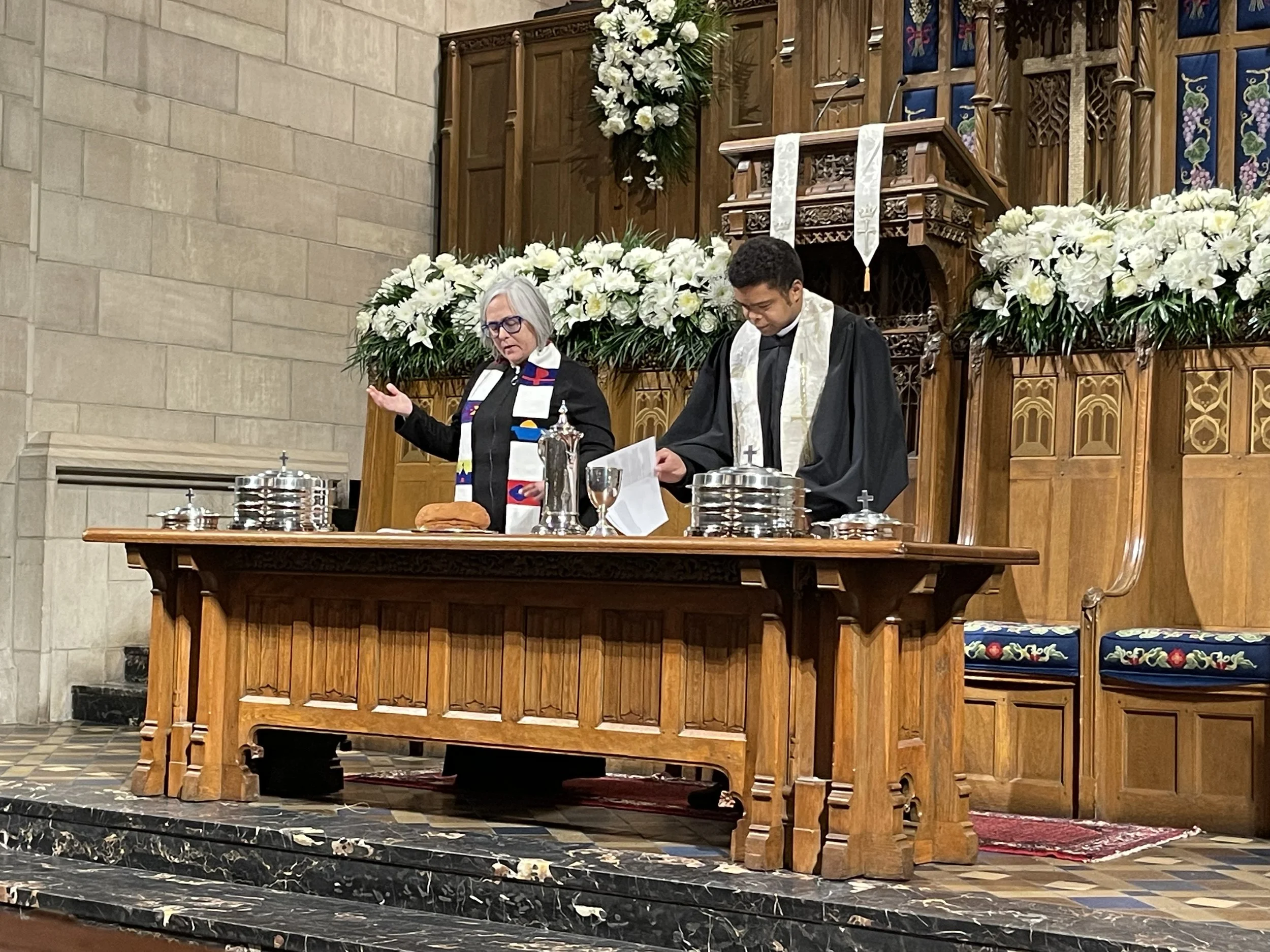
The Rev. Kristin Hutson and Rev. Joseph Morrow preside over the Table at Fourth Presbyterian Church in Chicago. Photo: Gerald Farinas.
Many Presbyterians (and other Protestants) pause when they hear the word catholic in the Apostles’ (and Nicene) Creed, “I believe in the holy catholic church.”
I happened to add the Nicene Creed to a service I was preaching at Edgewater Presbyterian Church several years ago and I was struck when I overheard someone say I was “bringing Catholic stuff into our church.”
[She was a visitor who never came back. Was it something I said?]
I guess she didn’t realize our own catechism. It sounded too Roman for her.
[It sounded like I was a subversive secret cabal of Catholics infiltrating Reformed churches?]
Others think calling themselves catholic means loyalty to the Pope.
But catholic does not mean Roman Catholic. It means “universal.”
It reminds us that the Church belongs to Jesus Christ, not to one denomination or tradition.
The word catholic comes from the Greek katholikos, meaning “universal” or “according to the whole.”
I recently remembered that original question of “Why do we say we’re Catholic when we are Protestant?” after reading a post by the Rev. John Allen Bankson of Union Presbyterian Church, Ft. Madison, Iowa.
[And likewise remembered that visitor I obviously offended.]
Heidelberg and Scripture proofs
The Heidelberg Catechism, which is foundational to Reformed churches, explains our catholicity in Question and Answer 54.
“I believe that the Son of God, through his Spirit and Word, out of the entire human race, from the beginning of the world to its end, gathers, protects, and preserves for himself a community chosen for eternal life and united in true faith. And of this community I am and always will be a living member.”
The Bible shows this clearly.
[Theologians like to back up catechism with proofs in Scripture.]
Jesus said, “I will build my church, and the gates of Hades will not prevail against it” (Matthew 16:18, NRSVue).
Paul wrote that God “chose us in Christ before the foundation of the world to be holy and blameless before him in love” (Ephesians 1:4, NRSVue).
Peter said, “You are a chosen race, a royal priesthood, a holy nation, God’s own people” (1 Peter 2:9).
John’s vision in Revelation shows a “great multitude… from every nation, from all tribes and peoples and languages” worshiping Jesus (Revelation 7:9).
We call the Church catholic because it is Christ’s body. It is global, historic, and eternal.
Presbyterians (nor Lutherans, Anglicans, Methodists, Congregationalists, et al) are not separate from the family of God.
We are part of the one Church that has existed since the first Pentecost.
Rejecting anti-Catholic rhetoric
Some Evangelical (and even some mainstream Protestant) voices mock or dismiss the Roman Catholic Church as if it is not truly Christian. This is wrong and harmful.
The Catholic Church helped preserve the Gospel, pass down Scripture, and spread the faith across the world for centuries.
John Calvin, one of the main voices of the Reformation, warned against hating or rejecting the Church.
John Calvin wrote, “We should not regard the Church with hatred, but with love, and strive with all our might to preserve her unity.”
Jesus prayed that His followers would be one, saying “that they may all be one… so that the world may believe that you have sent me” (John 17:21).
Paul said there is “one Lord, one faith, one baptism” (Ephesians 4:5).
When we attack each other, when we attack Roman Catholics, we go against Christ’s prayer for unity and hurt the witness of the Gospel.
Reformation of convergence
The Reformation did not aim to destroy the Church. It aimed to reform it according to God’s Word.
Presbyterians are a Reformed branch of the same tree.
Saying “holy catholic church” is our way of saying God’s people are bigger than any single tradition.
We are separated from Rome by history, but not forever.
We hope for the day when Christians share one Table again.
The Catholic Church is not “them.” It is all of us who belong to Christ.
The Spirit is already gathering God’s people together.
To call ourselves catholic is to claim hope and humility.
The Church is older than any denomination and will last long after human labels are gone.